Key takeaways
- Verified capacity, not just a printed number: Look for a welded steel or hardwood-and-steel hybrid frame behind the 400 lb rating. Reinforced side rails and metal-on-metal recline mechanisms are what hold up over years of daily cycling; particleboard bases under a high rating are the tell that the number is optimistic.
- Seat width against your wall clearance: A 26 to 28-inch seat is the useful range for broader frames, but measure the chair’s full recline footprint too. Many need six to ten inches behind them, and every inch it travels backward moves the sitter away from a fixed lamp or sconce.
- Motor count matched to how you sit: Single-motor lift chairs move back and footrest together. Dual motor separates the two. Three-motor adds independent headrest control, which is the difference between reading upright with your legs elevated and being forced into one fixed angle.
- Upholstery under a warm bulb: Chenille and textured fabric scatter light softly and hide the sheen lines that oversized panels tend to develop. Smooth faux leather reflects overhead fixtures and screen glow straight back at eye level. If your main light source is above and behind the chair, fabric is the calmer choice.
- Powered extras and where the cord goes: USB-A and USB-C ports, cup holders, and heat or massage are genuinely useful, but every one of them ties the chair to an outlet. Plan the plug run before you commit to a placement, especially if a floor lamp is already sharing that wall.
What's inside
Most guides for big-and-tall seating stop at the number on the spec sheet. Capacity matters, but the chairs that actually get used every night solve a quieter problem: a 28-inch-wide recliner is the largest object in most living rooms, and when it reclines it travels. It slides out from under the reading lamp, drops the sitter’s head below the lamp’s cone of light, and turns a comfortable evening into a squint. Add a glossy faux-leather back that mirrors the TV, and you have a chair that fights the room instead of anchoring it.
This roundup looks at heavy-duty recliners rated to 400 pounds through both lenses — frame integrity, seat width, and motor design, plus how each one behaves in a lit room: where the light needs to sit, how the upholstery handles a warm bulb, and whether the built-in ports and heat features earn their cable clutter. Below are six picks spanning manual, dual-motor, and three-motor lift, followed by a buying checklist and answers to the questions that come up most.
As an Amazon Associate we earn from qualifying purchases.


🛒 Best Price Today on Amazon
Prime members get fast, free shipping on everything above, plus member-only deals. New members get a 30-day free trial — cancel anytime.
How to Choose a Recliner For Heavy Man (2026)
- Verified capacity, not just a printed number: Look for a welded steel or hardwood-and-steel hybrid frame behind the 400 lb rating. Reinforced side rails and metal-on-metal recline mechanisms are what hold up over years of daily cycling; particleboard bases under a high rating are the tell that the number is optimistic.
- Seat width against your wall clearance: A 26 to 28-inch seat is the useful range for broader frames, but measure the chair’s full recline footprint too. Many need six to ten inches behind them, and every inch it travels backward moves the sitter away from a fixed lamp or sconce.
- Motor count matched to how you sit: Single-motor lift chairs move back and footrest together. Dual motor separates the two. Three-motor adds independent headrest control, which is the difference between reading upright with your legs elevated and being forced into one fixed angle.
- Upholstery under a warm bulb: Chenille and textured fabric scatter light softly and hide the sheen lines that oversized panels tend to develop. Smooth faux leather reflects overhead fixtures and screen glow straight back at eye level. If your main light source is above and behind the chair, fabric is the calmer choice.
- Powered extras and where the cord goes: USB-A and USB-C ports, cup holders, and heat or massage are genuinely useful, but every one of them ties the chair to an outlet. Plan the plug run before you commit to a placement, especially if a floor lamp is already sharing that wall.
The Best Recliners For Heavy Men (2026) Reviewed
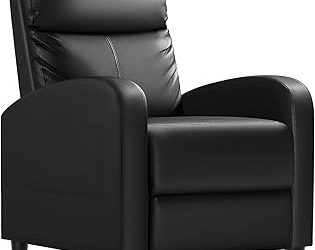
Manual Oversized Recliner with Phone Holder
A straightforward heavy-duty manual chair rated to 400 pounds, with an extra-large seat and a side phone holder that keeps a device out of the sitter’s sightline. Because there is no motor or power cord, this is the most flexible pick for placement — you can put it exactly where the light already falls rather than where an outlet dictates.
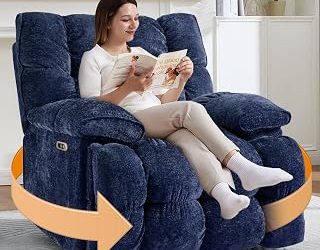
Euthymia Oversized Chenille Recliner
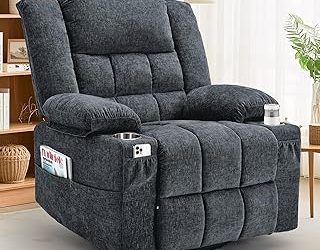
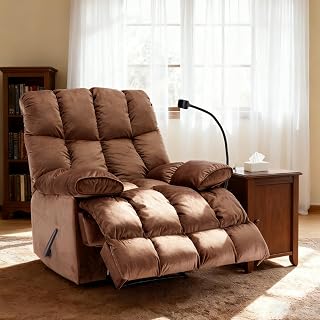
The chenille upholstery is the standout here: it diffuses lamplight instead of bouncing it, so the chair reads as a soft mass rather than a glare surface in a room lit from above. Extra-wide seating and a 400 lb rating make it a credible single-sofa substitute in a bedroom or den.
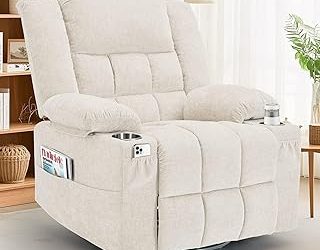
EONIX 3-Motor Power Lift Recliner
Independent backrest, footrest, and headrest control is the most meaningful upgrade in this category, letting you keep your head in a lamp’s beam while fully reclining your legs. The extended footrest and lumbar pillow suit taller heavy frames that bottom out on standard chairs.
FUNECORP Big Man Lay-Flat Lift Recliner
Dual motors with a true lay-flat position, plus heat and vibration that make it a legitimate evening wind-down chair rather than just a seat. The 28-inch seat and flip-arm storage with USB-C charging keep everything within reach, which matters when the room lights are already dimmed.
MCombo Power Lift Recliner R7399
Built around stand-assist for users who need help getting up, with 150-degree recline and a 4.7-inch extra footrest for longer legs. FSC-certified materials and straightforward assembly make it the sensible mid-size choice at a 26-inch seat width.
Frequently Asked Questions
How much seat width does a heavy man actually need?
Measure your hips while seated and add three to four inches. That usually lands between 24 and 28 inches. Going wider than necessary costs you floor space and pushes the armrests out of comfortable reach.
Are 400 lb capacity claims reliable?
Treat the rating as a starting point and inspect the frame material and mechanism. Steel-reinforced frames with welded joints back up the claim; check the warranty terms on the recline mechanism specifically, since that is the first component to fail under load.
Is a dual or three-motor lift chair worth the extra cost?
If you read, watch, or nap in the chair rather than just sitting in it, yes. Independent control means you can elevate your legs without dropping your head out of your reading light, which single-motor chairs cannot do.
Where should the lamp go relative to the recliner?
Position the light source beside and slightly forward of the shoulder, not directly behind the headrest. That keeps the beam on the page as the chair travels back and avoids casting the sitter’s own shadow across whatever they are reading.
Final Thoughts
For most buyers, the EONIX 3-Motor Power Lift Recliner is the strongest overall choice — independent headrest control keeps you in the light no matter how far back you go. The Euthymia Oversized Chenille Recliner is the better pick if you want a heavy-duty chair that sits quietly in a well-lit room, and the MCombo R7399 covers the stand-assist need at a more moderate footprint.