Key takeaways
- PSI Rating Compatibility: Match the wand’s maximum PSI to your pressure washer’s output. A wand rated for 4,000 PSI will handle most residential machines comfortably, but exceeding its rating risks seal failure or dangerous spray inconsistencies—especially on delicate surfaces like painted wood or natural stone.
- Connection Type and Fit: Check whether your machine uses M22-14mm or M22-15mm fittings, and confirm whether the wand offers quick-connect or threaded coupling. A mismatched fitting is the number-one reason for returns. If your washer has a 3/8″ quick connect inlet, look for wands like the YAMATIC that natively support it.
- Length and Reach: Extension lances and telescoping wands drastically reduce how much bending and stretching you do. For single-story homes, a 16–40 inch lance is sufficient. For second-story siding or gutters, a telescoping model reaching 18–24 feet saves you from hauling a ladder onto wet ground.
- Nozzle Tip Variety: Included nozzle tips determine spray angle and intensity. A 0° red tip cuts through stubborn stains on concrete, while a 40° white tip is forgiving enough for vehicle paint and composite decking. Wands that ship with a full set of five tips give you real flexibility without separate purchases.
- Material and Build Quality: Stainless steel construction resists rust and handles outdoor storage without deteriorating. Brass fittings outperform plastic couplings in both longevity and leak prevention. If you are working in a coastal or humid environment, invest in stainless steel and skip anything with ABS plastic internals.
What's inside
As someone who designs outdoor living spaces for a living, I can tell you that the difference between a tired patio and one that practically glows at golden hour often comes down to one thing: how clean every surface is. Grime, mildew, and weathered buildup kill the palette of your stone, composite decking, or rendered walls faster than anything. A pressure washer is only as good as the wand attached to it—and choosing the wrong one can turn a quick afternoon refresh into a frustrating, leaky mess.
That frustration is exactly why I put this guide together. We tested and evaluated the leading pressure washer wands available in 2026 across reach, connection quality, build durability, and spray versatility. Below you will find our curated picks, followed by a practical breakdown of what matters when you are shopping so you can match the right wand to your exact setup and outdoor surfaces.
As an Amazon Associate we earn from qualifying purchases.


How to Choose a Pressure Washer Wand (2026)
- PSI Rating Compatibility: Match the wand’s maximum PSI to your pressure washer’s output. A wand rated for 4,000 PSI will handle most residential machines comfortably, but exceeding its rating risks seal failure or dangerous spray inconsistencies—especially on delicate surfaces like painted wood or natural stone.
- Connection Type and Fit: Check whether your machine uses M22-14mm or M22-15mm fittings, and confirm whether the wand offers quick-connect or threaded coupling. A mismatched fitting is the number-one reason for returns. If your washer has a 3/8″ quick connect inlet, look for wands like the YAMATIC that natively support it.
- Length and Reach: Extension lances and telescoping wands drastically reduce how much bending and stretching you do. For single-story homes, a 16–40 inch lance is sufficient. For second-story siding or gutters, a telescoping model reaching 18–24 feet saves you from hauling a ladder onto wet ground.
- Nozzle Tip Variety: Included nozzle tips determine spray angle and intensity. A 0° red tip cuts through stubborn stains on concrete, while a 40° white tip is forgiving enough for vehicle paint and composite decking. Wands that ship with a full set of five tips give you real flexibility without separate purchases.
- Material and Build Quality: Stainless steel construction resists rust and handles outdoor storage without deteriorating. Brass fittings outperform plastic couplings in both longevity and leak prevention. If you are working in a coastal or humid environment, invest in stainless steel and skip anything with ABS plastic internals.
The Best Pressure Washer Wands (2026) Reviewed
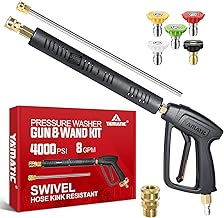
YAMATIC Pressure Washer Wand
The YAMATIC wand strikes an excellent balance between reach and ergonomics, with a swivel quick-connect that genuinely eliminates hose kink during extended use. Its stainless steel lance feels solid without being unwieldy, and the five included nozzle tips cover every standard cleaning scenario from car washing to driveway degreasing. A strong all-rounder for most homeowners.
Tool Daily Deluxe Pressure Washer Gun
At 40 inches with a 5,000 PSI ceiling, the Tool Daily Deluxe gun is built for people who want serious reach without a full telescoping setup. The integrated nozzle holder on the gun itself is a small but meaningful quality-of-life detail—no more setting tips down in the grass. This is my pick for medium-duty work on fences, decks, and vehicles.
Selkie 120″ Extension Wand
When you need to clean elevated surfaces without leaving the ground, the Selkie’s 120-inch stainless steel extension with 30° and 90° curved tips earns its keep. The 1/4″ quick connect keeps swaps fast, and the anti-leak ring design is noticeably better at maintaining consistent pressure than competing budget extensions. Excellent for gutters and second-story siding.
M MINGLE Pressure Washer Wand
M MINGLE’s 40-inch replacement wand offers broad compatibility with both M22-15mm and M22-14mm fittings, making it a safe choice if you are unsure of your exact spec. The five nozzles and sturdy lance make it a reliable workhorse, and the price-to-performance ratio is genuinely hard to beat for a first replacement wand.
TOR 24 FT Telescoping Wand
The TOR telescoping wand is the heavy-duty specialist here—24 feet of reach with a gutter cleaner attachment, brush head, and dual hose inlet adapters included. It demands two hands and a bit of practice, but once you get the rhythm, cleaning a two-story exterior from the ground up becomes almost meditative. Built for homeowners with tall properties who refuse to climb ladders.
Frequently Asked Questions
Can I use any pressure washer wand with my machine?
Not always. You need to verify both the PSI rating and the fitting type. Most consumer pressure washers use M22 fittings, but the thread diameter (14mm vs. 15mm) varies by brand. Always check your washer’s inlet specification before purchasing a replacement wand.
What is the difference between a pressure washer gun and a wand extension?
A pressure washer gun is the trigger-equipped handle that connects directly to your washer’s outlet. A wand extension attaches to the gun’s tip to add length and reach. Many kits, like the Tool Daily Deluxe, include both components together for convenience.
Do I need a telescoping wand for a single-story home?
Most likely not. A standard 16–40 inch lance will comfortably reach every surface on a single-story structure. Telescoping wands are worth the investment primarily for two-story homes, tall fences, or hard-to-reach gutter runs where a ladder would otherwise be necessary.
How often should I replace my pressure washer wand?
A quality stainless steel wand will last several seasons with normal residential use. Replace it if you notice persistent leaks at the connection points, a bent lance, or degraded O-rings that no longer seal after replacement. Brass fittings typically outlast plastic ones by a wide margin.
Final Thoughts
After evaluating every option against real-world performance, my top recommendations are the YAMATIC Pressure Washer Wand for everyday versatility, the Selkie 120″ Extension Wand for elevated cleaning jobs, and the TOR 24 FT Telescoping Wand for homeowners with multi-story properties. Each one excels in a distinct scenario, and investing in the right wand will transform the maintenance of your outdoor spaces from a chore into something closer to a craft.