Key takeaways
- Independent lumbar motor: Look for lumbar that adjusts on its own switch, not as a byproduct of the backrest angle. A fixed foam bolster feels supportive in a showroom and flattens within a year; a powered bladder or panel lets you dial in pressure as your posture drifts through the evening.
- Upholstery sheen over upholstery color: Matte and lightly pebbled surfaces diffuse lamplight; high-gloss bonded leather acts like a specular reflector and will bounce every bulb in the room. If your lighting is mostly overhead, prioritize a low-luster hide.
- Wall clearance and lamp real estate: Wall-hugger mechanisms need only a few inches behind the frame, which keeps your table lamps, cove lighting, or picture lights where you designed them. Traditional mechanisms can demand a foot or more and quietly push the whole lighting plan into the room.
- Headrest travel relative to your screen: Power headrests solve neck strain, but they also raise your eyeline. Check that the fully forward position still clears a wall-mounted TV without forcing you to look up through the glare band.
- Ports, and where they sit: USB-A and USB-C on the side panel are genuinely useful for phones, tablets, and small LED bias strips. Consoles with hidden storage are the better place to hide power bricks and remotes than a visible side table.
What's inside
Most people shop a reclining sofa the way they shop a mattress — sit, lean back, decide. But a sofa is the largest light-catching surface in a living room after the walls, and it spends most of its life in the low, warm, uneven light of an evening. That’s when the problems surface: a glossy faux-leather seat back that throws a lamp’s reflection straight into your eyes, a headrest that blocks the sconce you installed for reading, a recline angle that turns a perfectly aimed TV into a mirror. Add the specific ache of unsupported lumbar curve after ninety minutes of reclining, and a handsome piece of furniture becomes something you avoid after dark.
This guide looks at power reclining sofas with adjustable lumbar support through both lenses: how the mechanism treats your spine, and how the piece behaves in real ambient light. I’ve weighted upholstery sheen, headrest geometry relative to sightlines, wall clearance (which determines whether your floor lamp still has room to breathe), and onboard USB power — increasingly the easiest place to run a bias light or a small table lamp. Below are the models worth your attention in 2026.
As an Amazon Associate we earn from qualifying purchases.




🛒 Best Price Today on Amazon
Prime members get fast, free shipping on everything above, plus member-only deals. New members get a 30-day free trial — cancel anytime.
How to Choose a Power Reclining Sofa With Lumbar Support (2026)
- Independent lumbar motor: Look for lumbar that adjusts on its own switch, not as a byproduct of the backrest angle. A fixed foam bolster feels supportive in a showroom and flattens within a year; a powered bladder or panel lets you dial in pressure as your posture drifts through the evening.
- Upholstery sheen over upholstery color: Matte and lightly pebbled surfaces diffuse lamplight; high-gloss bonded leather acts like a specular reflector and will bounce every bulb in the room. If your lighting is mostly overhead, prioritize a low-luster hide.
- Wall clearance and lamp real estate: Wall-hugger mechanisms need only a few inches behind the frame, which keeps your table lamps, cove lighting, or picture lights where you designed them. Traditional mechanisms can demand a foot or more and quietly push the whole lighting plan into the room.
- Headrest travel relative to your screen: Power headrests solve neck strain, but they also raise your eyeline. Check that the fully forward position still clears a wall-mounted TV without forcing you to look up through the glare band.
- Ports, and where they sit: USB-A and USB-C on the side panel are genuinely useful for phones, tablets, and small LED bias strips. Consoles with hidden storage are the better place to hide power bricks and remotes than a visible side table.
The Best Power Reclining Sofas With Lumbar Support (2026) Reviewed
Signature Design by Ashley Boyington Power Reclining Sofa
The Boyington stacks heat, air massage, zero-gravity recline, and a drop-down table into one three-seat frame, and the leather-and-faux-leather mix keeps its sheen restrained enough to sit under a downlight without flaring. The drop-down table is the underrated feature here — it gives you a surface for a small candle or a puck lamp without adding another piece of furniture to the room.
Flexsteel Clive Power Reclining Sofa
Clive is the quiet, well-engineered choice: power headrests and power lumbar on separate controls, and Flexsteel’s frame and mechanism reputation behind it. The upholstery reads soft and low-luster in warm light, which makes it a good fit for rooms lit by lamps rather than ceiling fixtures.
Flexsteel Crew Leather Power Reclining Sofa
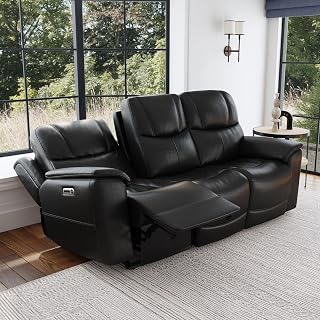
Black leather is the hardest surface in this category to light, and the Crew handles it about as well as black leather can — the grain breaks up reflections instead of forming hot spots. With zero-gravity recline, power headrest and lumbar, and USB-A plus USB-C, it’s the strongest pick for a dedicated home theater setup where you want the seating to disappear into the dark.
Watson & Whitely Power Reclining Sofa with Console
Genuine leather in saddle brown is the most forgiving finish in this roundup under warm 2700K light, where it glows rather than glares. Adjustable headrest and lumbar, super zero gravity, hidden storage, and cup holders make the console version the practical family choice.
5-Seat Power Reclining Leather Sectional
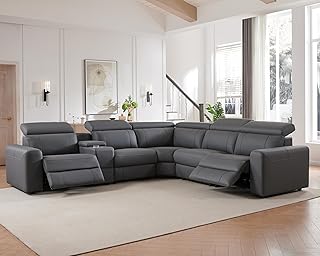
For open-plan rooms, the sectional’s wraparound geometry lets you build seating around a single lighting focal point instead of fighting two. Storage, USB, adjustable headrests, and a center console keep the surrounding surfaces clear, which matters when you’re relying on a couple of floor lamps to define the zone.
Frequently Asked Questions
Is power lumbar support worth the upgrade?
If you recline for more than an hour at a time, yes. Fixed lumbar foam supports one posture; a powered panel lets you increase support as you settle deeper into the recline, which is when most lower-back fatigue actually starts.
How much space do I need behind the sofa?
Wall-hugger designs typically need three to six inches. Traditional mechanisms can need eight to fourteen. Measure with your lamps in place, not just the empty wall.
Do heat and massage functions hold up?
The heating elements generally outlast the air-massage bladders. Treat massage as a pleasant extra rather than the reason to buy, and prioritize the recline and lumbar mechanism quality.
Leather or faux leather for a dim room?
Genuine leather develops a soft, uneven patina that scatters light attractively. Faux leather stays uniform and often glossier, so it shows reflections more readily — choose a matte, textured version if you go that route.
Final Thoughts
For a dedicated media room where you want the seating to vanish into low light, the Flexsteel Crew is the pick. For a living room lit mostly by lamps, the Watson & Whitely in saddle brown handles warm light better than anything else here, and the Flexsteel Clive is the safest all-around choice if you want proven mechanism quality with independent lumbar control.