Key takeaways
- Pure sine wave output: Non-negotiable if you run dimmers, LED drivers, or smart bulbs. Modified sine introduces harmonic distortion that shows up as visible shimmer at low brightness and can shorten driver lifespan.
- Decibel rating at 23 feet: Ambience dies above roughly 60 dB. Inverter generators in the low-to-mid 50s let conversation and music sit on top; open-frame units in the 70s dominate the space entirely.
- Starting versus running watts: A 13,500 BTU rooftop AC needs a surge cushion. Size for the inrush, not the steady draw, or you’ll trip the breaker mid-scene.
- RV-ready TT-30R outlet: Look for the 30-amp receptacle so you can plug the rig’s shore cord directly, no adapter stack, no voltage drop across cheap dogbones.
- Silent-hours strategy: Most campgrounds enforce a generator curfew. Pairing a gas inverter for daytime loads with a lithium station for overnight lighting solves this cleanly.
What's inside
Anyone who has strung warm-white festoon lights across an awning, only to watch them stutter and dim every time the fridge compressor kicks in, knows the real problem with RV power. It isn’t wattage on a sticker. It’s the quality and steadiness of the current reaching your fixtures, and the noise floor that sits underneath the evening you were trying to build. A cheap open-frame unit can light a campsite, but it will also flatten the mood with a mechanical drone and a flickering voltage curve that makes dimmable LEDs pulse like a bad fluorescent tube.
This guide looks at portable RV generators the way a lighting designer would: clean sine wave output for flicker-free dimming, decibel levels low enough that a string of Edison bulbs still reads as intimate rather than industrial, and runtime that carries you from golden hour through to bed. We cover gas inverters for heavy loads like rooftop air conditioning, and lithium power stations for silent, fumeless lighting and small-appliance duty. Below are six units worth considering in 2026.
As an Amazon Associate we earn from qualifying purchases.


How to Choose a Portable Rv Generator (2026)
- Pure sine wave output: Non-negotiable if you run dimmers, LED drivers, or smart bulbs. Modified sine introduces harmonic distortion that shows up as visible shimmer at low brightness and can shorten driver lifespan.
- Decibel rating at 23 feet: Ambience dies above roughly 60 dB. Inverter generators in the low-to-mid 50s let conversation and music sit on top; open-frame units in the 70s dominate the space entirely.
- Starting versus running watts: A 13,500 BTU rooftop AC needs a surge cushion. Size for the inrush, not the steady draw, or you’ll trip the breaker mid-scene.
- RV-ready TT-30R outlet: Look for the 30-amp receptacle so you can plug the rig’s shore cord directly, no adapter stack, no voltage drop across cheap dogbones.
- Silent-hours strategy: Most campgrounds enforce a generator curfew. Pairing a gas inverter for daytime loads with a lithium station for overnight lighting solves this cleanly.
The Best Portable Rv Generator (2026)s Reviewed
Champion 4500-Watt RV Ready Inverter
The strongest all-rounder here: enough surge headroom for a 15,000 BTU air conditioner while holding a clean waveform, and quiet enough that patio lighting and a conversation coexist. The three-year warranty and wide service network make it the safe pick for full-timers.
Champion 4000-Watt RV Ready Inverter
Same quiet technology and output stability in a lighter, easier-to-lift package, which matters when you’re loading it into a pass-through bay alone. Slightly less surge margin, so verify your AC’s startup draw first.
Oxseryn 4400-Watt Inverter Generator
An open-frame design that delivers strong wattage per dollar, with ECO mode pulling engine speed down to match light loads, a genuine help when you’re only running string lights and a fan. The tradeoff is a higher noise floor than enclosed units, so site it downwind and behind the rig.
maXpeedingrods MXR4000
The Bluetooth app monitoring is more useful than it sounds: you can watch load and fuel remotely instead of walking out mid-evening with a flashlight. Integrated CO alarm is a meaningful safety addition for anyone camping in tight sites.
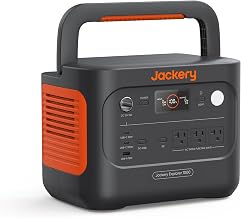
BLAVOR 1600W Portable Power Station
A LiFePO4 pack with a built-in solar panel and 1024Wh of capacity, which is roughly a full night of LED lighting plus device charging with margin left over. Completely silent and emission-free, making it the right tool for quiet hours and inside the coach.
Frequently Asked Questions
Will a generator make my dimmable LEDs flicker?
Only if the output isn’t a true sine wave, or if the unit is loaded near capacity and voltage sags. Inverter generators and quality lithium stations both produce clean power suited to dimming circuits.
Can a 300W solar power station run RV lighting?
Yes, for lighting alone. A 220Wh unit like the compact 300W solar generator will carry an evening of LED strips and a couple of device charges, but it won’t touch a compressor or induction load.
How far should I place a gas generator from the rig?
At least 20 feet, exhaust directed away from windows and vents. Distance also drops perceived noise substantially, which does as much for ambience as any fixture choice.
Do I need parallel capability?
If you may add a second air conditioner or want redundancy, buy a model that supports it now. Retrofitting isn’t an option, and paired 4000-watt units often run quieter than one large generator under the same load.
Final Thoughts
For most RV owners, the Champion 4500-Watt inverter is the right anchor purchase: quiet, RV-ready, and warrantied. Pair it with the BLAVOR 1600W power station for silent overnight lighting, or choose the Oxseryn 4400-Watt if you want maximum output per dollar and can live with a louder engine.