Key takeaways
- Inside diameter, not outside: 3/4" ID is the sweet spot for a home shop. It keeps pressure drop negligible over long runs, so a sander at the far wall behaves like it is bolted to the tank. Half-inch runs choke high-CFM tools once you pass about 50 feet.
- Total run length plus a margin: Measure your intended path along the joists, not the straight line across the room, then add 20 percent. Routing tight to structure looks intentional and costs you footage.
- Outlet block count and placement: Each aluminum block is a fixed point in the room, visually and functionally. Plan them where you already have good light, roughly one per work zone, so you are not dragging hose into a shadow.
- Finish and reflectivity: Raw aluminum manifolds pick up glare from LED shop fixtures and read as bright dots on the ceiling. Anodized or darker blocks recede. Minor detail, real difference in how finished the space feels.
- Fitting type and pressure rating: Look for a 200 PSI rating and confirm whether the kit ships brass or composite fittings. Brass threads tolerate repeated disassembly, which matters if you expect to expand the loop later.
What's inside
Anyone who plans light for a living learns to read a ceiling before anything else. Ceilings are where the eye goes when a room is working, and in a garage or shop they are usually a mess: coiled hose slung over a joist, an extension cord looped through a rafter, a compressor tucked in a corner with fifty feet of rubber snaking across the floor. The air line is almost always the offender. It sags, it casts a fat shadow across the bench, and it drags a tripping hazard through the one part of the floor you actually work on.
A hard-piped air system fixes the practical problem and the visual one at the same time. Run correctly, HDPE tubing sits tight against the joist line, throws almost no shadow, and puts air exactly where you need it through drop points you can plan the way you would plan a lighting layout. Below are six kits worth a look for 2026, plus the specs that matter, how to spec drop locations so your task lighting stays clean, and answers to the questions that come up once the tubing is out of the box.
As an Amazon Associate we earn from qualifying purchases.




🛒 Best Price Today on Amazon
Prime members get fast, free shipping on everything above, plus member-only deals. New members get a 30-day free trial — cancel anytime.
How to Choose a Pipe For Air Compressor Lines (2026)
- Inside diameter, not outside: 3/4" ID is the sweet spot for a home shop. It keeps pressure drop negligible over long runs, so a sander at the far wall behaves like it is bolted to the tank. Half-inch runs choke high-CFM tools once you pass about 50 feet.
- Total run length plus a margin: Measure your intended path along the joists, not the straight line across the room, then add 20 percent. Routing tight to structure looks intentional and costs you footage.
- Outlet block count and placement: Each aluminum block is a fixed point in the room, visually and functionally. Plan them where you already have good light, roughly one per work zone, so you are not dragging hose into a shadow.
- Finish and reflectivity: Raw aluminum manifolds pick up glare from LED shop fixtures and read as bright dots on the ceiling. Anodized or darker blocks recede. Minor detail, real difference in how finished the space feels.
- Fitting type and pressure rating: Look for a 200 PSI rating and confirm whether the kit ships brass or composite fittings. Brass threads tolerate repeated disassembly, which matters if you expect to expand the loop later.
The Best Pipe For Air Compressor Lines (2026)s Reviewed
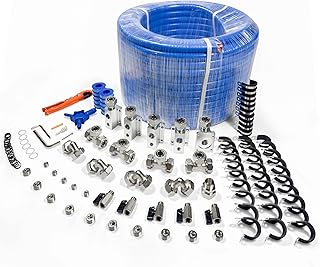
200 ft HDPE Kit with Aluminum Outlet Blocks (53 Pieces)
The most versatile starting point here: 200 feet of 3/4" HDPE and enough hardware to run a full perimeter loop in a two-car garage with drops on three walls. The 53-piece count means you can space outlets generously rather than rationing them to reach the far corner.
3/4" × 100 ft Pressure Gauge Shop Air Line Kit
Integrated gauges let you verify at the point of use instead of walking back to the tank, which is genuinely useful when you are diagnosing a starved tool. The tee and elbow selection handles standard joist routing without improvised bends.
300 ft 5-Way Multi-Outlet Manifold Kit (9130G)
Built for larger shops or anyone running several stations at once, with individual gauges on each of the five manifold outlets. Worth noting that a five-way manifold is a visually heavy object, so mount it where it reads as equipment rather than clutter.
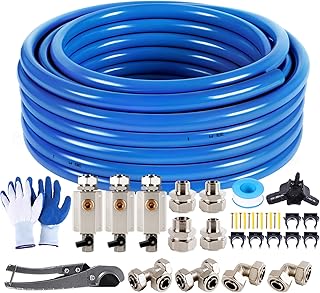
Shop Air Line Kit, 100/200/300 ft Rapid Air System
The length options make this the easiest kit to right-size, and the right-angle fittings let you turn corners tight instead of looping wide across open ceiling. Straightforward install, leak-free in practice when threads are sealed properly.
90-Piece Kit with HDPE-Aluminum Tubing and Brass Fittings
The brass fittings are the differentiator: they take repeated wrenching without deforming, so this is the kit to choose if you expect the layout to evolve. Ninety pieces gives you real flexibility in outlet placement.
Frequently Asked Questions
Can HDPE tubing handle shop air pressure safely?
Yes. These kits are rated to 200 PSI, comfortably above the 90 to 135 PSI most home compressors deliver. HDPE also will not corrode internally the way black iron does, so you are not blowing rust flakes into a spray gun.
Do I need to slope the lines for condensate?
Slope the main run slightly toward a drain leg or drop with a valve at the low point. Air carries moisture, moisture collects at low spots, and a drain leg you can crack open weekly saves your tools.
How many outlets should I plan?
Think in work zones rather than square footage. Bench, lift or center bay, and one near the door covers most single-car and two-car layouts. Add a drop anywhere you already installed dedicated task lighting.
Is this a job for one person?
Mostly. Cutting and fitting is simple, but holding a long run against joists while you set clamps goes much faster with a second set of hands or a few temporary hooks.
Final Thoughts
For most home shops, the 200 ft HDPE kit with aluminum outlet blocks gives you the coverage and outlet count to plan a genuinely clean ceiling run. If your space is larger or you work multiple stations simultaneously, the 300 ft 5-way manifold kit is the better spec. And if you suspect your layout will change as the shop evolves, the 90-piece kit with brass fittings is the one that will tolerate being taken apart and rebuilt.