Key takeaways
- Reflectance and tone: Pale greys, sands, and whites bounce warm light back up onto chair legs, table edges, and faces, softening the harsh downward cast of lanterns. Deep browns and charcoals absorb instead, which makes a site feel intimate and cave-like — lovely with a fire, dimmer under bulbs alone.
- Weave texture: Flat, tightly woven polypropylene reads smooth and slightly sheeny in raking evening light. A looser or ribbed weave catches low-angle sun and throws micro-shadows, adding visual warmth in photos and in person.
- Footprint over pattern: Size the rug to the zone you want lit, not to the trailer. A 9×12 or 9×18 mat carries the light out past your chairs; a 4×6 or 5×8 keeps it tight to the door as a threshold pad.
- UV stability: Sun-faded rugs shift color unevenly, and a rug that’s gone chalky in patches will scatter light inconsistently. UV-treated straw weave holds its value season after season.
- Drainage and drying: Perforated plastic weave lets dew and rain pass through instead of pooling. A damp rug darkens, kills reflectance, and stays that way through breakfast.
What's inside
Ask any lighting designer where an outdoor room begins and they’ll point at the ground, not the ceiling. At a campsite, the awning gives you shelter but the floor gives you the room — and most people discover this the hard way around dusk, when the string lights come on and everything below knee height dissolves into dirt, gravel, and shadow. Light needs a surface to land on. Without one, your carefully hung bulbs just hover in the dark like fireflies with nowhere to go, and the glow you paid for leaks straight into the ground.
This guide looks at camper rugs the way I’d look at any surface in a lighting plan: how it handles reflected light, whether it holds color under warm bulbs and low sun, how it reads at night versus noon, and whether it survives the practical realities of dew, mud, and packing up in the dark. Below are six plastic-straw and woven outdoor mats worth considering, with notes on sizing, tone, and the ambience each one actually delivers once the sun drops.
As an Amazon Associate we earn from qualifying purchases.



How to Choose a/an Outdoor Rug For Camper (2026)
- Reflectance and tone: Pale greys, sands, and whites bounce warm light back up onto chair legs, table edges, and faces, softening the harsh downward cast of lanterns. Deep browns and charcoals absorb instead, which makes a site feel intimate and cave-like — lovely with a fire, dimmer under bulbs alone.
- Weave texture: Flat, tightly woven polypropylene reads smooth and slightly sheeny in raking evening light. A looser or ribbed weave catches low-angle sun and throws micro-shadows, adding visual warmth in photos and in person.
- Footprint over pattern: Size the rug to the zone you want lit, not to the trailer. A 9×12 or 9×18 mat carries the light out past your chairs; a 4×6 or 5×8 keeps it tight to the door as a threshold pad.
- UV stability: Sun-faded rugs shift color unevenly, and a rug that’s gone chalky in patches will scatter light inconsistently. UV-treated straw weave holds its value season after season.
- Drainage and drying: Perforated plastic weave lets dew and rain pass through instead of pooling. A damp rug darkens, kills reflectance, and stays that way through breakfast.
The Best Outdoor Rug For Camper (2026)s Reviewed
fifame 9×18 Outdoor Rug
At 9×18 feet this is the closest thing to laying a floor down across an entire site, and it’s the one I’d choose when the goal is a genuinely lit outdoor room rather than a doormat. Reversible, so you can flip to whichever face better complements your bulb temperature.
Kohree Outdoor Rug, Wave, 9×12
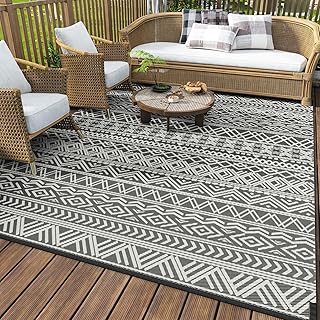
The grey-and-white wave pattern is the strongest performer under warm string lights — high reflectance without going bleach-white, and enough tonal variation to hide the dust that flattens solid-color rugs. Non-slip backing and easy rinse-off make it a low-maintenance choice.
FACOYANS 9×12 RV Outdoor Rug
A generous 9×12 with the “Home is Where We Park It” graphic, which reads clearly by daylight and recedes politely at night once the pattern is lit only at the edges. The included carry bag matters more than it sounds when you’re rolling up in the dark.
MontVoo 5×8 Outdoor Rug
Boho grey in a manageable 5×8 — my pick for a compact site or a defined lounge zone under a single hanging lantern. The lighter ground keeps a small area from feeling gloomy when your only light source is directly overhead.
Pauwer Waterproof Outdoor Rug 5×8
The leaf-brown colorway is the mood choice here: it drinks light rather than reflecting it, which is exactly right beside a fire pit where you want the flame to be the brightest thing in the scene. UV resistant and reversible for a lighter option when you’d rather not.
Frequently Asked Questions
Does rug color really change how a campsite feels at night?
Noticeably. A light rug returns roughly a third of the light hitting it back into the space, filling shadows under chairs and tables. A dark rug returns very little, which concentrates attention on your light sources.
Can I leave a plastic straw rug out overnight?
Yes — these weaves shed moisture and dry fast. Just shake it out before rolling, since trapped grit abrasively dulls the surface over time.
Will it hold up under a fire pit or grill?
Polypropylene is not heat-proof. Keep at least a few feet between the rug edge and any open flame or dropping ember.
How do I stop it lifting in wind?
Corner stakes through the weave, or weight the perimeter with your chair legs and a storage bin. Larger 9×12 and 9×18 mats are inherently more stable.
Final Thoughts
For a fully realized outdoor room, the fifame 9×18 gives you the most surface to work with, while the Kohree 9×12 Wave is the best all-around performer for bouncing warm light back into the space. If your evenings revolve around a fire, the Pauwer leaf-brown 5×8 is the more atmospheric call.