Key takeaways
- Daylight control: Adjustable louvered roofs let you dial shade like a dimmer, tilting blades to bounce light instead of blocking it. Fixed slatted roofs give you dappled, moving light. Solid hardtops give deep, consistent shade and rain cover but almost no daylight modulation.
- Finish and reflectance: Dark gray and bronze frames absorb light, so your fixtures do all the work at night and the structure reads as a silhouette. Cedar and light finishes bounce warm light back down, meaning fewer lumens for the same cozy result.
- Wire paths: Look for hollow posts, internal channels, or beam grooves. Hidden runs are the difference between an installed lighting scheme and extension cords zip-tied to a leg. Check for a post base near an outlet or a plausible conduit route.
- Mounting geometry: Count your anchor points. Crossbeams and rafters give you places to hang pendants, catenary wire, or downlights. A smooth-underside hardtop needs surface-mount fixtures or magnetic bases.
- Footprint and beam throw: Wider spans need light from more than one source or you get a bright center and dark corners. Budget roughly one warm source per 8 to 10 feet of span, and keep everything at the same color temperature.
What's inside
Most pergola shopping happens in the middle of a bright afternoon, which is exactly the wrong time to judge one. A structure that looks crisp at noon can turn a patio into a dim cave by six o’clock, or throw hard, striping shadows across a dinner table right when you want soft, even light. The real question isn’t just “will this block sun?” but “what does this space feel like at four, at seven, and at ten?” Roof geometry, post spacing, finish color, and whether there’s anywhere sane to run a wire all decide that.
This guide looks at outdoor pergolas the way a lighting designer would: how each one handles daylight through the day, how it behaves once the fixtures come on after dark, and how much control you actually get. You’ll find a short buying framework, honest notes on six well-reviewed 2026 models, and answers to the questions that come up once you start planning where the glow goes.
As an Amazon Associate we earn from qualifying purchases.


How to Choose a/an Outdoor Pergola (2026)
- Daylight control: Adjustable louvered roofs let you dial shade like a dimmer, tilting blades to bounce light instead of blocking it. Fixed slatted roofs give you dappled, moving light. Solid hardtops give deep, consistent shade and rain cover but almost no daylight modulation.
- Finish and reflectance: Dark gray and bronze frames absorb light, so your fixtures do all the work at night and the structure reads as a silhouette. Cedar and light finishes bounce warm light back down, meaning fewer lumens for the same cozy result.
- Wire paths: Look for hollow posts, internal channels, or beam grooves. Hidden runs are the difference between an installed lighting scheme and extension cords zip-tied to a leg. Check for a post base near an outlet or a plausible conduit route.
- Mounting geometry: Count your anchor points. Crossbeams and rafters give you places to hang pendants, catenary wire, or downlights. A smooth-underside hardtop needs surface-mount fixtures or magnetic bases.
- Footprint and beam throw: Wider spans need light from more than one source or you get a bright center and dark corners. Budget roughly one warm source per 8 to 10 feet of span, and keep everything at the same color temperature.
The Best Outdoor Pergolas of 2026, Reviewed
Louvered Pergola 10′ x 13′ Aluminum with Reinforced Steel Roof
The reinforced steel louvers close tight enough for real rain cover, then open to let low evening sun rake across the deck. The gray finish keeps the frame visually quiet, so uplighting the posts reads as architecture rather than clutter.
Jocisland 20′ x 20′ Cedar Wood Gazebo
At 400 square feet with a sloped galvanized roof, this is the pavilion of the group, and the cedar interior is its lighting advantage: warm wood under a 2700K source glows instead of just being lit. Plan on multiple pendants or a perimeter of wall-washers, since a single center fixture will leave the edges dim.
Aoxun Louvered Pergola 10×16
Thickened 3.8-inch posts are genuinely useful here, both for wind stability and as substantial anchor points for sconces or catenary wire. Built-in drainage keeps water off your fixtures, and the adjustable roof means you can flatten the louvers at dusk to open the sky.
12′ x 16′ Pergola with Louvered Roof, Curtains & Netting
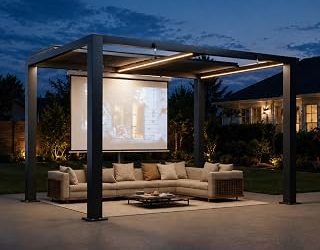
The curtain track is the standout feature for ambience: drawn fabric turns hard fixture output into soft, diffused light and gives the space visible edges after dark. The dark gray frame disappears at night, which is exactly what you want when the lighting is meant to be the focal point.
10x12FT Hardtop Gazebo with Double Galvanized Steel Roof
A double-roof hardtop in brown makes the most sense as a warm, enclosed pocket rather than a daylight-shaping structure. Shade is deep and permanent, so treat it as an interior room and light it accordingly with low-glare, downward-facing fixtures.
Frequently Asked Questions
What color temperature works best under a pergola?
Stay between 2200K and 2700K. Anything cooler reads clinical outdoors and makes wood tones look gray. Consistency matters more than the exact number, so match every fixture.
Can I mount lights directly to an aluminum louvered roof?
Mount to the frame, beams, or posts rather than the moving louvers. Fixtures on the blades interfere with rotation and stress the mechanism over time.
Do slatted wood roofs work for evening lighting?
Yes, and often better than solid tops. The BlueWish 12′ x 14′ cedar pergola’s slatted trellis roof catches uplight and creates layered shadow above the seating zone, giving the space visual depth.
How much lighting load can these structures handle?
LED string and pendant loads are trivial electrically; the real limits are mechanical and code-related. Keep hardware within manufacturer fastening guidance and have a licensed electrician handle any permanent circuit.
Final Thoughts
For the most control over how light moves through the day, the Aoxun Louvered Pergola 10×16 offers the best combination of adjustable roofing and substantial posts to build a lighting scheme around. The 12′ x 16′ louvered pergola with curtains is the pick if you want soft, diffused evening ambience out of the box, and the Jocisland 20′ x 20′ cedar gazebo is the choice when you’re lighting a genuine outdoor room rather than a seating nook.