Key takeaways
- Fabric tone under warm light: Dark blues and grays absorb glow and recede into evening shadow, which suits a lit garden path. Whites and creams bounce light back and become a soft secondary source — excellent if your patio is underlit, distracting if you already have bright fixtures.
- Weave openness: Rope hammocks break light into pattern, casting lattice shadows on decking that shift through the evening. Solid quilted beds give a clean, unbroken form. Neither is better; they simply do different things to a floor.
- Frame finish and profile: Powder-coated steel in a matte tone disappears at night. Glossy or light-colored frames pick up specular highlights from every nearby bulb, which reads as visual noise. Check the arc height too, since a tall frame will intercept overhead lighting.
- Capacity with honest headroom: Look for 450 lb ratings and up for two-person use. Rated capacity assumes even, static load, so buy above your actual need.
- Stand or straps: A stand lets you place the hammock exactly where your lighting already works. Tree straps tie you to whatever the trees allow, which usually means hanging outside your lit zone entirely.
What's inside
Most hammock shopping goes wrong at dusk. Buyers pick a fabric they liked under harsh midday sun, hang it, and then discover the thing looks like a sagging tarp the moment the patio lights come on. As someone who spends most of my working hours deciding where shadows land, I’d argue a hammock is less a piece of furniture than a light-catching surface: it reflects, filters, and throws color across your deck for the four or five hours a night you actually use the space. Weave density, frame finish, and fabric tone matter as much as weight rating.
This guide looks at six outdoor hammocks through that lens — how they read under warm string bulbs, how their frames behave next to low path lighting, and how the bed itself handles the glare of an afternoon before settling into evening. Capacity, portability, and assembly are covered too, because a beautiful hammock you can’t move or trust is just decor. Ratings and pricing update automatically below.
As an Amazon Associate we earn from qualifying purchases.




How to Choose a/an Outdoor Hammock (2026)
- Fabric tone under warm light: Dark blues and grays absorb glow and recede into evening shadow, which suits a lit garden path. Whites and creams bounce light back and become a soft secondary source — excellent if your patio is underlit, distracting if you already have bright fixtures.
- Weave openness: Rope hammocks break light into pattern, casting lattice shadows on decking that shift through the evening. Solid quilted beds give a clean, unbroken form. Neither is better; they simply do different things to a floor.
- Frame finish and profile: Powder-coated steel in a matte tone disappears at night. Glossy or light-colored frames pick up specular highlights from every nearby bulb, which reads as visual noise. Check the arc height too, since a tall frame will intercept overhead lighting.
- Capacity with honest headroom: Look for 450 lb ratings and up for two-person use. Rated capacity assumes even, static load, so buy above your actual need.
- Stand or straps: A stand lets you place the hammock exactly where your lighting already works. Tree straps tie you to whatever the trees allow, which usually means hanging outside your lit zone entirely.
The Best Outdoor Hammock (2026)s Reviewed
Portable Outdoor Hammock with Stand, Balance Ropes
The dark blue bed is the quiet standout here — it swallows ambient light rather than reflecting it, so the hammock reads as a soft mass rather than a bright shape after sundown. Balance ropes keep the bed flat enough that it holds a clean silhouette even unoccupied, and the carrying bag makes seasonal repositioning painless.
Double Outdoor Hammock with Stand, Dark Gray
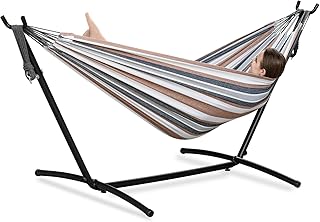
Cotton rope over a polyester pad is the best of both optical worlds: the open weave throws a woven shadow pattern across pavers while the pad underneath catches enough light to define the curve. Dark gray is the most forgiving color I’ve tested under mixed warm and cool fixtures.
Double Hammock with Stand, Coffee (450 lb, 9 ft)
A genuinely space-saving footprint for a 9-foot two-person setup, which matters when you’re fitting a hammock between existing light positions instead of rebuilding the layout around it. The coffee tone sits warm under 2700K bulbs and never goes muddy the way true browns can.
ANAGOO Double Hammock with Stand, White (500 lb)
The highest capacity in this group and the most active piece of lighting design — white fabric functions as a broad reflector, softening a hard downlight into something diffuse. Tool-free assembly and a balance strap make it easy to live with, though I’d skip white if you already have bright wall packs nearby.
Sunnydaze Quilted Double Hammock, Mountainside
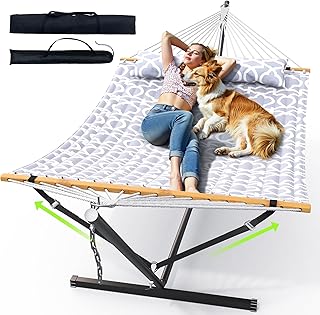
The quilted 74″ x 55″ bed holds a smooth, sculptural curve that catches raking light beautifully across its stitched channels. No stand is included, so plan your hardware and placement around your existing fixtures before ordering.
Frequently Asked Questions
Does hammock color really affect outdoor lighting?
Meaningfully, yes. A large light-colored fabric surface can noticeably lift ambient brightness on a small patio, while dark fabric does the opposite and helps other fixtures read as focal points.
Can I leave a hammock outside year-round?
Most fabric beds should come in during hard winter or prolonged wet weather. Powder-coated steel stands tolerate more, but expect finish wear at joints over several seasons.
How much space does a hammock stand need?
Budget the stated length plus about two feet of clearance at each end for entry and swing. Space-saving 9-foot models are easiest to fit around planters and lighting.
Are camping hammocks usable at home?
Absolutely. The Camping Hammock Lightweight with tree straps packs down small and works well for a shaded corner, though its thin nylon reads translucent and glows oddly if backlit.
Final Thoughts
For most patios, the Portable Outdoor Hammock with Stand in dark blue is the safest choice — it disappears politely into an evening scheme while carrying a soft pillow and easy portability. If you want the hammock itself to do lighting work, the ANAGOO Double in white is the strongest reflector here with the highest capacity, and the Sunnydaze Quilted Double rewards anyone with directional fixtures and existing hanging hardware.