Key takeaways
- Standard battery quartz: The most common option. One AA battery may last 6–18 months, depending on the movement and weather conditions. Choose a clock with a rear compartment that can be opened without removing the entire clock.
- High-torque quartz: Better for large clocks or long hands. It can move heavier hands reliably but may use more power and cost more to replace.
- Solar-assisted: Convenient where the dial receives regular daylight. It is less dependable in deep shade, under dense trees, or during long cloudy winters, so check whether it includes a backup battery.
- Plug-in or wired: Uncommon for ordinary wall clocks and usually impractical outdoors unless the outlet, cord, and connection are specifically protected for exterior use.
The best outdoor clocks are weather-resistant clocks sized for the viewing distance, protected against condensation and ultraviolet light, and powered by a dependable quartz movement or solar-assisted mechanism; for most patios, a 16–20-inch outdoor wall clock with high-contrast hands is the safest all-around choice.
Best Outdoor Clocks by Outdoor Space
| Outdoor situation | Recommended clock size | Best construction | Why it works |
|---|---|---|---|
| Small balcony or apartment patio | 10–14 inches | Lightweight resin, aluminum, or sealed plastic | Fits narrow walls without dominating the space; easier to mount on masonry or siding |
| Covered porch or 10 × 12 ft patio | 16–20 inches | UV-resistant resin, powder-coated metal, or sealed wood | Readable from typical seating 10–15 feet away |
| Large garden wall or pool area | 20–30 inches | Powder-coated aluminum or exterior-rated resin | Large numerals remain visible across 20–30 feet |
| Uncovered, rainy location | 14–24 inches | Sealed case with gasketed lens and corrosion-resistant hardware | Better protection from driving rain, humidity, and temperature changes |
These measurements refer to the clock’s overall diameter, not just the dial. Leave at least 3 inches of clear wall space around a clock so the case does not visually crowd a door frame, light fixture, trellis, or hanging planter. On a narrow porch, check the wall width and door swing before choosing a large decorative design.
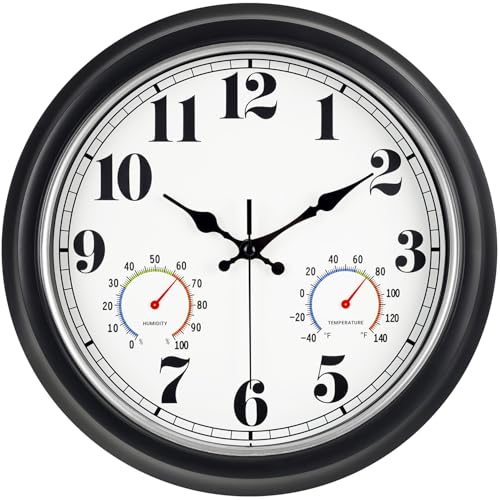
45MinST 13-Inch Vintage Outdoor Wall Clock with Thermometer and Hygrometer, Waterproof, Large Numbers, Silent, for Indoor and Outside Use,Porch,Garden,Pool(Black Frame with Silver Trim)
Included for 'Best Outdoor Clocks for Patios, Porches, and Gardens' because the listing specifies Waterproof and Large Numbers, details this guide uses to compare options.
View on Amazon
Horizent Outdoor Clocks Waterproof with Thermometer Combo Vintage Rustic Wall Clock for Patio Pool Bathroom Kitchen(8 Inch,Bronze)
Included for 'Best Outdoor Clocks for Patios, Porches, and Gardens' because the listing specifies Bronze), details this guide uses to compare options.
View on Amazon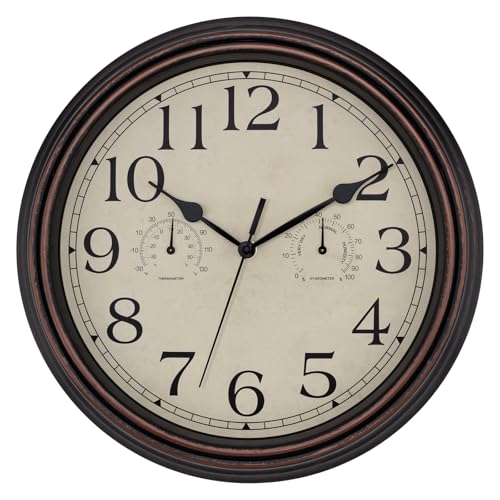
Foxtop 14" Outdoor Wall Clock with Thermometer and Hygrometer Combo, Bronze
Included for 'Best Outdoor Clocks for Patios, Porches, and Gardens' because the listing specifies Bronze, details this guide uses to compare options.
View on Amazon
Large Outdoor Patio Clock - Waterproof Thermometer Combo, 18 Inch, Bronze
Included for 'Best Outdoor Clocks for Patios, Porches, and Gardens' because the listing specifies Waterproof Thermometer Combo and 18 Inch, details this guide uses to compare options.
View on AmazonWhat to Look for in the Best Outdoor Clocks
Weather resistance is more than a waterproof label
An outdoor clock should be described as suitable for outdoor use, but the construction details matter more than the phrase alone. Look for a sealed or gasketed lens, a case that drains or resists water entry, stainless-steel or coated mounting hardware, and a dial printed with UV-resistant ink. A clock rated only for damp locations may be appropriate beneath a deep porch roof but not on an exposed garden wall.
Sunlight is often more damaging than rain. Direct ultraviolet exposure can fade numerals, yellow clear plastic, make decorative finishes chalky, and cause thin plastic hands to warp. For a sunny south- or west-facing wall, powder-coated aluminum and UV-stabilized resin generally outlast untreated wood or ordinary indoor plastic.
No outdoor clock is maintenance-free. Wipe dust and pollen from the lens several times a year, inspect the battery compartment for corrosion, and retighten mounting hardware after severe wind. In freezing climates, condensation inside the lens is a warning that the case seal or ventilation design is inadequate.
Readability depends on distance and contrast
Large numbers are useful only when the hands and dial contrast clearly. Black hands on a pale face or white hands on a dark face are easier to read than metallic hands against a patterned background. Avoid ornate numerals, reflective lenses, and thin hands if the clock will be viewed from a dining table or across a lawn.
As a practical guide, a 12-inch clock is usually comfortable to read from about 10 feet, a 16-inch model from roughly 15 feet, and a 24-inch model from approximately 25 feet in normal daylight. These are estimates: glare, shade, font thickness, and eyesight make a major difference. If the clock is intended to be read from a pool, outdoor kitchen, or distant seating area, choose the larger size rather than relying on a decorative but cramped dial.
Choose power for access, not appearance
- Standard battery quartz: The most common option. One AA battery may last 6–18 months, depending on the movement and weather conditions. Choose a clock with a rear compartment that can be opened without removing the entire clock.
- High-torque quartz: Better for large clocks or long hands. It can move heavier hands reliably but may use more power and cost more to replace.
- Solar-assisted: Convenient where the dial receives regular daylight. It is less dependable in deep shade, under dense trees, or during long cloudy winters, so check whether it includes a backup battery.
- Plug-in or wired: Uncommon for ordinary wall clocks and usually impractical outdoors unless the outlet, cord, and connection are specifically protected for exterior use.
For a clock mounted high above a porch, solar-assisted power or a long-life battery movement can prevent the nuisance of getting a ladder out twice a year. Avoid placing a battery clock where water can collect around the rear cover, even if the front lens is sealed.
Material Choices: Appearance Versus Outdoor Durability
| Material | Advantages | Common weaknesses | Best placement |
|---|---|---|---|
| UV-resistant resin or molded plastic | Lightweight, affordable, rustproof, easy to clean | Can fade, become brittle, or distort in intense sun if quality is poor | Balconies, covered porches, rental homes |
| Powder-coated aluminum | Light, corrosion-resistant, strong for its weight, good in wet climates | Coating can scratch; cheap cases may dent | Uncovered walls, coastal or humid areas |
| Stainless steel | Strong and corrosion-resistant with a clean modern appearance | Can show fingerprints and glare; often heavier or more expensive | Contemporary patios and outdoor kitchens |
| Sealed wood | Warm, traditional appearance and visual depth | Requires finish maintenance and can swell, crack, or fade | Deeply covered porches and sheltered garden rooms |
Metal cases are not automatically rustproof: steel screws, rear brackets, and unsealed edges may corrode first. If the clock will be exposed to salt air, specify stainless or non-corroding hardware as well as a weather-resistant case.
Mounting Styles and Installation Realities
A single rear keyhole slot is adequate for a small clock on a protected wall, but larger clocks benefit from two mounting points or a bracket that prevents twisting in the wind. Before drilling, confirm the clock’s weight and the wall structure. A 14-inch resin clock may weigh 2–4 pounds, while a large metal or wood design may weigh 8–15 pounds.
- Wood siding or a porch post: Fasten into framing whenever possible. Use an exterior-rated screw long enough to penetrate solid wood by at least 1 inch.
- Brick or concrete: Use a masonry bit and an anchor rated above the clock’s weight. Do not rely on a small adhesive strip for a heavy clock in heat or humidity.
- Vinyl siding: Mount to a structural surface behind the siding or use a purpose-made siding hook for lightweight clocks. Avoid compressing or cracking the siding.
- Rental installation: Choose a model under about 3 pounds and use a removable exterior mounting system only if its published weight rating covers the clock and the wall is clean, smooth, and sheltered.
Allow enough clearance to remove the battery cover. A clock mounted only 1 inch above a bench back or beneath a low shelf may be impossible to service. If it hangs over a walkway, keep the lower edge at least 78 inches above the walking surface to reduce the chance of someone striking it.
Quick Decision Matrix
| Your priority | Choose | Avoid |
|---|---|---|
| Small apartment balcony | 10–14-inch lightweight quartz clock with a sealed plastic or aluminum case | Oversized metal clocks that overload a thin railing wall |
| Children or pets nearby | Shatter-resistant lens, rounded case, secure two-point mounting | Glass lens, sharp metal projections, loose hanging hardware |
| Renter who may move | Under-3-pound clock with a removable mounting option | Heavy stone-look designs requiring masonry anchors |
| Strong sun and rain | Powder-coated aluminum or UV-stabilized resin with a gasketed lens | Unsealed wood and indoor clocks labeled only for occasional dampness |
| Clock viewed from 20 feet or more | 20–30-inch face, bold numerals, wide contrasting hands | Small Roman numerals and reflective silver hands |
Are Decorative Outdoor Clocks Worth the Cost?
Basic outdoor quartz clocks usually cost about $25–$60, mid-range weather-resistant designs commonly fall between $60 and $150, and large metal, solar-assisted, or highly decorative models often cost $150–$400 or more. The extra cost is worthwhile when it buys a better lens seal, UV-stable finish, high-torque movement, corrosion-resistant hardware, or a readable dial—not merely additional ornament.
For most homes, prioritize readability and serviceability over features such as temperature or humidity displays. Those secondary instruments can be useful, but they add openings, electronics, and batteries that may create more failure points. A simple, well-sealed clock with replaceable hands and an accessible movement is usually the more durable purchase.
Bottom Line
For a covered patio or porch, select a 16–20-inch quartz clock with bold numerals, a sealed lens, UV-resistant construction, and a battery compartment that can be reached without removing it from the wall. Choose 10–14 inches for a compact balcony, 20–30 inches for a large garden or pool area, and powder-coated aluminum or high-quality resin for exposed locations. The best outdoor clocks are the ones whose size, mounting method, weather protection, and power system match the exact wall and viewing distance—not simply the most decorative option.