Key takeaways
- Silence as a design feature: Oil-filled units have no fan, but they do click as the thermostat cycles. Mechanical knobs click louder than digital boards. If the heater lives in a bedroom or a quiet study, favor electronic thermostats — the cycling is far less intrusive at 2am.
- Display brightness and light pollution: A digital screen is convenient, but check whether it dims or sleeps. An always-on LED at full output acts like a nightlight you didn’t ask for and will visibly shift the mood of a dim room. Knob-controlled models sidestep this entirely.
- Finish and visual weight: Matte black recedes into shadow and reads almost furniture-like against dark floors or a deep wall color. White or off-white brightens under lamplight and suits pale, airy rooms, but shows more in a low-lit space. Choose the one that disappears in your room, not the one that looks best in the listing photo.
- Fin count and footprint: More fins mean more radiating surface and slower, steadier warmth. They also mean a longer body. Measure the wall run or desk gap you’re filling before you commit — a seven-fin unit sits differently in a room than an eleven-fin one.
- Non-negotiable safety: Tip-over cutoff, overheat protection, and an ETL or equivalent listing. If it will share a room with pets or children, add child lock to that list. Radiator surfaces get genuinely hot; treat placement with the same care you’d give a floor lamp cord.
What's inside
In room design, the pieces that succeed are usually the ones you stop noticing. I spend my working hours placing lamps, dimming circuits, and layering warm pools of light so a room feels settled after dark — and nothing undoes that work faster than a space heater with a glowing orange element, a whirring fan, and a bright blue LED panel throwing cold light across the wall. Most portable heaters are designed as appliances. They read as appliances, and they interrupt a room the way a ceiling fixture at full brightness does.
Oil-filled radiators are the exception. They warm by radiant surface heat rather than forced air, which means no fan hum under your podcast, no dust pushed into a corner reading nook, no visible glow to fight the 2700K lamps you carefully chose. This guide covers the models worth putting in a finished room: how to judge them on noise, controls, finish, and safety, plus honest notes on the units I’d actually place beside a sofa or under a desk.
As an Amazon Associate we earn from qualifying purchases.

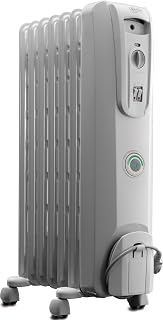


🛒 Best Price Today on Amazon
Prime members get fast, free shipping on everything above, plus member-only deals. New members get a 30-day free trial — cancel anytime.
How to Choose a/an Oil-Filled Space Heater (2026)
- Silence as a design feature: Oil-filled units have no fan, but they do click as the thermostat cycles. Mechanical knobs click louder than digital boards. If the heater lives in a bedroom or a quiet study, favor electronic thermostats — the cycling is far less intrusive at 2am.
- Display brightness and light pollution: A digital screen is convenient, but check whether it dims or sleeps. An always-on LED at full output acts like a nightlight you didn’t ask for and will visibly shift the mood of a dim room. Knob-controlled models sidestep this entirely.
- Finish and visual weight: Matte black recedes into shadow and reads almost furniture-like against dark floors or a deep wall color. White or off-white brightens under lamplight and suits pale, airy rooms, but shows more in a low-lit space. Choose the one that disappears in your room, not the one that looks best in the listing photo.
- Fin count and footprint: More fins mean more radiating surface and slower, steadier warmth. They also mean a longer body. Measure the wall run or desk gap you’re filling before you commit — a seven-fin unit sits differently in a room than an eleven-fin one.
- Non-negotiable safety: Tip-over cutoff, overheat protection, and an ETL or equivalent listing. If it will share a room with pets or children, add child lock to that list. Radiator surfaces get genuinely hot; treat placement with the same care you’d give a floor lamp cord.
The Best Oil-Filled Space Heater (2026) Models Reviewed
DREO Oil Filled Radiator Heater
The one I recommend most often for rooms designed around lamplight — the digital thermostat holds temperature with minimal audible cycling, and ECO mode keeps output low and steady instead of surging. Remote control, a 24-hour timer, and child lock make it the most livable of the group, and the grey body sits quietly against most neutral palettes.
Pelonis Oil Filled Radiator Heater (2025 Upgraded)
A strong choice for larger open rooms where you want warmth to build slowly across a wide area rather than blast from one corner. The black finish is the practical pick: it absorbs light rather than reflecting it, so the unit reads as a low, dark mass instead of a bright appliance in your sightline.
PELONIS Radiator Heater for Large Space
The dual-knob version, and better for it if you dislike screens. Nothing lights up, nothing needs a remote, and 1500W across three modes gives you enough range to hold a big living room comfortably — just expect an audible click each time the thermostat engages.
Amazon Basics Portable Oil Radiator Heater
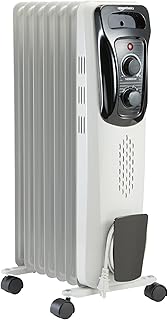
Seven fins in a compact 25-inch body, which makes it the easiest of these to tuck beside a desk or behind an armchair. The white finish works beautifully in pale rooms and less so in dark ones, where it stays visible after the lamps come down.
CAYNEL Space Oil Filled Radiator Heater
The most considered-looking unit here, with a genuinely handsome black casing and a 24-hour timer that lets you pre-warm a room before you use it. A sensible pick for a home office you want to look composed on camera.
Frequently Asked Questions
Do oil-filled heaters glow or emit light?
No. There’s no exposed element, which is the core reason they suit finished rooms. The only light is whatever control panel the model has, and on knob-based units there’s none at all.
Are they truly silent?
Silent in airflow, yes — there’s no fan. You will hear occasional thermostat clicks and faint expansion ticks as the oil heats. Digital models are the quieter option.
How long do they take to warm a room?
Longer than a fan heater, typically 20 to 40 minutes for noticeable change. The payoff is heat that lingers well after the unit cycles off, which feels far more even.
Can I run one overnight?
Generally yes, with tip-over and overheat protection and a clear perimeter around the unit. Plug directly into a wall outlet — never an extension cord or power strip.
Final Thoughts
If you want warmth that respects a carefully lit room, the DREO Oil Filled Radiator Heater is the one to buy: quiet cycling, real controls, and a dimmable-friendly digital panel. For large open spaces, the upgraded Pelonis in black does the most with 1500W while staying visually recessed, and the CAYNEL is the pick if the heater has to look as intentional as everything else in the room.