Key takeaways
- Deck-to-support alignment: Your outfeed rollers must sit level with the saw’s table, not near it. A support 2 mm high lifts the far end of a 10-foot casing and opens the miter at the wall. Look for stands with fine height adjustment on the end stops, and check alignment with a straightedge every time you remount the saw.
- Working height and your sightline: Cutting a bevel means reading a pencil line at an angle, often with a task lamp somewhere behind you. Stands in the 31–35 inch range put the cut near sternum height, which keeps your head above the blade guard instead of craning into your own shadow.
- Frame stiffness over raw capacity: A 500 lb rating tells you it won’t collapse. It doesn’t tell you whether the beam flexes when you lean on a 12-foot board. Steel box beams and wide-splayed legs resist the lateral twist that walks your stop block out of position mid-cut.
- How it travels and stores: Wheeled stands roll over thresholds and gravel, then fold to lean against a wall. Compact rail stands hang on a garage hook. Decide honestly whether you work in one shop or six houses a month, because the wrong answer costs you an hour every day.
- Universal mounting versus proprietary rails: Saws get replaced more often than stands. Adjustable mounting brackets that accept almost any 10 or 12 inch saw will outlive two or three tools; a stand keyed to one chop saw family will not.
What's inside
Ask anyone who installs lighting for a living where their projects actually go wrong, and you’ll rarely hear “the fixture.” You’ll hear about the trim. Cove valances, slat screens, plinth boxes for uplights, the shallow hardwood frames that hide an LED channel from view — every one of them lives or dies on a miter that closes tight. And here is the cruel part: raking light from a wall washer will find a 1-degree gap from across the room and turn it into a shadow line you cannot unsee. That gap almost never comes from the saw. It comes from a workpiece that sagged, twisted, or bounced because the thing holding it was never really holding it.
A miter saw stand is the least glamorous purchase in a build, and the one that most quietly determines whether your joints read clean under directional light. This guide looks at six stands through that lens: how steady they keep long stock, how honestly they hold the saw’s deck coplanar with your supports, how well they behave in a finished room where you can’t just drop a pile of offcuts on the rug, and how quickly they fold down when the client wants their living room back before dinner.
As an Amazon Associate we earn from qualifying purchases.



How to Choose a Miter Saw Stands (2026)
- Deck-to-support alignment: Your outfeed rollers must sit level with the saw’s table, not near it. A support 2 mm high lifts the far end of a 10-foot casing and opens the miter at the wall. Look for stands with fine height adjustment on the end stops, and check alignment with a straightedge every time you remount the saw.
- Working height and your sightline: Cutting a bevel means reading a pencil line at an angle, often with a task lamp somewhere behind you. Stands in the 31–35 inch range put the cut near sternum height, which keeps your head above the blade guard instead of craning into your own shadow.
- Frame stiffness over raw capacity: A 500 lb rating tells you it won’t collapse. It doesn’t tell you whether the beam flexes when you lean on a 12-foot board. Steel box beams and wide-splayed legs resist the lateral twist that walks your stop block out of position mid-cut.
- How it travels and stores: Wheeled stands roll over thresholds and gravel, then fold to lean against a wall. Compact rail stands hang on a garage hook. Decide honestly whether you work in one shop or six houses a month, because the wrong answer costs you an hour every day.
- Universal mounting versus proprietary rails: Saws get replaced more often than stands. Adjustable mounting brackets that accept almost any 10 or 12 inch saw will outlive two or three tools; a stand keyed to one chop saw family will not.
The Best Miter Saw Stands (2026)s Reviewed
DEWALT DWX724 Compact Miter Saw Stand
The one I keep in the van for interior trim days: a 40-inch beam that extends for longer stock, 500 lb capacity, and a folded profile slim enough to carry through a furnished hallway without knocking a lampshade. Its end supports adjust finely enough to true up with the saw deck in under a minute, which is most of the battle.
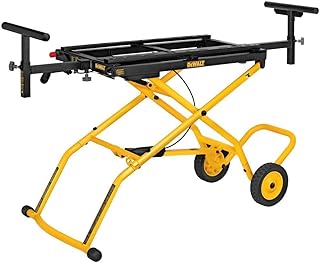
DEWALT DWX726 Rolling Miter Saw Stand
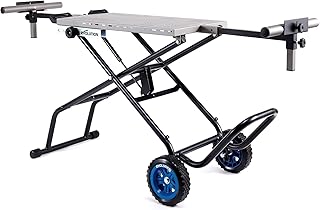
Wheels change the calculus entirely — this one rolls out fully rigged, supports 8 feet of material, and offers adjustable height so you can match the stand to the room rather than to your back. The universal mounting rails mean your next saw bolts straight on, and the steel frame stays honest under long hardwood.
Evolution MCSSTAND Chop Saw Stand
Built for metal-cutting chop saws, and the obvious pick if you’re fabricating steel channel, brackets, or conduit runs for architectural lighting. The gas-strut Powerlift assist takes the weight of a heavy S355-class saw as you raise it, and the all-terrain wheels handle sites where a smooth floor is a rumour.
BORA PM-4000 Portable Miter Saw Stand
A genuinely universal-fit stand with a wide, planted stance and quick-release mounting brackets. It’s the value choice for a home shop that swaps between saws, though the setup ritual rewards patience over speed.
BORA Adjustable Roller Stand
The cheapest fix for the most common problem: unsupported outfeed. Park one at each end of a long board on any bench or stand, dial the height to match, and sagging stock stops sabotaging your miters.
Frequently Asked Questions
Do I really need a dedicated stand if I have a workbench?
For short blocks, no. The moment you’re cutting 8-foot casing or LED channel, yes — a bench supports the middle of the board and nothing else, and that unsupported overhang is exactly where the angle drifts.
What about a simple roller stand instead?
Roller stands like the Trend R/STAND/A, with 140 lb capacity and 2 to 6.3 inch height adjustment, are excellent supplements rather than substitutes. They add outfeed support where you need it but don’t hold the saw or give you a repeatable stop system.
Will a universal stand fit my saw?
Most 10 and 12 inch sliding compound saws mount fine, but measure your base’s bolt-hole spread against the stand’s bracket range before buying. Metal chop saws are the exception and generally need a purpose-built frame.
How do I stop dust ruining a finished room?
Position the stand so the ejection port faces a drop cloth or a shrouded corner, and light the work from the side rather than behind — a backlit dust plume hides your cut line completely.
Final Thoughts
For most trim and lighting-carpentry work, the DEWALT DWX726 rolling stand is the one I’d buy first: it travels loaded, spans 8 feet of material, and its universal rails will outlast the saw you mount today. If your projects are indoors and space is tight, the DWX724 folds smaller and sets up faster, and a pair of BORA adjustable roller stands is the cheapest way to make any of it cut straight.