Key takeaways
- Weather rating over marketing language: “Outdoor” is a claim; IPX4 is a measurement. Danby’s IPX4-rated cabinet is tested against splashing water from any direction, which matters within a few feet of a pool coping or an exposed pergola edge. Anything without a stated rating belongs under solid cover.
- Ambient temperature ceiling: Outdoor compressors work against the air around them. Check the operating range before you commit — a unit rated to hold 37–65°F in a 90°F courtyard behaves very differently than one spec’d for a 72°F kitchen, and undersized condensers announce themselves by running constantly.
- Interior light color and control: This is the detail nearly every buyer skips. Cool white LEDs at 5000K or above will fight a warm exterior scheme every time the door swings. Look for soft or warm-toned interior lighting, or at minimum a switchable lamp you can leave off during entertaining hours.
- Noise floor under 40 dB: Outdoor conversation happens at roughly 55–60 dB. A compressor at 42 dB disappears; one at 48 dB becomes the thing everyone hears during pauses. Feelfunn publishes a sub-40dB figure, which is the number to benchmark against.
- Built-in versus freestanding ventilation: Front-venting units can be recessed into a cabinet run with a flush face; rear-venting units cannot, no matter how neatly the opening is framed. Confirm this before your carpenter cuts the aperture, because retrofitting clearance is expensive.
What's inside
Anyone who has designed an evening terrace knows the fridge is the loudest object out there — not acoustically, but visually. You spend weeks dialing in warm 2700K path lights, a low glow under the bar lip, maybe a single grazing wash across the stone, and then a chrome box arrives with a blue-white interior lamp that throws hard cyan across everyone’s faces the moment the door opens. Meanwhile the indoor unit somebody dragged onto the patio last summer has already rusted at the hinge, fogged its glass, and started struggling every time the afternoon sun hits it. Outdoor refrigeration fails on two fronts: it fails the weather, and it fails the mood.
This guide looks at compact outdoor fridges the way a lighting designer would spec any fixture — by housing durability, thermal behavior under real ambient load, acoustic floor, and the quality and control of the light it emits into a finished space. Below you’ll find the models worth building into a bar run or standing freely beside a lounge grouping, plus the specification details that separate a unit you forget about from one you keep apologizing for.
As an Amazon Associate we earn from qualifying purchases.



🛒 Best Price Today on Amazon
Prime members get fast, free shipping on everything above, plus member-only deals. New members get a 30-day free trial — cancel anytime.
How to Choose a Mini Fridge For Outdoors (2026)
- Weather rating over marketing language: “Outdoor” is a claim; IPX4 is a measurement. Danby’s IPX4-rated cabinet is tested against splashing water from any direction, which matters within a few feet of a pool coping or an exposed pergola edge. Anything without a stated rating belongs under solid cover.
- Ambient temperature ceiling: Outdoor compressors work against the air around them. Check the operating range before you commit — a unit rated to hold 37–65°F in a 90°F courtyard behaves very differently than one spec’d for a 72°F kitchen, and undersized condensers announce themselves by running constantly.
- Interior light color and control: This is the detail nearly every buyer skips. Cool white LEDs at 5000K or above will fight a warm exterior scheme every time the door swings. Look for soft or warm-toned interior lighting, or at minimum a switchable lamp you can leave off during entertaining hours.
- Noise floor under 40 dB: Outdoor conversation happens at roughly 55–60 dB. A compressor at 42 dB disappears; one at 48 dB becomes the thing everyone hears during pauses. Feelfunn publishes a sub-40dB figure, which is the number to benchmark against.
- Built-in versus freestanding ventilation: Front-venting units can be recessed into a cabinet run with a flush face; rear-venting units cannot, no matter how neatly the opening is framed. Confirm this before your carpenter cuts the aperture, because retrofitting clearance is expensive.
The Best Mini Fridge For Outdoors (2026)s Reviewed
Danby DAR044A6BSLDBO 4.4 Cu. Ft. Outdoor Mini Fridge
The only unit here with a published IPX4 rating and Energy Star certification, which makes it the honest choice for a cabana wall or an uncovered pool bar where spray is a given. Its solid spotless-steel door means no interior light bleeds into your scheme at all — a quiet asset if you’ve worked hard on a dark, low-lumen evening palette.
Feelfunn 24 Inch Beverage Refrigerator, 180 Cans
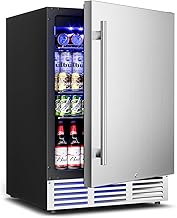
The strongest all-round spec in this group: a 37–65°F range that flexes from lager to lighter reds, a sub-40dB compressor, and interior LED lighting on a switch rather than a permanent fixture. At 24 inches it fills a standard cabinet bay cleanly, which keeps your under-counter light line unbroken.
Antarctic Star 24 Inch Outdoor Beverage Refrigerator
Tuned tighter than the Feelfunn at 32–50°F, so it’s the better pick if the priority is genuinely cold beer rather than mixed-temperature storage. Fast pull-down and low noise make it forgiving during heavy afternoon use, and the glass door does real work as a soft, self-contained glow source in a dim bar corner.
EUHOMY 15 Inch Under Counter Beverage Fridge, 127 Cans
A narrow 15-inch footprint with a stainless door, built for the leftover bay in a tight outdoor kitchen where a 24-inch unit simply won’t land. Capacity holds up better than the width suggests, and the opaque door keeps the cabinet face reading as one continuous material.
15 Inch Outdoor Beverage Refrigerator with French Door
The French door layout is the practical highlight — half-width swings mean less cold loss and far less clearance needed in a walkway-adjacent install. Worth specifying where a full-width door would otherwise open straight into a traffic path or across a floor-level uplight.
Frequently Asked Questions
Can I use an indoor mini fridge outside if it’s under a roof?
Under full cover with stable temperatures, it may survive a season, but indoor units aren’t built for humidity swings or wide ambient ranges. Expect condensation in the door seal, corrosion at fasteners, and a compressor that cycles hard on hot days.
Does the interior LED really affect outdoor ambience that much?
More than most people expect. A 5000K interior lamp inside a glass door acts as a small, uncorrected light source in your scheme, shifting skin tones and flattening the warm layering you’ve built. A switchable or warm-toned lamp solves it entirely.
How much clearance does a built-in installation need?
Follow the manufacturer’s figures rather than a rule of thumb — front-venting models often need almost none at the sides, while rear-venting units typically want several inches behind. Restricting airflow is the fastest way to shorten compressor life.
Should I unplug the fridge over winter?
If temperatures drop below the stated minimum ambient range, yes. Empty it, clean and dry the interior, and leave the door slightly ajar so the gasket doesn’t hold moisture against the cabinet.
Final Thoughts
For genuinely exposed positions, the Danby DAR044A6BSLDBO earns its place on the IPX4 rating alone. If you’re building into a covered bar run and care about how the space reads after dark, the Feelfunn 24 Inch offers the best balance of temperature range, quiet operation, and controllable lighting, with the Antarctic Star 24 Inch a sharper choice when cold beer is the whole assignment.