Key takeaways
- Darkening behavior: Oil-heavy conditioners deepen tone permanently, which is fine on espresso leather and ruinous on stone grey or cream. If your sofa sits where daylight hits it, a non-darkening formula protects the color relationship you already designed around.
- Finish after curing: Some products dry to a satin that diffuses light gently; others leave a semi-gloss that throws hard reflections from downlights and lamp bulbs. Match the finish to your fixtures, not to a bottle’s marketing.
- Cleaner and conditioner as a pair: Conditioning over embedded soil seals the grime in and creates blotchy, uneven patches. Buying both steps together — or a kit — is the difference between uniform surface and mottled surface.
- Coverage per bottle: A three-seat sofa with a chaise is a lot of square footage, and two thin coats beat one heavy one. Undersized bottles lead to rationing, and rationing leads to visible inconsistency.
- Hide type and finish: Pigmented and semi-aniline leathers tolerate more; unfinished, nubuck, and suede need specialist treatment. Test on a hidden panel, then check it in both daylight and lamplight before committing.
What's inside
Leather is the one material in your living room that reads differently under every light source you own. A warm 2700K lamp at dusk forgives a lot; late-morning window light does not. That raking daylight across the seat cushions is when you notice it — the dull patch where a shoulder rests, the faint chalkiness along a roll arm, the way one side of the sofa has quietly gone matte while the other still catches a soft specular sheen. Leather doesn’t usually fail dramatically. It loses its ability to hold light, and that shows up as tiredness long before it shows up as cracking.
This guide approaches sofa leather care the way you’d approach a room’s ambience: as a question of surface behavior. What follows is a look at cleaners and conditioners that restore even, uniform reflectance without pushing the hide darker or leaving a plastic gloss that fights your fixtures. We cover how to choose a formula for your particular hide and lighting conditions, focused reviews of the strongest options for 2026, and answers to the questions that come up once you’ve actually got a cloth in hand.
As an Amazon Associate we earn from qualifying purchases.



How to Choose a/an Leather Care For Sofa (2026)
- Darkening behavior: Oil-heavy conditioners deepen tone permanently, which is fine on espresso leather and ruinous on stone grey or cream. If your sofa sits where daylight hits it, a non-darkening formula protects the color relationship you already designed around.
- Finish after curing: Some products dry to a satin that diffuses light gently; others leave a semi-gloss that throws hard reflections from downlights and lamp bulbs. Match the finish to your fixtures, not to a bottle’s marketing.
- Cleaner and conditioner as a pair: Conditioning over embedded soil seals the grime in and creates blotchy, uneven patches. Buying both steps together — or a kit — is the difference between uniform surface and mottled surface.
- Coverage per bottle: A three-seat sofa with a chaise is a lot of square footage, and two thin coats beat one heavy one. Undersized bottles lead to rationing, and rationing leads to visible inconsistency.
- Hide type and finish: Pigmented and semi-aniline leathers tolerate more; unfinished, nubuck, and suede need specialist treatment. Test on a hidden panel, then check it in both daylight and lamplight before committing.
The Best Leather Care For Sofa (2026)s Reviewed
Leather Honey Leather Conditioner
Made in the USA since 1968, this remains the reference point for restoring suppleness without a shiny film — it settles into a low satin that reads soft under warm lighting. It’s rated safe for all colors including white, and a little goes remarkably far across a large sofa.
Leather Honey Leather Cleaner
A genuine deep cleaner that lifts body oils and grey haze from leather, faux leather, and vinyl, which is exactly the buildup responsible for that dull, light-absorbing look on high-contact areas. Use it first, let the surface dry fully, then condition.
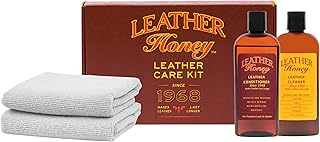
Leather Honey Complete Leather Care Kit (8 oz + 8 oz)
The straightforward pairing of 8 oz cleaner and 8 oz conditioner, sized sensibly for a sofa plus the odd jacket or bag. Buying both together removes the temptation to skip the cleaning step, which is where most restoration attempts go wrong.
Bick 4 Leather Conditioner & Cleaner
Bick 4’s defining trait is that it won’t darken leather, making it the safer choice for pale, cool-toned, or two-tone sofas where a shift in value would upset the whole palette. It cleans lightly and conditions in one pass, leaving a flat, well-behaved finish.
Furniture Clinic Large Leather Care Kit
Two 17 oz bottles plus a sponge and cloth — the sensible pick for large sectionals where smaller kits run dry mid-project. The conditioning protection cream adds a barrier that helps resist future soiling on frequently used seats.
Frequently Asked Questions
How often should I condition a leather sofa?
Every six months suits most homes; every three to four if the sofa sits in direct sun or near a radiator, both of which accelerate moisture loss. Clean first each time — conditioning a dirty surface causes uneven patches.
Will conditioner make my sofa look shiny?
Quality conditioners cure to a satin, not a gloss. Shine almost always comes from over-application, so use thin coats, buff after curing, and check the result under your actual room lighting rather than overhead work light.
Can these products fix existing cracks?
Conditioning restores flexibility and makes fine surface lines far less visible, but it can’t rebuild fibers that have already split. Deep cracks need a repair compound and recoloring, not care products.
Are they safe on white or cream leather?
Leather Honey products are rated for all colors including white, and Bick 4 is specifically formulated not to darken. Still spot-test on a hidden area, since dye and finish vary between manufacturers.
Final Thoughts
For most sofas, the Leather Honey Complete Leather Care Kit covers both steps and delivers that even, light-holding satin surface that makes leather look cared for rather than coated. Choose Bick 4 if your sofa is pale or two-tone and any darkening would be unacceptable, and step up to the Furniture Clinic Large Leather Care Kit if you’re treating a full sectional and need the volume to finish the job in one consistent pass.