Key takeaways
- Measure the gap, not the stool: Subtract seat height from counter height and look for 9 to 12 inches of clearance. Standard kitchen islands at 36 inches want 24 to 26 inch stools; a 42 inch bar needs 29 to 30 inches. Get this wrong and no amount of good design saves the seat.
- Watch how the finish handles warm light: Linen and woven fabrics diffuse light softly and lift the room’s overall brightness — useful in kitchens with only a few pendants. Faux and bonded leather reflect in tighter highlights, which reads sharper and more graphic under directional fixtures but can go flat under diffuse ceiling light.
- Consider the shadow, not just the shape: Barrel and curved backs throw one soft continuous shadow. Open metal frames scatter thin overlapping lines across the floor, which can look busy under multiple light sources but keeps sightlines airy in small kitchens.
- Match seat tone to your color temperature: Beige and cream warm up considerably under 2700K bulbs, sometimes reading yellow. If your kitchen runs cooler at 3000K or above, warm neutrals hold their intended tone far better. Blacks and deep browns are temperature-agnostic and always safe.
- Count the seats you’ll actually use: Sets of four are efficient buys but visually crowd islands under seven feet. Two stools with breathing room between them almost always looks more intentional than four crammed shoulder to shoulder.
What's inside
Most people shop for bar stools the way they shop for a sofa: they look at the fabric swatch, check the height, and hit buy. Then the pendant lights go on at 7 p.m. and the whole island reads wrong. The seats swallow light instead of returning it, shadows pool in the wrong places, and a room that photographed beautifully at noon feels like a hotel lobby after dark. Seating is the largest soft surface at counter height, which makes it one of the most influential ambience decisions in the kitchen — and almost nobody treats it that way.
This guide evaluates 2026’s strongest kitchen bar stools through that lens: how each finish behaves under warm downlight versus daylight, whether the silhouette casts a clean shadow or a cluttered one, how the seat height relates to your pendant drop, and how much visual weight the frame adds to a sightline. Comfort, build quality, and weight capacity are all covered too — a stool that photographs well but wobbles is a failure. But the ranking below reflects something the spec sheets never mention: which of these actually make your kitchen feel good to sit in once the sun goes down.
As an Amazon Associate we earn from qualifying purchases.



🛒 Best Price Today on Amazon
Prime members get fast, free shipping on everything above, plus member-only deals. New members get a 30-day free trial — cancel anytime.
How to Choose a Kitchen Bar Stools (2026)
- Measure the gap, not the stool: Subtract seat height from counter height and look for 9 to 12 inches of clearance. Standard kitchen islands at 36 inches want 24 to 26 inch stools; a 42 inch bar needs 29 to 30 inches. Get this wrong and no amount of good design saves the seat.
- Watch how the finish handles warm light: Linen and woven fabrics diffuse light softly and lift the room’s overall brightness — useful in kitchens with only a few pendants. Faux and bonded leather reflect in tighter highlights, which reads sharper and more graphic under directional fixtures but can go flat under diffuse ceiling light.
- Consider the shadow, not just the shape: Barrel and curved backs throw one soft continuous shadow. Open metal frames scatter thin overlapping lines across the floor, which can look busy under multiple light sources but keeps sightlines airy in small kitchens.
- Match seat tone to your color temperature: Beige and cream warm up considerably under 2700K bulbs, sometimes reading yellow. If your kitchen runs cooler at 3000K or above, warm neutrals hold their intended tone far better. Blacks and deep browns are temperature-agnostic and always safe.
- Count the seats you’ll actually use: Sets of four are efficient buys but visually crowd islands under seven feet. Two stools with breathing room between them almost always looks more intentional than four crammed shoulder to shoulder.
The Best Kitchen Bar Stools (2026)s Reviewed
26″ Modern Barrel Counter Stools with Arms, Set of 2 (Beige)
The barrel silhouette is the most forgiving shape in bar seating — it reads as a soft mass under pendant light rather than a collection of struts, which quiets a busy kitchen considerably. At 450 lbs support per seat, the linen upholstery isn’t decorative padding on a flimsy frame, and the beige diffuses warm light without going dingy.
DUMOS Faux Leather Counter Stools, Set of 4 (Brown, 26″)
Armless and low-backed, these keep the sightline across an island almost completely open, which matters when you have a view or a feature backsplash to protect. The brown faux leather picks up warm highlights in a way that adds visible depth under directional lighting rather than reading as one flat block.
LUE BONA Barrel Counter Stools with Arms, Set of 3 (Beige)
The black metal frame against beige linen creates deliberate contrast that holds up in low light, when softer stools tend to dissolve into the cabinetry. A set of three is an unusually practical count for islands that seat two comfortably and three in a pinch.
Raynesys 24″ Curved Bonded Leather Stools, Set of 2 (All Black)
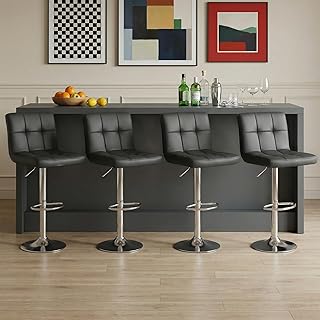
All-black seating absorbs rather than returns light, so these work best in kitchens that already have generous illumination and need visual grounding at the island. The curved seat and heavy-duty metal legs give them real presence, and the finish is genuinely indifferent to bulb temperature.
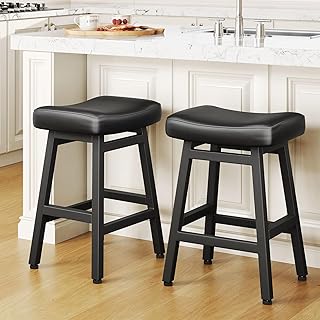
DUMOS PU Leather Saddle Stools, Set of 4 (Inky Black, 24″)
Saddle seats read lower and more casual than backed stools, keeping the counter zone visually calm. The inky black PU catches a crisp highlight along the seat curve under pendants, which is a subtle but effective way to define the island edge after dark.
Frequently Asked Questions
What stool height works with a standard kitchen island?
Most residential islands sit at 36 inches, which pairs with 24 to 26 inch counter-height stools. Taller 42 inch bars need 29 to 30 inch bar-height stools. Always measure your own counter rather than assuming standard.
Do fabric stools survive a working kitchen?
Linen-look upholstery handles daily use better than people expect, especially in mid-tone neutrals that hide light soiling. If you cook heavily or have young kids, faux and bonded leather wipe clean in seconds and are the more realistic choice.
How far apart should stools sit?
Allow 26 to 30 inches between seat centers so nobody’s elbows collide. That means a six foot island comfortably seats two, and you need roughly eight feet before four stools stop feeling cramped.
Will beige stools look yellow under my lights?
Under 2700K bulbs, warm neutrals shift noticeably toward yellow. At 3000K or higher they hold closer to their true tone. Swapping a single pendant bulb to a slightly cooler temperature is a cheap fix if the shift bothers you.
Final Thoughts
For most kitchens, the 26″ barrel stools in beige are the strongest all-round choice — soft light diffusion, a quiet silhouette, and a 450 lb rating that outlasts trend cycles. The LUE BONA set of three is the pick if you want that same softness with enough contrast to stay visible in low light, while the DUMOS faux leather set of four is the best value for anyone furnishing a larger island without sacrificing sightlines.