Key takeaways
- Nightlight temperature and dimming: Look for a warm, low-lumen glow you can fully extinguish. A single fixed white LED will read as a cold spike against lamplight and can pull an infant’s attention across a dark room.
- Mist trajectory, not just output: A 360° or angled nozzle lets you steer vapor away from crib rails, wall finishes, and any downlight or lamp beam where it will visibly hang in the air.
- Noise floor under 30 dB: Anything above that competes with white noise machines and becomes audible during the quiet stretches between sleep cycles.
- Runtime past a single night: Twenty-five hours is the practical minimum; thirty-six lets you refill on your own schedule instead of during a nap.
- Top-fill tanks and matte surfaces: Top-fill means no flipping a full reservoir in the dark, and a matte or softly textured housing avoids the hard specular highlights that make glossy plastic look cheap under warm light.
What's inside
A nursery is the most carefully lit room in most homes, and also the most fragile. You spend weeks dialing in a dimmer, choosing a shade that softens rather than scatters, and positioning a lamp so it never rakes across a crib. Then winter arrives, the forced-air heat runs dry, and a humidifier gets plugged in on top of all that considered work. Suddenly there is a cold blue LED pulsing near the baseboard, a glossy plastic tank throwing hard reflections, and a mist plume drifting into a light beam like stage fog. The air improves. The room stops feeling calm.
That tension is the real buying problem, and it rarely shows up in spec sheets. This guide evaluates infant humidifiers the way I evaluate any object that emits light or occupies visual space in a sleep room: how warm and controllable its glow is, how quietly it sits in the field of view, where its mist actually travels, and whether the whole thing disappears once the lamps go down. Sound levels, runtime, and refill design still matter enormously for a room you enter at 3 a.m., so those are weighted heavily too.
As an Amazon Associate we earn from qualifying purchases.



How to Choose a/an Infant Humidifier (2026)
- Nightlight temperature and dimming: Look for a warm, low-lumen glow you can fully extinguish. A single fixed white LED will read as a cold spike against lamplight and can pull an infant’s attention across a dark room.
- Mist trajectory, not just output: A 360° or angled nozzle lets you steer vapor away from crib rails, wall finishes, and any downlight or lamp beam where it will visibly hang in the air.
- Noise floor under 30 dB: Anything above that competes with white noise machines and becomes audible during the quiet stretches between sleep cycles.
- Runtime past a single night: Twenty-five hours is the practical minimum; thirty-six lets you refill on your own schedule instead of during a nap.
- Top-fill tanks and matte surfaces: Top-fill means no flipping a full reservoir in the dark, and a matte or softly textured housing avoids the hard specular highlights that make glossy plastic look cheap under warm light.
The Best Infant Humidifier (2026)s Reviewed
Frida Baby 3-in-1 Cool Mist Humidifier
Its 60-hour runtime is the longest here by a wide margin, which effectively removes refilling from your nighttime routine, and the diffuser function means one object handles two jobs instead of cluttering a dresser. The nightlight is gentle and the carry handle makes it easy to reposition once you see where mist actually settles in your room.
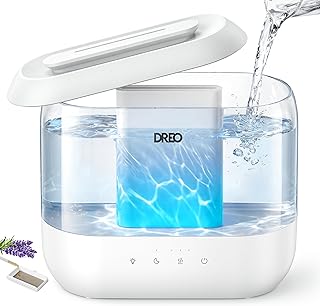
DREO 4L Humidifier (HM311)
A 4L tank at 28 dB with a 36-hour cycle is the most forgiving combination for a large nursery, and the wide top-fill opening genuinely simplifies weekly cleaning, which is where most humidifiers quietly fail. The integrated nightlight is soft enough to serve as a low ambient marker without becoming the brightest thing in the room.
Levoit Top Fill Humidifier, 2.5L
The best choice for smaller nurseries or a corner where a full-size unit would visually crowd a lamp or chair. Twenty-five hours of runtime at 28 dB with auto shut-off covers the essentials, and the compact profile keeps it from casting an awkward silhouette against a wall.
DREO Smart 4L Humidifier
App and voice control is the real ambience advantage: you can adjust output or kill the nightlight without opening the door or crossing a dark room. Same 36-hour, 28 dB foundation as the HM311, with the added benefit of setting humidity targets from bed.
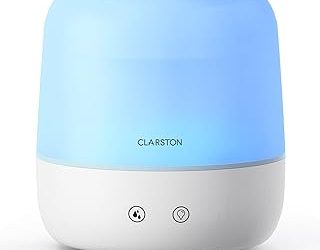
Clarston 2L Cool Mist Humidifier
At 24 dB this is the quietest unit in the group, and the 360° nozzle gives you precise control over where vapor drifts, which matters if a crib sits near a window or a wall sconce. A smart pick for light-sleeping infants in modestly sized rooms.
Frequently Asked Questions
Should the nightlight stay on all night?
Generally no. A brief warm glow helps during feeds and changes, but continuous light in the crib’s line of sight can interfere with settling. Choose a model that switches off independently of the mist.
Where should I place a nursery humidifier?
Three to six feet from the crib, on a hard surface, with the nozzle aimed away from bedding, walls, and any light beam. Never directly beneath a shelf or on carpet.
Is a smaller tank ever better?
Yes. In a small room, the DREO 3L or Clarston 2L will hold target humidity without over-saturating the air or dominating the space visually.
How often does it need cleaning?
Rinse daily, deep clean weekly. Wide-mouth top-fill designs make this realistic rather than aspirational.
Final Thoughts
For most nurseries, the DREO 4L HM311 offers the best balance of capacity, quiet operation, and easy maintenance, while the DREO Smart 4L is worth the upgrade if controlling light and output from outside the room appeals to you. If refill frequency is your main frustration, the Frida Baby 3-in-1 and its 60-hour runtime is hard to beat.