Key takeaways
- Light layers, not one switch: Look for at least two independent sources — a task light for entering and toweling off, plus a low ambient source for the session itself. Cabins with a single bright ceiling fixture force you to choose between seeing and settling.
- Color temperature and control: Warm white in the 2700K range flatters hemlock and keeps the cabin feeling like furniture. Chromotherapy is a bonus, but static-hold mode matters more than the number of colors; a slow fade is restful, a fast cycle is not.
- Heater count and placement: More panels spread across back, sides, calves, and floor deliver steadier warmth than fewer high-wattage units. Check for low-EMF carbon or carbon crystal emitters and confirm the tested figures.
- Footprint plus swing clearance: Measure the cabin, then add the door arc. A 35-inch square unit still needs roughly two feet of open floor in front, and a glass door needs somewhere to reflect that isn’t a window or lamp.
- Assembly and cabin sound: Buckle-clip systems go together in under an hour with two people. Bluetooth speakers vary widely inside a small wooden box, so treat them as background audio rather than a listening system.
What's inside
Most sauna shopping advice fixates on watts and wood species, which leaves out the thing you actually experience for twenty minutes at a stretch: the light. A cabin lit like a walk-in closet reads clinical no matter how good the heat is, and a chromotherapy panel cycling through candy colors on a fixed loop gets tiring by week three. If you’re placing a cabin in a bedroom corner, a finished basement, or beside a home gym, its glow becomes part of that room’s evening character whether you planned for it or not.
This guide evaluates six indoor far infrared saunas through a lighting-and-ambience lens alongside the usual practical checks: heater layout, EMF, footprint, assembly, and how well each one handles the transition from bright setup to a low, restful session. I’ve noted where a reading lamp is genuinely warm enough to read by, where red light therapy panels do real double duty as mood lighting, and where the color options feel considered rather than decorative.
As an Amazon Associate we earn from qualifying purchases.


🛒 Best Price Today on Amazon
Prime members get fast, free shipping on everything above, plus member-only deals. New members get a 30-day free trial — cancel anytime.
How to Choose a/an Indoor Infrared Sauna (2026)
- Light layers, not one switch: Look for at least two independent sources — a task light for entering and toweling off, plus a low ambient source for the session itself. Cabins with a single bright ceiling fixture force you to choose between seeing and settling.
- Color temperature and control: Warm white in the 2700K range flatters hemlock and keeps the cabin feeling like furniture. Chromotherapy is a bonus, but static-hold mode matters more than the number of colors; a slow fade is restful, a fast cycle is not.
- Heater count and placement: More panels spread across back, sides, calves, and floor deliver steadier warmth than fewer high-wattage units. Check for low-EMF carbon or carbon crystal emitters and confirm the tested figures.
- Footprint plus swing clearance: Measure the cabin, then add the door arc. A 35-inch square unit still needs roughly two feet of open floor in front, and a glass door needs somewhere to reflect that isn’t a window or lamp.
- Assembly and cabin sound: Buckle-clip systems go together in under an hour with two people. Bluetooth speakers vary widely inside a small wooden box, so treat them as background audio rather than a listening system.
The Best Indoor Infrared Sauna (2026)s Reviewed
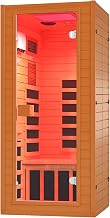
1 Person Far Infrared Home Sauna with 7 Low EMF Carbon Heaters
Seven distributed carbon heaters give this one the most even warmth in the group, and the seven-color therapy lighting holds a single hue instead of only cycling, which makes deep amber or soft red a genuine wind-down setting. The compact frame suits a spare-room corner where you want the cabin to read as a wood cabinet rather than equipment.
35.2″ Single Person Sauna with 1200W Heating Panels
The 25–60°C adjustable range is unusually wide for this size, so you can run gentle 40°C sessions on weeknights and save full heat for post-training. Hemlock construction takes the LED interior light warmly, though the fixture is bright enough that most users will want it off once seated.
Far Infrared Sauna Box with Red Light Therapy
The nine-level carbon crystal heating and integrated red light make this the most flexible pick for anyone stacking recovery protocols, and the red panel doubles as a low-glare ambient source at night. Full-size at 5.9ft, it still stows more easily than a rigid cabin if your space has to do double duty.
Canadian Hemlock 800W Sauna with Tempered Glass Door and Reading Lights
The reading lights here are the standout: positioned and warm enough to actually read a book without squinting, which is rare in this category. Circulation vents and a straightforward control panel round out a cabin that behaves like considered furniture, and assembly is genuinely manageable.
Far Infrared Sauna Cabin with Digital Temperature Control
The most restrained design of the group — plug-in simplicity, digital temperature control, and no visual noise, which is why it works in an apartment bedroom or a home office. If you want the sauna to disappear into the room when it’s off, this is the one.
Frequently Asked Questions
Does chromotherapy lighting actually do anything?
Clinical evidence for specific color effects is thin. What’s better supported is that dim, warm light supports evening relaxation, so the practical value is in having a low ambient option rather than in any particular hue.
Can I use the red light therapy panel and the sauna heat together?
Yes, on units where they’re separately controlled. Many users run red light for the first ten minutes, then switch to heat-only in low light for the remainder.
How much clearance does an indoor sauna need?
Allow four to six inches behind and to the sides for airflow, plus full door-swing clearance in front. Keep it off thick carpet and away from direct window light that will glare on the glass.
Will a 110V sauna trip my breaker?
Most 800–1350W units run fine on a standard 15-amp circuit, but give the sauna its own outlet and avoid sharing with space heaters or a dryer.
Final Thoughts
For the best balance of even heat and genuinely usable lighting, the 7-heater low-EMF cabin is the strongest overall pick, while the 800W Canadian Hemlock model with reading lights wins for anyone who wants to read through a session. Choose the Far Infrared Sauna Box with Red Light Therapy if recovery stacking and flexible placement matter more than fixed cabinetry.