Key takeaways
- Motor Power & Voltage: A 1.75–2 HP motor on a standard 120V circuit suits most ripping and crosscutting in hardwoods up to 2 inches thick. Step up to 3 HP with 230V only if you regularly resaw thick stock or run dado stacks through dense material all day.
- Fence System & Rip Capacity: Look for a T-square–style fence that locks parallel without micro-adjustments after every use. A 30-inch rip capacity handles full sheet goods; anything under 26 inches will push you toward a jobsite compromise.
- Dust Collection: A 4-inch port paired with a riving knife and blade guard captures far more fine particulate than a bare-bones setup. Models with enclosed cabinets channel airflow more effectively than open-stand designs, which matters for shop air quality during long sessions.
- Table Surface & Extensions: Cast-iron wings stay flat and reduce vibration that shows up as burn marks under raking light. Steel wings save weight and cost but may need leveling over time. Extension tables with solid fences are essential if you work with sheet goods.
- Portability vs. Permanence: Wheeled stands and folding bases let you reclaim floor space in a shared garage, but a bolted-down cabinet hybrid will always deliver less vibration and greater accuracy. Decide honestly which shop scenario you’ll live with for years.
What's inside
Picking a hybrid table saw is one of those decisions that quietly shapes every project you’ll build for the next decade, and the sheer number of overlapping specs on the market makes it easy to either overspend on horsepower you’ll never tap or under-buy and regret it the first time you resaw a cabinet door. Between cabinet-level dust collection, fence accuracy measured in thousandths, and motor configurations that assume a dedicated 220V circuit you may not have, the average buyer ends up comparing charts that all start to blur.
This guide cuts through that noise. I spent time evaluating six leading hybrid table saws against the criteria that matter most in a real home shop—cut quality under varying light conditions where blade vibration becomes instantly visible, fence repeatability, dust extraction efficiency, and footprint relative to the workspace you actually have. Below you’ll find a clear buying framework followed by hands-on-style assessments of each model so you can match the right saw to your shop and your craft.
As an Amazon Associate we earn from qualifying purchases.



How to Choose a Hybrid Table Saw (2026)
- Motor Power & Voltage: A 1.75–2 HP motor on a standard 120V circuit suits most ripping and crosscutting in hardwoods up to 2 inches thick. Step up to 3 HP with 230V only if you regularly resaw thick stock or run dado stacks through dense material all day.
- Fence System & Rip Capacity: Look for a T-square–style fence that locks parallel without micro-adjustments after every use. A 30-inch rip capacity handles full sheet goods; anything under 26 inches will push you toward a jobsite compromise.
- Dust Collection: A 4-inch port paired with a riving knife and blade guard captures far more fine particulate than a bare-bones setup. Models with enclosed cabinets channel airflow more effectively than open-stand designs, which matters for shop air quality during long sessions.
- Table Surface & Extensions: Cast-iron wings stay flat and reduce vibration that shows up as burn marks under raking light. Steel wings save weight and cost but may need leveling over time. Extension tables with solid fences are essential if you work with sheet goods.
- Portability vs. Permanence: Wheeled stands and folding bases let you reclaim floor space in a shared garage, but a bolted-down cabinet hybrid will always deliver less vibration and greater accuracy. Decide honestly which shop scenario you’ll live with for years.
The Best Hybrid Table Saw (2026)s Reviewed
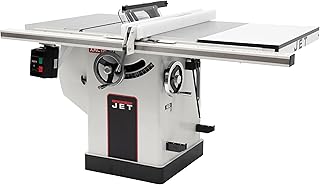
JET Deluxe XACTA 10-Inch (JTAS-10XL30-DX)
The JET XACTA is the saw I’d point a serious home furniture builder toward first. Its 3 HP motor and 30-inch rip capacity handle everything from thin hardwood veneers to thick maple slabs without laboring, and the cast-iron table surface stays dead flat—something you’ll appreciate when raking workshop light reveals any ripple mid-cut. The enclosed cabinet also keeps dust contained remarkably well, meaning cleaner air and cleaner joinery.
Shop Fox W1837 10-Inch Hybrid
Shop Fox’s W1837 strikes an excellent balance between cabinet-saw performance and open-stand accessibility. The 2 HP motor on 120V makes it shop-circuit friendly, while the cast-iron top and substantial trunnion assembly damp vibration enough for clean rip cuts in hardwood. It’s a strong pick if you want cabinet-class build quality without wiring in a dedicated 220V line.
JET ProShop II 10-Inch (JPS-10)
The ProShop II is JET’s value play, and it doesn’t feel like a compromise. Steel wings keep the price honest, but the precision-ground table and rack-and-pinion fence deliver repeatable cuts that rival pricier models. For a woodworker whose shop doubles as a well-lit living space, the compact footprint and quieter 1.75 HP motor keep the environment pleasant during long evening sessions.
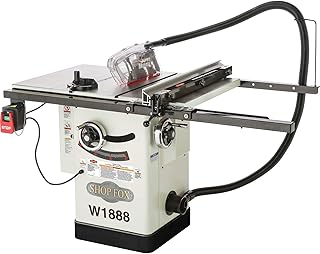
Shop Fox W1888 10-Inch Hybrid
The W1888 builds on Shop Fox’s hybrid platform with a riving knife that installs without tools—a meaningful safety upgrade over older designs. The enclosed lower cabinet improves dust pickup noticeably compared to open-stand models, and the overall fit and finish feels a step above its price bracket. It’s a reliable workhorse for someone building furniture on weekends who values a clean, organized workspace.
Evolution R10TBLX 10-Inch Jobsite
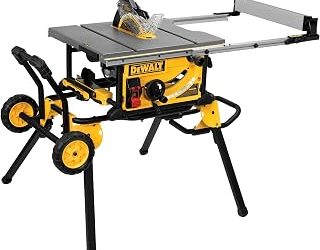
Evolution’s R10TBLX is the wildcard here: a jobsite-class saw with a wheeled stand that punches above its weight class. The included dado plate and zero-clearance throat plate are bonuses you’d normally buy separately, and the 26-inch rip capacity, while tighter than cabinet hybrids, covers most furniture components. If your shop is a corner of the garage that needs to disappear when company arrives, this saw earns its place.
Frequently Asked Questions
Can a hybrid table saw handle hardwoods like walnut and maple?
Absolutely. Models with 2 HP or higher motors rip through 8/4 walnut and maple without bogging down. Pair the saw with a sharp rip blade and let the motor do the work at a steady feed rate rather than forcing material through.
How much space does a hybrid table saw need?
Plan for roughly 50 to 60 inches of width including the extension table and 35 to 40 inches of depth with the fence at full rip. Leave at least three feet of clearance behind and to the left of the saw for infeed and outfeed maneuvering—good lighting in those zones prevents accidents.
Is a 120V hybrid table saw powerful enough for furniture building?
For the vast majority of furniture projects, yes. A 1.75 to 2 HP motor on a standard household circuit handles ripping, crosscutting, and dado cuts in hardwoods up to 2 inches thick. Reserve 230V and 3 HP for commercial-volume work or consistently thick stock.
Do I need a separate dust collector with a hybrid saw?
A dedicated dust collector paired with the saw’s 4-inch port is the single biggest upgrade you can make for shop air quality. Hybrid saws with enclosed cabinets move air more efficiently, but even the best cabinet won’t capture fine dust without external suction pulling it through the system.
Final Thoughts
If I had to narrow the field to three recommendations, the JET Deluxe XACTA leads for anyone who wants no-compromise performance and is ready for 230V wiring. The Shop Fox W1837 is the smartest pick for builders who want cabinet-level quality on a 120V circuit without overspending. And for the space-constrained maker who still demands accuracy, the Evolution R10TBLX offers a surprisingly capable platform that rolls out of the way when the project is done. Any of these three will serve a home furniture shop well for years.