Key takeaways
- Nightlight behavior: Warm and steady beats bright and shifting. Color-changing modes are charming at bedtime and counterproductive at 3 a.m., so the feature only earns its keep if you can lock it on a single warm tone or shut it off entirely without the unit reverting on the next power cycle.
- Panel glow after dark: Every display looks reasonable in a lit showroom. Check the unit in a fully dark room before committing — a bank of white status LEDs can put enough light on the ceiling to keep a light sleeper surfacing. Recessed or dimmable panels are worth paying for.
- Noise floor, honestly measured: The 24 to 28 dB range covers most quality units, but placement matters as much as the spec. A humidifier on a hard surface transmits low-frequency hum through the floor; on a rug or a wood shelf, the same machine disappears.
- Mist column and light interaction: A tall, narrow plume that meets a lamp beam or a gap in the curtains becomes visible fog. A 360-degree nozzle you can angle away from your light sources keeps the output invisible and stops damp patches forming on one wall.
- Refill without turning on the overheads: Top-fill designs let you pour from a jug at arm’s length in near-darkness. Bottom-tank units mean lifting, carrying, inverting, and usually flipping on the big light, which resets a settled room in one move.
What's inside
A nursery lives or dies by its light. You spend weeks choosing a dimmer switch that fades instead of clicks, a lamp that throws warmth up the wall rather than glare down into a crib, blackout panels that hold the room at dusk while the sun does whatever it wants outside. Then you plug in a humidifier and a blue LED the size of a pea starts strobing across the ceiling at 2 a.m. Every carefully layered decision undone by an indicator light nobody thought to test in the dark.
This guide treats the humidifier as what it actually is in a nursery: a piece of always-on equipment sitting inside your lighting scheme. We looked at how each unit behaves after lights-out — whether its nightlight is a usable amber glow or a color-cycling distraction, how bright the control panel stays, whether the mist plume catches stray light and reads as haze on the wall. Dry-air performance still matters, and we cover runtime, tank size, and cleaning access. But the sorting criterion here is ambience.
As an Amazon Associate we earn from qualifying purchases.




🛒 Best Price Today on Amazon
Prime members get fast, free shipping on everything above, plus member-only deals. New members get a 30-day free trial — cancel anytime.
How to Choose a/an Humidifier Nursery (2026)
- Nightlight behavior: Warm and steady beats bright and shifting. Color-changing modes are charming at bedtime and counterproductive at 3 a.m., so the feature only earns its keep if you can lock it on a single warm tone or shut it off entirely without the unit reverting on the next power cycle.
- Panel glow after dark: Every display looks reasonable in a lit showroom. Check the unit in a fully dark room before committing — a bank of white status LEDs can put enough light on the ceiling to keep a light sleeper surfacing. Recessed or dimmable panels are worth paying for.
- Noise floor, honestly measured: The 24 to 28 dB range covers most quality units, but placement matters as much as the spec. A humidifier on a hard surface transmits low-frequency hum through the floor; on a rug or a wood shelf, the same machine disappears.
- Mist column and light interaction: A tall, narrow plume that meets a lamp beam or a gap in the curtains becomes visible fog. A 360-degree nozzle you can angle away from your light sources keeps the output invisible and stops damp patches forming on one wall.
- Refill without turning on the overheads: Top-fill designs let you pour from a jug at arm’s length in near-darkness. Bottom-tank units mean lifting, carrying, inverting, and usually flipping on the big light, which resets a settled room in one move.
The Best Humidifier Nursery (2026)s Reviewed
Levoit Top Fill 2.5L
The most visually discreet unit here — no nightlight at all, minimal panel illumination, and a matte shell that absorbs rather than reflects ambient light. At 28 dB with a 25-hour run and genuine top-fill access, it’s the pick for anyone who has already solved lighting with lamps and wants the humidifier to stay out of the scheme entirely.
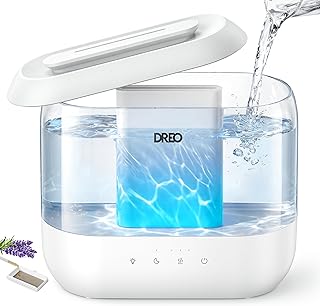
DREO 3L New Edition
Precise humidity control is the real draw: it holds a target reading instead of cycling hard, which keeps mist output low and steady so the plume never thickens into something you can see. The nightlight is soft enough to serve as a low-level floor wash during feeds, and 30 hours means one refill every night and a half.
Vicks 3-in-1 SleepyTime
The color-changing nightlight is the whole proposition here, and it works beautifully as a wind-down cue — a slow shift through soft hues while you read the last book. Just plan on switching it to a fixed warm tone or off once the room settles, and treat the Vapopad tray as an occasional tool rather than a nightly habit.
DREO 4L HM311
Four litres and 36 hours makes this the unit for larger nurseries or homes with aggressive winter heating, where a smaller tank runs dry before dawn. The nightlight is understated, the BPA-free tank is wide enough to reach into with a cloth, and 28 dB holds up even at higher output settings.
Clarston 2L Quiet Sleep
At 24 dB this is the quietest unit on the list, and the 360-degree nozzle lets you aim mist toward a dark corner and away from any lamp or window gap. The 2L tank still delivers 25 hours because output is genuinely gentle — ideal for a small, well-sealed room.
Frequently Asked Questions
Does a nightlight on the humidifier replace a proper nursery lamp?
No. A humidifier nightlight is a low-level orientation glow — enough to find the door, not enough to change a nappy or read by. Keep a dimmable warm lamp for tasks and let the humidifier handle the background layer.
Why does the mist show up as visible haze some nights?
Because something is lighting it. A lamp beam, a streetlight through a curtain gap, or a hallway door left ajar will catch suspended droplets. Lower the output, angle the nozzle away from the light path, or close the gap.
Where should the unit sit in the room?
Two to three feet off the floor, at least a metre from the crib, and away from your primary light source. Elevation helps mist disperse before it settles; distance from lamps keeps the plume invisible.
How often does it actually need cleaning?
Rinse the tank daily, descale weekly with diluted white vinegar. Mineral buildup makes ultrasonic units louder, and noise creep is the first sign a machine has stopped disappearing into the room.
Final Thoughts
For a nursery where the lighting is already dialled in, the Levoit Top Fill 2.5L is the cleanest addition — silent, unlit, and out of the way. The DREO 3L New Edition is the better all-rounder thanks to real humidity regulation and a nightlight restrained enough to leave on, while the Clarston 2L earns its place in small rooms on the strength of that 24 dB floor and an aimable nozzle.