Key takeaways
- Warm steam vs. cool mist: Warm-steam units boil water, which sterilizes it and gives that familiar loosening sensation on the sinuses — ideal for stubborn overnight congestion in a closed bedroom. Cool mist moves more moisture per hour, runs cheaper, and is the safer pick in a child’s room where a hot tank is a hazard.
- Runtime against your actual sleep window: A tank that empties at 3 a.m. leaves you drying out during the exact hours congestion peaks. Look for 12 hours minimum on the mid setting, and treat “50-hour runtime” claims as low-output figures rather than what you’ll get at full mist.
- Noise floor in a quiet room: Ratings around 23–28 dB are genuinely below a whisper, but placement matters as much as spec. Hard surfaces amplify the gurgle of a refilling reservoir, so a rug or fabric-topped nightstand does real acoustic work.
- Night light behavior: This is where most humidifiers fail as bedroom objects. You want an amber or warm-white glow that dims fully off — cool blue LEDs sit right in the wavelength that suppresses melatonin, and a brand-logo indicator you can’t disable becomes a nightly irritation.
- Cleaning access: Any humidifier neglected for a week becomes a mineral-crusted bacterial diffuser. Top-fill designs with a wide opening you can reach into with a cloth get cleaned; narrow-necked tanks that need a bottle brush get skipped.
What's inside
Anyone who has woken at 3 a.m. with one nostril sealed shut knows the problem is rarely the room’s temperature — it’s the air itself. Winter heating and summer air conditioning both strip moisture out of a bedroom, and once relative humidity slips below roughly 30%, the mucous membranes lining your sinuses dry, thicken, and stop draining the way they should. As someone who spends most days thinking about how a room *feels* after dark — the warmth of a bulb, the hush of a fan, the way a bedside glow either settles you or keeps you alert — I’ve come to see humidifiers as part of that same sensory layer. A good one disappears into the room. A bad one hums, glares, and reminds you it exists every time you roll over.
This guide looks at six humidifiers through that lens: how quietly they run, how their night lights behave in a dark room, how much fuss they demand at 11 p.m., and whether they actually hold humidity through a full night’s sleep. I’ve split the field between warm-steam and cool-mist designs, because they suit different rooms and different kinds of congestion, and flagged which ones make the most sense for small bedrooms versus open-plan spaces.
As an Amazon Associate we earn from qualifying purchases.


How to Choose a Humidifier For Sinus Problems (2026)
- Warm steam vs. cool mist: Warm-steam units boil water, which sterilizes it and gives that familiar loosening sensation on the sinuses — ideal for stubborn overnight congestion in a closed bedroom. Cool mist moves more moisture per hour, runs cheaper, and is the safer pick in a child’s room where a hot tank is a hazard.
- Runtime against your actual sleep window: A tank that empties at 3 a.m. leaves you drying out during the exact hours congestion peaks. Look for 12 hours minimum on the mid setting, and treat “50-hour runtime” claims as low-output figures rather than what you’ll get at full mist.
- Noise floor in a quiet room: Ratings around 23–28 dB are genuinely below a whisper, but placement matters as much as spec. Hard surfaces amplify the gurgle of a refilling reservoir, so a rug or fabric-topped nightstand does real acoustic work.
- Night light behavior: This is where most humidifiers fail as bedroom objects. You want an amber or warm-white glow that dims fully off — cool blue LEDs sit right in the wavelength that suppresses melatonin, and a brand-logo indicator you can’t disable becomes a nightly irritation.
- Cleaning access: Any humidifier neglected for a week becomes a mineral-crusted bacterial diffuser. Top-fill designs with a wide opening you can reach into with a cloth get cleaned; narrow-necked tanks that need a bottle brush get skipped.
The Best Humidifier For Sinus Problems (2026)s Reviewed
Vicks Sinus Inhaler with VapoPads
This isn’t a room humidifier at all — it’s a targeted plug-in steam inhaler you hold to your face for a few minutes, and it excels at exactly that narrow job. Pair it with a whole-room unit rather than expecting it to change your bedroom’s humidity, and it earns its place as a fast-acting reset before bed or before speaking at length.
Homvana 3.6L Top-Fill Cool Mist Humidifier
The 23 dB rating holds up in practice, and the top-fill design means you’re not carrying a sloshing tank to the sink at midnight. The grey finish reads more like a small speaker than a medical device, which matters if your nightstand is already crowded, though the four-night claim assumes a low output setting.
Everlasting Comfort 6L Cool Mist Humidifier
The filterless 6L tank is the pragmatic choice for larger or open-plan rooms where smaller units simply can’t keep pace with the air volume. No filter means no recurring cost, but it also means the burden of hygiene falls entirely on you — plan a weekly descale and it will serve you for years.
Vicks Warm Steam Vaporizer
For genuine overnight sinus relief in a small or medium bedroom, warm steam remains the most convincing option, and the 1.5-gallon tank carries a full night without intervention. The night light is soft rather than clinical, and VapoSteam compatibility gives you a medicated option that cool-mist units can’t safely replicate.
8L Top-Fill Humidifier with Night Light and Diffuser
At 2.1 gallons this is built for whole-floor coverage, and the essential oil diffuser plus adjustable night light make it the most deliberately “ambient” unit in this lineup. The black casing recedes into a dark room better than white plastic does — a small detail that keeps it from becoming a glowing focal point.
Frequently Asked Questions
What humidity level actually helps sinus problems?
Aim for 40–50% relative humidity. Below 30% your nasal passages dry and crack; above 60% you invite dust mites and mold, which trigger the same congestion you’re trying to solve. A cheap hygrometer is the single best accessory you can buy.
Should I use tap water?
Distilled water is meaningfully better in cool-mist units, which aerosolize whatever minerals are in the tank and deposit them as white dust across your furniture. Warm-steam vaporizers are more forgiving, since minerals stay behind in the boiling chamber.
Can I add essential oils for congestion?
Only in units with a dedicated diffuser tray or VapoPad slot. Dropping oil directly into a tank degrades plastic seals, voids most warranties, and can clog the ultrasonic plate.
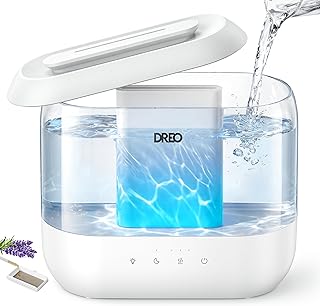
Is a DREO HM311 enough for a large bedroom?
The DREO 4L handles a standard bedroom comfortably at 28 dB with a 36-hour runtime, and its nightlight is well-judged. For rooms beyond about 400 square feet, step up to a 6L or 8L unit rather than running a smaller tank at maximum.
Final Thoughts
For most people whose congestion peaks overnight, the Vicks Warm Steam Vaporizer is the most effective single purchase — it delivers real therapeutic steam with a night light that doesn’t fight your sleep. If you’d rather run cool mist, the Homvana 3.6L is the better-behaved bedside object at 23 dB, while the Everlasting Comfort 6L is the one to choose when the room is simply too large for anything smaller to matter.