Key takeaways
- Humidity Method: Passive sponges, two-way membrane packs, and water-reservoir designs all regulate RH differently. Two-way systems like the D’Addario Humidipak both add and release moisture, keeping the target range steadier than one-directional sponges.
- Placement Compatibility: Soundhole-mounted units live inside the instrument; case-mounted packs work only in a hardshell. Match the humidifier to the case you actually use — a gig-bag player has different constraints than someone storing guitars in a sealed cabinet.
- Monitoring Built In: A humidifier paired with a hygrometer (MusicNomad Humitar ONE, GUITTO GHD-01) eliminates the guesswork of external monitors. Without one, you are trusting feel over data, which is the lighting-design equivalent of choosing bulbs by vibes.
- Maintenance Cycle: Refillable sponges demand weekly attention; pre-charged membrane kits run for weeks hands-free. If your guitars live on a stand in a living room and you travel frequently, a lower-touch system prevents the lapse that actually causes damage.
- Guitar Size and Shape: Clip-on soundhole units must seal adequately without rattling against bracing. Classical and 12-string models may need a different footprint than a slim parlor; always check the manufacturer’s compatibility notes before committing.
What's inside
Anyone who has watched a guitar crack split along the spruce top during January knows the dread: a season of dry air undoes months of careful playing, and the repair bill reminds you that neglecting humidity is never the cheaper option. As a designer who spends his career engineering the invisible qualities of indoor environments, I can tell you that RH fluctuations are the silent enemy of anything built from tone wood.
This guide walks through the six leading guitar humidifiers heading into 2026 — what sets each apart, how they manage moisture differently, and which setup actually fits the way you store and play your instrument. No filler, no ranking gymnastics; just what the specs and real-world behavior reveal.
As an Amazon Associate we earn from qualifying purchases.




How to Choose a Humidifier for Guitars (2026)
- Humidity Method: Passive sponges, two-way membrane packs, and water-reservoir designs all regulate RH differently. Two-way systems like the D’Addario Humidipak both add and release moisture, keeping the target range steadier than one-directional sponges.
- Placement Compatibility: Soundhole-mounted units live inside the instrument; case-mounted packs work only in a hardshell. Match the humidifier to the case you actually use — a gig-bag player has different constraints than someone storing guitars in a sealed cabinet.
- Monitoring Built In: A humidifier paired with a hygrometer (MusicNomad Humitar ONE, GUITTO GHD-01) eliminates the guesswork of external monitors. Without one, you are trusting feel over data, which is the lighting-design equivalent of choosing bulbs by vibes.
- Maintenance Cycle: Refillable sponges demand weekly attention; pre-charged membrane kits run for weeks hands-free. If your guitars live on a stand in a living room and you travel frequently, a lower-touch system prevents the lapse that actually causes damage.
- Guitar Size and Shape: Clip-on soundhole units must seal adequately without rattling against bracing. Classical and 12-string models may need a different footprint than a slim parlor; always check the manufacturer’s compatibility notes before committing.
The Best Humidifier for Guitars (2026) Reviewed
D’Addario Humidipak Two-Way Humidity Control Kit
Still the gold standard for passive, two-way RH control. The Humidipak holds case humidity in the 45–50 % sweet spot without the user babysitting a sponge — it simply works, which is exactly what a well-designed system should do. Ideal for anyone storing instruments in a hardshell case long-term.
Oasis OH-1 Soundhole Humidifier
A slender water-reservoir design that slides into the soundhole and hangs vertically, letting slow evaporation humidify from the inside out. The transparent body makes the water level instantly visible, and a wet sponge beneath the reservoir absorbs evenly with very low maintenance overhead.
MusicNomad Humitar ONE Humidifier & Hygrometer
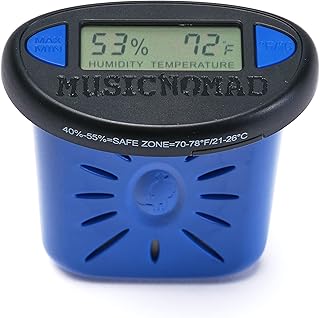
The MN311 marries a slow-release sponge with an integrated analog hygrometer, giving you real-time feedback inside the case. For players who want a single device that both conditions and reports, the Humitar ONE eliminates the extra tool and the uncertainty that comes with it.
Oasis OH-5 Humidifier for Acoustic Guitars
A scaled-up version of the OH-1 with a larger water reservoir and a longer run time between refills. If you own dreadnoughts or jumbos and find yourself refilling smaller humidifiers too often, the OH-5 stretches the maintenance interval meaningfully while maintaining the same straightforward soundhole placement.
GUITTO 2-in-1 Humidifier & Analog Hygrometer
The GHD-01 clips onto the soundhole with a refillable sponge and a no-battery analog gauge, all at a price point undercuts most competitors by a wide margin. It doesn’t feel premium, but it measures accurately enough for casual players who want integrated monitoring without a steep outlay.
Frequently Asked Questions
What humidity level should I target for my guitar?
Most luthiers recommend keeping the relative humidity inside the case between 45 % and 55 %. Below 40 %, finish checking and top cracks accelerate; above 60 %, glue joints and fretboard swelling become the risk. Think of it as the comfort zone your instrument’s wood was never designed to leave.
Do I need a humidifier if I live in a humid climate?
Even in humid regions, air conditioning and seasonal shifts can create sharp swings. A hygrometer on the case — whether standalone or built-in like the Humitar ONE — tells you whether intervention is actually needed or the room is already doing the work for you.
Can I make my own guitar humidifier cheaply?
Damp sponges in sealed bags with pin holes do function, but they offer no two-way regulation and no way to measure output. For a few dollars more, a purpose-built system provides the consistency that DIY setups simply cannot match over months of use.
Final Thoughts
For set-it-and-forget-it reliability, the D’Addario Humidipak remains the benchmark. Players who want integrated monitoring should look straight at the MusicNomad Humitar ONE. And if you need a long-reservoir, low-refill soundhole unit for larger body shapes, the Oasis OH-5 delivers. Pick the one that matches how you actually store your guitar — then let it do the quiet, unglamorous work of keeping the wood stable.