Our Top Picks
 COMFORT ZONE Reversible Twin Window Fan with 3-Speeds9 inch (3-Speed)4.88 x 22.5 x 10.88 inches4.6 PoundsCheck on Amazon
 COMFORT ZONE Reversible Twin Window Fan with 2-Speeds9 inch (2-Speed)5.5 x 11.88 x 22.5 inches5.49 PoundsCheck on Amazon
 Air King 20" 1/6 HP Whole House Window26.25 in. High11.25 x 26.75 x 26.25 inches33.5 poundsCheck on Amazon
If you want the most air moved through a window, a twin-blade fan with independent speed control is the practical choice: the Lasko W09560 suits buyers who want smart controls, the Bionaire twin window fan suits those who value a thermostat and remote, the Holmes dual-blade fan suits budget shoppers, and the Vornado Transom suits short horizontal openings. This guide compares those models using maker-listed features and what independent reviewers report, and it explains how to size and install a window fan so the airflow actually reaches the room.
At a Glance: Window Fans Compared
| Model | Best for | Key stated specs and features | Limits |
|---|---|---|---|
| Lasko W09560 | Smart-home users who want app control | Dual blades, Bluetooth control through the Lasko Connect app, timer, thermostat; about 12 in tall per a reviewer | Bulkier than comparable fans; one outlet is unimpressed by its top airflow |
| Bionaire twin 8.5 in (BW2300-N family) | Everyday cooling with a thermostat | Twin 8.5 in blades, three speeds, built-in thermostat, remote control | Bright display in dark bedrooms; modest top speed |
| Holmes dual-blade twin (HAWF2041-N family) | Budget buyers | Two 8 in blades, two speed settings reported by one outlet, manual reversing | Reviewers call it noisy; reverse mode is described as less effective |
| Vornado Transom | Short windows and transom openings | Needs about 8 in of open window height, four speeds, water-resistant per a reviewer | Horizontal windows only; costs more per unit of airflow |
| Comfort Zone CZ319WT / CZ310R | Wide windows up to about 37 in | Twin blades, remote, three speeds on the CZ310R as reported | Panels may need extra sealing; installation described as fiddly |
What Counts as High Capacity in a Window Fan
Window fans are sold on blade size, number of blades and speed settings rather than a standard airflow label, and makers do not always publish cubic feet per minute. In practice, high capacity means larger or twin blades, independently reversible motors, and a frame that expands to cover the full window opening so the fan pulls air rather than recirculating it around the edges.
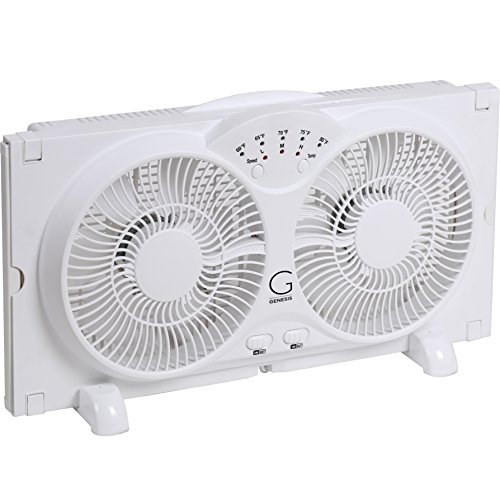
Genesis Twin Fan High Velocity Reversible AirFlow Fan, LED Indicator Lights Adjustable Thermostat & Max Cool Technology, ETL Certified, White (A1WINDOWFAN)
Chosen because it specifies ETL Certified and White (A1WINDOWFAN).
View on AmazonCOMFORT ZONE Reversible Twin Window Fan with 3-Speeds & Expandable Width | Draw Cool Air In or Manually Reverse to Pull Warm Stale Air Out, Removeable Bug Screen, ETL Certified for Home and Kitchen
Chosen because it specifies Removeable Bug Screen and ETL Certified for Home and Kitchen.
View on AmazonCOMFORT ZONE Reversible Twin Window Fan with 2-Speeds & Expandable Width | Draw Cool Air In or Manually Reverse to Pull Warm Stale Air Out, With Bug Screen & Fabric Cover, ETL Certified for Home
Chosen because it specifies With Bug Screen & Fabric Cover and ETL Certified for Home.
View on AmazonAir King 20" 1/6 HP Whole House Window Fan with 3-Speeds and Storm Guards for Circulation and Exhausting Air, 9166, Black
Chosen because it specifies 9166 and Black.
View on AmazonTwin fans let you run one blade in and one blade out. That creates a flow pattern across the room that many reviewers prefer to a single-direction fan, particularly on warm nights when outdoor air is cooler than indoors. If you only need to exhaust hot air from a kitchen or an attic stairwell, a single exhaust direction can be enough.
Lasko W09560: Smart Controls and Dual Blades
Today’s Homeowner gives the Lasko W09560 its smart-features award. The fan has dual blades, a timer, a thermostat and Bluetooth control through the maker’s app. That makes it a good fit for people who want to schedule it for the evening or switch direction from the sofa. Reviewed is less impressed with its raw wind speed, and the Today’s Homeowner entry notes it is bulkier than comparable models, so measure the sill and the space above it before buying.
Bionaire Twin Window Fan: Thermostat and Remote
The Bionaire 8.5 in twin window fan is Today’s Homeowner’s top pick. It has three speeds, a remote-controlled thermostat and an expandable frame; the same outlet’s only complaint is that the LCD can be bright in a dark room. Reviewed names the Bionaire BW2300-N among its favourites, citing an intuitive interface and the included remote, with the caveat that it does not reach very high speeds. A longer five-year limited warranty is listed for the Holmes Bionaire BWF0522M, which is the longest among the models in that roundup.
Pick it if you want automatic on-off cycling to hold a room temperature and do not mind the airflow being moderate.
Holmes Dual Blade: The Budget Option
BestReviews calls the Holmes dual-blade twin its best bang for the buck, while Reviewed rates the HAWF2041-N as its best-value pick. The trade-offs are plainly stated: BestReviews says it is noisy, offers only two speeds and that the reverse function is not very effective. Soundproof Geek’s quiet-fan list still names a Holmes dual 8 in model among its picks, so noise reports vary by unit and window.
It is a reasonable buy for a spare room, workshop or rental where you want an economical way to exhaust heat.
Vornado Transom: For Short Openings
If your window is wide but short, such as a basement window or a transom, the Vornado Transom needs only about 8 inches of vacant height according to a roundup reviewer. It has four speeds and is described as water-resistant, but it only fits horizontally and tends to cost more than twin-blade alternatives. Reviewed lists the Transom AE as one of its two favourites.
Wider Windows and Value Twin Fans
Comfort Zone’s CZ319WT and CZ310R extend to roughly 37 inches wide according to the Today’s Homeowner roundup. They include remotes and twin blades. Reviewers note that side panels may need caulking or foam to seal, and that installation can be tricky on certain window types. The Genesis twin fan is a no-remote budget alternative with independent motors but noisier operation.
Sizing and Installation Notes
- Measure the opening: Record the width and the height of the open sash. Most window fans expand across a range of widths, and some roundup entries list ranges such as 24 to 38 inches or up to 37 inches.
- Window type: Double-hung and sliding windows are the easiest. Casement and awning windows often cannot take a standard box-style window fan.
- Seal the gaps: Use the supplied side panels and add foam or weatherstripping where air can slip around the frame.
- Stability and security: Make sure the fan sits firmly and that the sash cannot slide shut on it. Window fans can also leave a gap that lets insects or rain in, so close the window or remove the fan when it rains unless the model is stated to be water-resistant.
- Placement: Pair a fan in a cooler or shaded room with an open window elsewhere in the house for cross-ventilation.
Care and Safety Notes
- Unplug the fan before cleaning blades and grilles, and wipe with a damp cloth.
- Keep fingers, hair and objects out of the grille. Fans with open guards should not be used in rooms with small children unattended.
- Use only the supplied power cord, avoid extension cords that are not rated for the load, and keep cords away from foot traffic.
- If the fan smells hot, trips a breaker or the cord is damaged, stop using it and have an electrician or the maker’s service team look at it.
Pick X If… Decision Table
| If you… | Pick | Why |
|---|---|---|
| Want app and timer control | Lasko W09560 | Bluetooth, timer and thermostat |
| Want a thermostat and a remote | Bionaire twin window fan | Top pick of Today’s Homeowner |
| Have a small budget | Holmes dual-blade twin | Described as best value by two outlets |
| Have a short, wide opening | Vornado Transom | Needs only about 8 in of height |
| Have a window up to about 37 in wide | Comfort Zone CZ310R or CZ319WT | Twin blades and remote |
Alternatives
- Box fans set in a window can move large volumes of air at a low tier, but they are not designed for the purpose and need a stable support.
- Whole-house fans, such as attic-mounted units, move far more air but require installation and a professional electrician.
- Portable air circulators from Vornado and others move air within a room rather than between indoors and outdoors.
Using a Window Fan Effectively
Timing matters more than most people expect. Run the fan in the evening and overnight when outdoor air is cooler than indoors, then close windows and blinds during the hottest part of the day to keep that cool air inside. If you have two windows, put the fan in the one on the hotter side and set it to exhaust, while keeping a second window open on the cooler side so replacement air flows through the room. Opening interior doors helps air pass through the house.
Pay attention to air quality and noise. If pollen, smoke or road dust is a concern in your area, keep the window closed instead. Street noise comes through the open window along with the air, so bedroom use on a busy road may be unpleasant. A model with variable speeds and a timer can help balance cooling against noise, and thermostat-equipped fans such as the Bionaire switch on and off to hold a set temperature.
Frequently Asked Questions
Do window fans cool a room or just move air?
They bring in cooler outdoor air or push hot indoor air out. They help when the outside air is cooler than inside, and they do not lower temperature the way an air conditioner does.
Should I run one blade in and one out?
Many twin fans let you set each blade independently. Running one in and one out creates a flow pattern that suits many rooms, while two blades exhausting is useful for getting rid of kitchen heat.
Are window fans noisy?
Reviewers report that some models, notably budget dual-blade units, are noisy. Soundproof Geek’s quiet-fan list includes the Bionaire and a Holmes twin, but window, installation and speed all change the sound.
Can I leave a window fan running overnight?
Many people do, but follow the manual. Use a unit in good condition, avoid damaged cords, and make sure it is stable in the window. Models with timers or thermostats can help limit unnecessary running.
Will a window fan fit a casement window?
Most standard window fans are designed for sliding and double-hung openings. Casement and awning windows usually need a different fan style, or an adapter if the maker offers one.
How do I keep rain out?
Remove the fan or close the window when rain is forecast, unless the maker states the model is water-resistant. Even then, follow the maker’s guidance for weather exposure.