Key takeaways
- Adjustment range over adjustment type: Look for a span that covers seated detail work through standing assembly, roughly 28 to 44 inches. That range is what lets you move the surface into your light rather than dragging light to the surface.
- Surface finish and reflectance: Rubberwood and laminated oak tops sit in a mid-tone zone that diffuses light kindly. Glossy or very pale surfaces bounce glare back into your eyes; very dark ones swallow the light you paid for.
- Vertical mounting real estate: A pegboard or upright frame is where your LED bars, magnifier lamps, and gooseneck fixtures live. Benches without it force you into clamp lamps that eat clamp space.
- Frame rigidity at full extension: Load capacity tells you what the bench holds; rigidity tells you whether your light source vibrates when you hammer. Reinforced steel with a wide footprint stays quiet.
- Mobility versus anchoring: Lockable casters let you rotate the bench toward daylight through the day, which is genuinely useful in a garage with one window. Levelling feet win if the bench doubles as a saw station.
What's inside
Most workbench problems are actually light problems in disguise. You set the bench at a fixed height, sit or stand at whatever posture the frame dictates, and then wonder why the solder joint looks fine until you carry it to the window. The culprit is almost always the relationship between your hands, your eyes, and the nearest light source — a triangle that collapses the moment a bench is too low. Drop the surface four inches and your torso becomes the fixture blocking its own task light. Raise it too far and your overhead throws hard shadow straight into the workpiece.
This guide looks at adjustable-height workbenches through the lens I use when designing a room’s ambience: where the shadow falls, how the surface finish handles reflection, and whether the frame gives you somewhere to mount light instead of fighting it. I’ve weighed load ratings and build quality too, because a bench that flexes will never hold a clamp lamp steady. Below are six benches worth your attention, followed by what actually matters when you’re choosing.
As an Amazon Associate we earn from qualifying purchases.


How to Choose a/an Height Workbench (2026)
- Adjustment range over adjustment type: Look for a span that covers seated detail work through standing assembly, roughly 28 to 44 inches. That range is what lets you move the surface into your light rather than dragging light to the surface.
- Surface finish and reflectance: Rubberwood and laminated oak tops sit in a mid-tone zone that diffuses light kindly. Glossy or very pale surfaces bounce glare back into your eyes; very dark ones swallow the light you paid for.
- Vertical mounting real estate: A pegboard or upright frame is where your LED bars, magnifier lamps, and gooseneck fixtures live. Benches without it force you into clamp lamps that eat clamp space.
- Frame rigidity at full extension: Load capacity tells you what the bench holds; rigidity tells you whether your light source vibrates when you hammer. Reinforced steel with a wide footprint stays quiet.
- Mobility versus anchoring: Lockable casters let you rotate the bench toward daylight through the day, which is genuinely useful in a garage with one window. Levelling feet win if the bench doubles as a saw station.
The Best Height Workbench (2026)s Reviewed
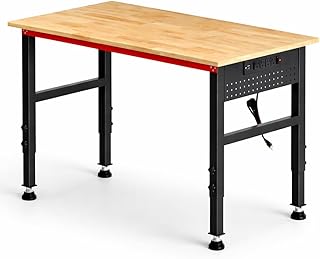
70″ Adjustable Workbench with Power Outlets & Pegboard
The 70-inch rubberwood top is the standout here for anyone lighting a long workflow, because you can zone it — bright task light at one end, soft ambient at the other — without the two pools of light fighting. Integrated outlets and a full pegboard mean your fixtures plug in and mount where you need them instead of trailing cords across the floor.
FLEXISPOT 47.2″ Hand-Crank Workbench
The hand crank gives you fine, unhurried height control, which matters more than it sounds when you’re chasing the exact point where your overhead stops casting shadow over your knuckles. Lockable casters and a drawer make it a tidy fit for a studio corner where the light changes through the afternoon.
48″ Heavy Duty Workbench with Laminated Oak Top
At 2500 pounds capacity with a 1.2-inch laminated oak surface, this is the most planted bench of the group, and the warm oak tone is genuinely flattering under 3000K task lighting. It reads as furniture rather than equipment, which matters if the bench lives somewhere you also relax.
FLEXIMOUNTS 47.2″ Adjustable Workbench
A rubberwood top on a heavy steel frame with drawers and 360-degree wheels, and it takes a strip light along its underside better than most thanks to the clean frame geometry. Well suited to kitchens and craft spaces where you want the bench to disappear when the work stops.
48″ Work Bench with Drawers and Power Outlets
The drawer bank plus onboard outlets makes this the most self-contained option, so your lamps, chargers, and magnifiers all draw from one point. Wheels let you swing it perpendicular to a window when you want raking light across a surface to reveal texture and flaws.
Frequently Asked Questions
What height should I set my workbench to?
Start with your surface roughly at wrist height when standing relaxed, then adjust in half-inch steps until your own shoulders stop shadowing the work. Detail tasks usually want it two to four inches higher.
Do I need built-in outlets?
If you plan on more than one light fixture, yes. Onboard outlets keep cords off the floor and let you reposition a mobile bench without unplugging your whole setup.
Does the top material affect lighting?
Meaningfully. Mid-tone wood tops diffuse light evenly, while glossy laminates create hot spots that force you to keep repositioning your head to see clearly.
Hand crank or feet with fixed adjustment?
Cranks reward frequent switching between seated and standing work. Bolt-set feet are better if you’ll pick one height and keep it, and they hold vibration-sensitive lighting steadier.
Final Thoughts
For a full lit workstation, the 70″ bench with pegboard and outlets gives you the most room to shape light. The 48″ laminated oak model is the pick for warmth and absolute stability, while the FLEXISPOT hand-crank bench suits anyone chasing changing daylight in a smaller space.