Key takeaways
- Roof material and light quality: Fabric tops glow and cast a tint, so pick a neutral beige or gray rather than a saturated color that turns faces green or pink. Hardtop steel and aluminum roofs block light entirely, giving you a dark ceiling you can light deliberately with your own fixtures.
- Interior surface reflectance: Cedar and light-toned frames bounce warm light back down at night and make a single lamp feel like three. Dark gray and black aluminum absorbs it, so plan on more fixtures or uplighting to avoid a cave effect after dusk.
- Power access: A built-in outlet in a post is the difference between a designed lighting scheme and an extension cord running across the lawn. If the frame has no power provision, budget for a weatherproof outdoor outlet nearby before you buy fixtures.
- Curtains and netting as diffusers: Side panels are lighting tools, not just bug screens. Light-colored textilene softens harsh late-afternoon sun into an even wash, while dense mesh cuts glare on a west-facing patio without darkening the space.
- Permanence versus portability: Pop-up canopies suit renters and events but cannot carry pendant fixtures or wiring. Anchored wood and aluminum structures accept hooks, conduit, and mounted lights, which is what you need for a space that works every night.
What's inside
Most gazebo shopping happens at noon, which is exactly the wrong time to make the decision. You stand in the yard, squint at the sun, and buy the structure that blocks the most of it. Then the first evening arrives, you hang a string of bulbs from a beam, and the whole thing reads like a parking structure with fairy lights taped to it. Shade is a daytime problem. Ambience is an all-day one, and the two are solved by different design details.
This guide looks at the gazebo brands worth your money in 2026 through the lens I use on client projects: how a canopy handles light. That means roof translucency and the color it casts on skin, whether the interior surfaces bounce warm light or swallow it, how curtains and netting diffuse a low sun, and whether there is anywhere sane to run power for lamps and fans. Below are the models that hold up when the sun drops.
As an Amazon Associate we earn from qualifying purchases.




How to Choose a Gazebo in 2026
- Roof material and light quality: Fabric tops glow and cast a tint, so pick a neutral beige or gray rather than a saturated color that turns faces green or pink. Hardtop steel and aluminum roofs block light entirely, giving you a dark ceiling you can light deliberately with your own fixtures.
- Interior surface reflectance: Cedar and light-toned frames bounce warm light back down at night and make a single lamp feel like three. Dark gray and black aluminum absorbs it, so plan on more fixtures or uplighting to avoid a cave effect after dusk.
- Power access: A built-in outlet in a post is the difference between a designed lighting scheme and an extension cord running across the lawn. If the frame has no power provision, budget for a weatherproof outdoor outlet nearby before you buy fixtures.
- Curtains and netting as diffusers: Side panels are lighting tools, not just bug screens. Light-colored textilene softens harsh late-afternoon sun into an even wash, while dense mesh cuts glare on a west-facing patio without darkening the space.
- Permanence versus portability: Pop-up canopies suit renters and events but cannot carry pendant fixtures or wiring. Anchored wood and aluminum structures accept hooks, conduit, and mounted lights, which is what you need for a space that works every night.
The Best Gazebo Brands (2026), Reviewed
COOS BAY 11×11 Pop Up Gazebo
The beige canopy is the smart call here, since it filters daylight into a soft neutral rather than throwing a colored cast across the table, and the UPF 50+ fabric keeps midday glare manageable across the full 121 square feet. Treat it as a daytime and event structure: the frame handles battery lanterns and clip-on LEDs well, but it is not built to carry hung fixtures.
PURPLE LEAF Gazebo 10′ x 14′
The 260 GSM textilene netting is the standout for ambience work, diffusing low sun into an even, flattering wash instead of the hard stripes you get from thinner mesh. The 4.7-inch posts and drainage system make it a genuine year-round structure, and those thick posts give you real surface area for mounted sconces.
Backyard Discovery Barrington 14′ x 12′ Cedar
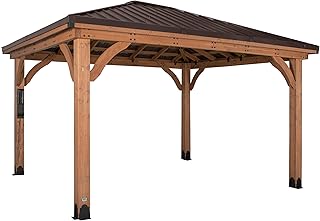
Cedar is the most forgiving material for evening lighting because the grain reflects warm light back into the space, so a modest pendant reads as generous rather than dim. The integrated PowerPort is the feature I care about most: it lets you run dimmable fixtures without a cord snaking across the deck. The Arcadia model offers the same package with a slope roof if a hip profile does not suit your rooflines.
Modern Shade Wood Gazebo 10×12
The pairing of a double galvanized steel roof with yard-dyed curtains gives you unusual control: a fully opaque ceiling for deliberate downlighting, plus fabric sides that soften whatever daylight comes in from the west. The included hooks are sturdy enough for real pendants rather than novelty bulbs.
AirWire 10′ x 12′ Hardtop Aluminum Gazebo
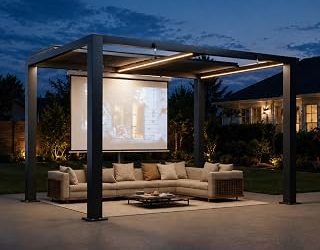
The dark gray aluminum reads sharp and contemporary, but understand that it absorbs light rather than reflecting it, so layer warm uplights at the posts alongside anything overhead. The rustproof frame and double steel roof make it the low-maintenance pick for coastal or high-rain sites.
Frequently Asked Questions
What color temperature should I use in a gazebo?
Stay between 2200K and 2700K. Anything cooler turns a warm cedar interior gray and makes an aluminum frame look industrial. Dimmable fixtures matter more than raw brightness.
Can I hang a chandelier from a gazebo?
From a hardtop wood or aluminum structure, yes, provided you mount to a rafter or use a rated hook and keep the fixture rated for damp locations. Never hang weight from a pop-up canopy frame.
Do hardtop roofs make the space too dark during the day?
They create genuine shade with no light transmission, which most people prefer for dining. If you want a glow overhead, a fabric canopy suits you better.
Is a PowerPort worth paying for?
If you plan any lighting beyond battery lanterns, yes. Retrofitting outdoor power to a finished patio costs considerably more than the feature adds to the purchase price.
Final Thoughts
For a permanent space you will actually use after dark, the Backyard Discovery Barrington is the strongest all-around choice thanks to cedar’s warm reflectance and built-in power. The PURPLE LEAF 10′ x 14′ wins on light diffusion if you want a softer, airier feel, and the AirWire hardtop is the durable modern pick as long as you plan for uplighting to offset that dark frame.