Key takeaways
- Match PSI with headroom: Buy a hose rated above your machine’s output, not level with it. A 3,000 PSI washer paired with a 4,000 PSI hose runs cooler in the jacket and shrugs off the pressure spikes that happen every time you release the trigger.
- Check the fitting standard first: Most consumer units use M22 threads, but the internal pin diameter differs — 14mm and 15mm are not interchangeable. Confirm which your wand and pump take before anything else, since adapters add another leak point.
- Inner diameter drives flow: A 1/4″ ID suits electric and mid-range gas units and stays light in the hand. Step up to 3/8″ only if your machine pushes serious volume, otherwise you’re carrying weight you never use.
- Prioritise cold-weather flexibility: Rubber and steel-braided jackets stay supple in early spring, while cheap PVC turns to coiled wire below 40°F. If you clean before the season warms, this matters more than the PSI number on the box.
- Think about what it drags across: A smooth, abrasion-resistant jacket and a 360° swivel connector keep the line from scoring sealed stone, powder-coated furniture legs, or freshly stained timber. Swivels also stop the twist that eventually splits a hose at the collar.
What's inside
Grime is a light problem before it’s a cleaning problem. Algae on a bluestone patio drinks the warm output of a path light and gives nothing back; a chalky film on composite decking flattens the grazing angle you spent an evening dialing in. I spend most of my working hours deciding how surfaces receive and return light, and the single most dramatic “upgrade” I’ve ever handed a client wasn’t a fixture at all — it was a Saturday morning with a pressure washer and a hose that didn’t fight back. The problem is that the hose is almost always the weak link. Stock hoses coil into memory loops, kink at the trigger, scuff the very stone you’re trying to restore, and turn a two-hour reset into a full day of wrestling.
This guide looks at replacement pressure washer hoses through that lens: reach, flexibility, fitting quality, and how gracefully the line behaves when you’re dragging it across finished surfaces near dusk. Below are the hoses I’d actually keep on a reel, with notes on PSI headroom, inner diameter, and the connection standards that decide whether a hose is a genuine upgrade or a returns-label waiting to happen.
As an Amazon Associate we earn from qualifying purchases.


🛒 Best Price Today on Amazon
Prime members get fast, free shipping on everything above, plus member-only deals. New members get a 30-day free trial — cancel anytime.
How to Choose a Garden Hose For Pressure Washer (2026)
- Match PSI with headroom: Buy a hose rated above your machine’s output, not level with it. A 3,000 PSI washer paired with a 4,000 PSI hose runs cooler in the jacket and shrugs off the pressure spikes that happen every time you release the trigger.
- Check the fitting standard first: Most consumer units use M22 threads, but the internal pin diameter differs — 14mm and 15mm are not interchangeable. Confirm which your wand and pump take before anything else, since adapters add another leak point.
- Inner diameter drives flow: A 1/4″ ID suits electric and mid-range gas units and stays light in the hand. Step up to 3/8″ only if your machine pushes serious volume, otherwise you’re carrying weight you never use.
- Prioritise cold-weather flexibility: Rubber and steel-braided jackets stay supple in early spring, while cheap PVC turns to coiled wire below 40°F. If you clean before the season warms, this matters more than the PSI number on the box.
- Think about what it drags across: A smooth, abrasion-resistant jacket and a 360° swivel connector keep the line from scoring sealed stone, powder-coated furniture legs, or freshly stained timber. Swivels also stop the twist that eventually splits a hose at the collar.
The Best Garden Hose For Pressure Washer (2026)s Reviewed
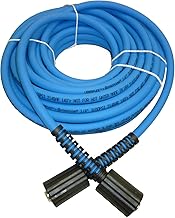
UBERFLEX Kink Resistant Hose, 50 ft
The most obedient hose here — it lies flat almost immediately and takes tight turns around planters and furniture without folding at the bend. At 3,100 PSI with two 22MM fittings included and US manufacturing behind it, it’s the one I’d choose for detail work on delicate surfaces where a kink costs you your rhythm.
YAMATIC 3/8 in Hose, 4000 PSI, 50 ft
Built for higher-volume gas machines, with a steel-braided rubber jacket rated from 15°F to 212°F, so it handles hot-water detergent runs and pre-dawn spring cleaning alike. The 360° swivel quick connect is the standout feature: it eliminates the slow twist that shortens hose life.
McKillans Pressure Washer Hose, 50 ft
A tidy, well-priced steel-braided option with a stainless M22-14mm plug that resists the corrosion you get from hard water and coastal air. The 1/4″ ID keeps it manageable overhead, which counts when you’re rinsing pergola beams or soffits above a seating area.
YAMATIC Steel-Wire Braided Hose, 4000 PSI
Essentially the workhorse version of the 3/8″ model, with 1/4″ ID for lighter handling and both M22-14mm adapters in the box. Its abrasion-resistant jacket is the one I’d trust dragged repeatedly across aggregate and gravel.
YAMATIC 3200 PSI Hose with Brass Fittings
The straightforward replacement for Ryobi, Greenworks, Craftsman and Troy-Bilt owners, with solid brass M22-14mm female ends that seal reliably without overtightening. The black jacket also disappears visually at twilight, which sounds trivial until you’ve had a bright hose photobomb an evening lighting test.
Frequently Asked Questions
Will a longer hose reduce my pressure?
Marginally. Moving from 50 to 100 feet costs you a small amount of pressure at the nozzle, but for most residential machines the loss is imperceptible compared with the convenience of not moving the unit. A 100 ft option with 3/8″ quick connects, rated to 4,200 PSI, is worth it for long driveways and detached patios.
How do I know if I need M22-14mm or 15mm?
Measure the pin inside the threaded fitting on your machine, or check the manual. Both are labelled M22, so the thread will engage either way — the mismatch shows up as a persistent drip you’ll never fully tighten out.
Can I use hot water through these hoses?
Only up to the stated rating, typically 140°F for standard hoses and 212°F for the rubber steel-braided models. Never feed hot water into a cold-water-only pump, regardless of hose rating.
How should I store a pressure washer hose?
Drain it, coil it loosely in wide loops rather than tight figure-eights, and keep it out of direct sun. UV exposure degrades the outer jacket faster than pressure ever will.
Final Thoughts
If you want the most cooperative hose for careful work around finished stone and outdoor furniture, the UBERFLEX 50 ft is the one that keeps you moving. For higher-output gas machines and hot-water cleaning, the YAMATIC 4000 PSI steel-braided hose is the more durable investment, and the YAMATIC 3200 PSI with brass fittings is the sensible, no-drama replacement for anyone running a Ryobi, Craftsman or Greenworks unit. Clean the surface properly, and your existing lighting will look like you rewired the whole garden.