Key takeaways
- Drop height versus fixture plane: Overhead racks with 22″–45″ adjustable drops let you tune how far the platform hangs below the ceiling. Set it so the rack sits above or beside your fixtures, never directly under them, or you turn a shop light into a spotlight on plywood.
- Load rating with real margin: Look for 750 lbs on ceiling racks and 1,000 lbs per shelf on floor units. Buy well above what you plan to store; deflection over time is what causes sagging platforms and stressed anchors.
- Finish and reflectance: Matte black steel absorbs light and visually recedes, which keeps a ceiling from feeling low. Light gray and powder-coated color panels bounce light back down and brighten a dim bay considerably.
- Mounting substrate: Ceiling racks need joists or solid blocking, located and confirmed before you order. Floor shelving only needs level concrete, which makes it the safer pick in a finished or unfamiliar ceiling.
- Vertical zoning: Push long-term storage overhead, keep tools and consumables at eye level, and leave the bench wall clear for task lighting. Rack choice should follow that plan, not fight it.
What's inside
Most garage lighting fails for a reason nobody mentions in the storage aisle: the room gets reorganized without anyone thinking about where the light goes afterward. A single ceiling fixture that once reached the far wall now stops dead against a wall of bins, and the workbench where you actually need to see something sits in a soft gray fog. I spend my working life placing light in rooms, and garages are the space where I see the most avoidable darkness — not from weak fixtures, but from steel and boxes parked directly in the beam path.
This guide looks at garage storage racks with that in mind. Alongside the usual concerns — load rating, mounting, depth, adjustability — I’ve flagged how each option behaves as an object in a lit room: whether it hangs low enough to clip your fixtures, how its finish handles reflected light, and whether it opens up floor space you can then light properly. Choose well and you gain storage and visibility at the same time.
As an Amazon Associate we earn from qualifying purchases.


🛒 Best Price Today on Amazon
Prime members get fast, free shipping on everything above, plus member-only deals. New members get a 30-day free trial — cancel anytime.
How to Choose Garage Storage Racks (2026)
- Drop height versus fixture plane: Overhead racks with 22″–45″ adjustable drops let you tune how far the platform hangs below the ceiling. Set it so the rack sits above or beside your fixtures, never directly under them, or you turn a shop light into a spotlight on plywood.
- Load rating with real margin: Look for 750 lbs on ceiling racks and 1,000 lbs per shelf on floor units. Buy well above what you plan to store; deflection over time is what causes sagging platforms and stressed anchors.
- Finish and reflectance: Matte black steel absorbs light and visually recedes, which keeps a ceiling from feeling low. Light gray and powder-coated color panels bounce light back down and brighten a dim bay considerably.
- Mounting substrate: Ceiling racks need joists or solid blocking, located and confirmed before you order. Floor shelving only needs level concrete, which makes it the safer pick in a finished or unfamiliar ceiling.
- Vertical zoning: Push long-term storage overhead, keep tools and consumables at eye level, and leave the bench wall clear for task lighting. Rack choice should follow that plan, not fight it.
The Best Garage Storage Racks (2026) Reviewed
SafeRacks 3×8 Overhead Rack
The 3-foot depth is the quiet advantage here — narrow enough to run alongside a ceiling fixture rather than under it, so you keep your light throw intact. The 24″–45″ height range gives you genuine room to sequence rack and fixture heights in a tall garage.
FLEXIMOUNTS 4×8 Ceiling Rack, Classic Series
The most predictable install of the group, with clear joist hardware and a 22″–40″ drop that tucks tight to the ceiling when you need clearance. Matte black keeps a large 4×8 platform from reading as a low, heavy slab overhead.
4×8 Overhead Rack, 750 lbs
Built around anti-sag bracing, which matters for a full-width platform loaded with seasonal bins. The 26″–40″ adjustment is slightly shallower at the top end than the FLEXIMOUNTS, so plan your fixture layout before mounting.
4000 lb Heavy Duty Shelving, 60″ W
Four adjustable tiers at 70″ tall keep everything at hand height and demand nothing from your ceiling. The orange uprights read clearly under cool LED light, which genuinely helps when you’re scanning shelves from across the bay.
8-Piece Corner Garage Cabinet System
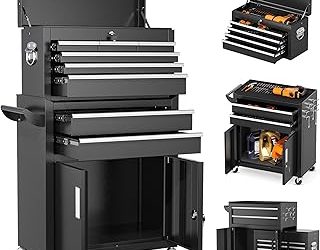
Cabinets, drawers, workbench, and pegboard in a corner layout — the configuration that pairs best with an undercabinet or bench-mounted task light. The black-and-grey scheme is restrained enough that a warm fixture above the bench won’t fight it.
Frequently Asked Questions
Will an overhead rack block my garage light?
It can, easily. Mark your fixture positions on the ceiling first, then site the rack beside that line rather than across it. Where that isn’t possible, add a linear LED on the rack’s underside.
How much ceiling clearance do I actually need?
Measure your tallest vehicle plus opened hatch, add the rack’s minimum drop, then add four inches. Anything less and you’ll be reversing by feel.
Do overhead racks or floor shelves store more?
Overhead racks win on square footage recovered; floor shelving wins on access and lighting simplicity. Most garages benefit from one of each.
Should I choose black or light-colored racks?
Black for ceilings, where you want the structure to disappear. Light gray or bright color for floor units, where reflected light aids visibility.
Final Thoughts
For most garages, the FLEXIMOUNTS 4×8 Classic Series handles overhead storage with the least disruption to your existing light, while the SafeRacks 3×8 is the smarter choice in narrow bays or alongside a run of shop fixtures. If your ceiling is off the table, the 4000 lb 60″ shelving unit delivers serious capacity while keeping every fixture’s beam path completely clear.