Key takeaways
- Capacity vs. Footprint: A 3.2 cu. ft. unit holds more but demands roughly 20 percent more floor width than a 1.6 cu. ft. model. Measure your actual gap — including door-swing clearance — before falling in love with a spec sheet.
- Freezer Compartment: A built-in single-door freezer section adds real utility for storing ice packs, frozen meals, or cooling towels during summer projects. Units without one are strictly refrigeration only.
- Energy Certification: Look for Energy Star ratings or low annual kilowatt-hour consumption. A fridge running 24/7 in an unconditioned garage can quietly inflate your utility bill if efficiency is an afterthought.
- Thermostat Control: Adjustable thermostats let you dial in a cooler range for beverages or a milder zone for snacks and dairy. Fixed-thermostat units remove that flexibility entirely.
- Finish and Surface Presence: In a garage that doubles as workspace, a stainless-look or matte-black surface scatters overhead shop lighting differently than glossy retro enamel. Pick a finish that integrates with your existing palette rather than fighting it.
What's inside
Shopping for a garage mini fridge feels deceptively simple until you realize how many small design decisions ripple outward. A fridge that hums too loudly can turn a creative workshop into a headache. A finish that clashes with your tool wall or shelving setup makes the whole space feel disjointed, and a unit without a freezer means your lunch plan goes sideways by Tuesday. Most buyers click through dozens of listings without a framework for comparing capacity, energy draw, and spatial presence — so they end up with the cheapest option that “looks fine.” Fine is not the vibe you want in a space you actually spend hours in.
This guide cuts through the noise. We evaluated six current-generation garage mini fridges on temperature reliability, footprint efficiency, energy certification, and — because a garage workspace deserves the same attention as any designed room — how each unit reads visually within a utilitarian setting. Our top five picks below cover every budget tier and use case, from retro-charm beverage stations to no-nonsense freezer-equipped workhorses.
As an Amazon Associate we earn from qualifying purchases.



How to Choose a Garage Mini Fridge (2026)
- Capacity vs. Footprint: A 3.2 cu. ft. unit holds more but demands roughly 20 percent more floor width than a 1.6 cu. ft. model. Measure your actual gap — including door-swing clearance — before falling in love with a spec sheet.
- Freezer Compartment: A built-in single-door freezer section adds real utility for storing ice packs, frozen meals, or cooling towels during summer projects. Units without one are strictly refrigeration only.
- Energy Certification: Look for Energy Star ratings or low annual kilowatt-hour consumption. A fridge running 24/7 in an unconditioned garage can quietly inflate your utility bill if efficiency is an afterthought.
- Thermostat Control: Adjustable thermostats let you dial in a cooler range for beverages or a milder zone for snacks and dairy. Fixed-thermostat units remove that flexibility entirely.
- Finish and Surface Presence: In a garage that doubles as workspace, a stainless-look or matte-black surface scatters overhead shop lighting differently than glossy retro enamel. Pick a finish that integrates with your existing palette rather than fighting it.
The Best Garage Mini Fridge (2026)s Reviewed
Igloo 3.2 Cu.Ft. Mini Fridge with Freezer
This single-door Igloo hits the sweet spot for garage buyers who need both refrigeration and a compact freezer without upgrading to a full-size unit. Glass shelves keep things organized, and the generous 3.2 cu. ft. interior swallows a week of meal-prep containers and a dozen cans with room to spare. It is the best all-rounder in this roundup for a reason — practical capacity married to simple, clean lines that sit unobtrusively under a workbench.
FRIGIDAIRE Black Retro Mini Refrigerator (1.6 Cu.Ft.)
The side-mounted bottle opener is a small touch that proves Frigidaire actually thought about garage and workshop life. At 1.6 cu. ft., this retro-styled unit is compact enough for tight corners, and its black enamel finish reads intentional rather than apologetic against pegboard walls and steel shelving. Energy consumption stays low, making it a smart pick for secondary spaces that run all day.
BLACK+DECKER BCRK25V Compact Refrigerator (2.5 Cu.Ft.)
The stainless-look finish on this BLACK+DECKER model catches overhead LED shop lights in a way that feels deliberately industrial rather than accidentally cheap. Energy Star certification and R600a refrigerant signal modern efficiency, while the chiller compartment handles light freezing duties. For garages that serve as both workspace and hangout zone, the 2.5 cu. ft. middle-ground capacity keeps the footprint manageable.
Frigidaire EFR115 Mini Refrigerator (1.6 Cu.Ft.)
Slide-out shelves are the quiet hero here — they make cleaning spills and rearranging for oddly shaped items genuinely easy, which matters more in a garage than you might expect. CFC-free construction and a straightforward black exterior keep this EFR115 honest and functional. It is the unit you pick when simplicity and easy maintenance outrank every other consideration.
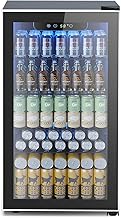
Electactic 130-Can Beverage Cooler (3.2 Cu.Ft.)
If your garage doubles as a game-day headquarters or neighborhood cookout staging area, this beverage-focused cooler is purpose-built for the role. Adjustable temperature control lets you nail the ideal serving range for soda, beer, or wine, and the 130-can capacity means you are not restocking every weekend. The black exterior disappears under counter-height installations, maintaining a clean visual line along a garage bar setup.
Frequently Asked Questions
Can I run a mini fridge in an unheated garage year-round?
Most mini fridges operate within ambient temperatures of 50°F to 80°F. In garages that drop below freezing in winter or exceed 90°F in summer, compressor strain increases and efficiency drops. If your garage experiences extreme swings, look for units with wider operating ranges or consider adding a small space heater or insulated enclosure nearby.
How much electricity does a garage mini fridge use?
Energy consumption varies widely. Energy Star-certified models like the BLACK+DECKER BCRK25V may use as little as 200–250 kWh annually, while non-certified units can climb toward 350+ kWh. Over a year, that difference translates to meaningful savings on your electric bill, especially if the fridge runs around the clock.
Do I need a freezer compartment in my garage fridge?
It depends on your routine. A freezer compartment is invaluable for storing ice packs, frozen lunches, or emergency supplies. If you only plan to keep drinks and packaged snacks cold, a fridge-only unit saves space and typically costs less upfront.
What size mini fridge fits best in a standard garage setup?
A 2.0–2.5 cu. ft. model sits comfortably on most workbench surfaces or narrow shelving units without dominating the visual plane. For dedicated floor placement, 3.2 cu. ft. units offer substantially more storage while still occupying less than two square feet of floor area.
Final Thoughts
For most garage setups, the Igloo 3.2 Cu.Ft. with Freezer delivers the strongest balance of storage, freezer utility, and clean visual presence at a reasonable price point. The BLACK+DECKER BCRK25V is the runner-up for anyone who prioritizes energy efficiency and a polished stainless-look finish that elevates the space. And if your garage is a social hub as much as a workspace, the Electactic 130-Can Beverage Cooler transforms a corner into a legitimate refreshment station without cluttering the room’s design intent.