Key takeaways
- Surface sheen: Glossy faux leather reflects specularly — it mirrors your bulbs as bright points, which reads modern but demands diffused sources or shades. Woven fabrics like twill, linen, and corduroy scatter light instead, softening a room and hiding the hot spots that ruin evening photos.
- Seat height and lamp geometry: A standard 18-inch frame pairs with a 58 to 64 inch floor lamp. Drop to a boneless 12-inch seat and that same lamp now shines into faces rather than across laps. Low seating wants low light: table lamps, sconces at 40 inches, or an arc fixture aimed downward.
- Frame color under warm light: Dark finishes such as Barbados absorb rather than bounce, so they anchor a room but also swallow ambient output. If your space runs dim, budget for one additional light source or accept a moodier result — that’s a legitimate choice, not a failure.
- Conversion clearance: Map the flat-open footprint before buying, then check what it collides with. A futon that unfolds into the throw of a wall sconce or the swing of a pendant creates glare directly above a sleeper’s face.
- Assembly and permanence: No-assembly modular pieces can be repositioned seasonally as daylight angles shift. Bolted hardwood frames are effectively fixed, so commit to their orientation relative to your primary window.
What's inside
Most futon shopping happens under the flat, high-CRI glare of a warehouse showroom or the white cyclorama of a product photo — neither of which resembles the room the piece will actually live in. That gap explains a lot of buyer’s remorse. A frame that read as warm walnut under 4000K retail lighting can turn grey and lifeless beside a west-facing window at 6pm. A faux leather that looked sleek in a lightbox can throw a hard specular streak across your ceiling once a floor lamp lands on it. Futons compound the problem, because they occupy two entirely different lighting scenarios: an upright seat at eye level, and a flat sleeping plane roughly 18 inches off the floor.
I design lighting and ambience for a living, which means I evaluate furniture the way I evaluate a fixture — by how it handles light, holds shadow, and behaves when the room dims. This guide covers six futons across the three families worth considering in 2026: hardwood frame sets, folding metal-frame convertibles, and the boneless floor-level sleepers that have quietly taken over small apartments. Below you’ll find selection criteria grounded in surface behavior and sightlines, followed by reviews of the strongest options.
As an Amazon Associate we earn from qualifying purchases.


How to Choose a Futon (2026)
- Surface sheen: Glossy faux leather reflects specularly — it mirrors your bulbs as bright points, which reads modern but demands diffused sources or shades. Woven fabrics like twill, linen, and corduroy scatter light instead, softening a room and hiding the hot spots that ruin evening photos.
- Seat height and lamp geometry: A standard 18-inch frame pairs with a 58 to 64 inch floor lamp. Drop to a boneless 12-inch seat and that same lamp now shines into faces rather than across laps. Low seating wants low light: table lamps, sconces at 40 inches, or an arc fixture aimed downward.
- Frame color under warm light: Dark finishes such as Barbados absorb rather than bounce, so they anchor a room but also swallow ambient output. If your space runs dim, budget for one additional light source or accept a moodier result — that’s a legitimate choice, not a failure.
- Conversion clearance: Map the flat-open footprint before buying, then check what it collides with. A futon that unfolds into the throw of a wall sconce or the swing of a pendant creates glare directly above a sleeper’s face.
- Assembly and permanence: No-assembly modular pieces can be repositioned seasonally as daylight angles shift. Bolted hardwood frames are effectively fixed, so commit to their orientation relative to your primary window.
The Best Futons (2026) Reviewed
Flamaker Futon Sofa Bed
The black faux leather is the most reflective surface in this roundup, so treat it as a design element: it picks up window light as long, liquid highlights and looks genuinely striking with a single diffused source off to one side. Removable armrests and integrated cup holders make it a capable media seat, though bare overhead bulbs will produce visible glare across the backrest.
Kodiak Monterey Futon Set, Linen Charcoal
Charcoal linen is the most forgiving fabric here — it diffuses light evenly and holds its tone from morning through lamplight without the color shift that plagues mid-brown upholstery. Paired with the dark Barbados frame it reads intentionally dim and enclosed, which suits studios and den corners better than bright open-plan rooms.
Stanford Futon Set, Full Size
The 8-inch twill khaki mattress is the ambience workhorse of the group: a warm, light-scattering neutral that reflects roughly enough to help an underlit room without washing out. It’s the safest pick if you haven’t finalized your lighting plan, since it flatters both 2700K and 3000K sources.
COMAX Boneless Futon Sofa Bed
At 11.8 inches high and 59 inches wide, this low-profile sleeper fundamentally changes a room’s vertical rhythm — it opens sightlines and makes ceilings feel taller, which is a real ambience win in cramped spaces. Plan on table lamps or wall-mounted light rather than tall floor fixtures, which will overshoot it entirely.
78.8″ Convertible Corduroy Futon Sofa
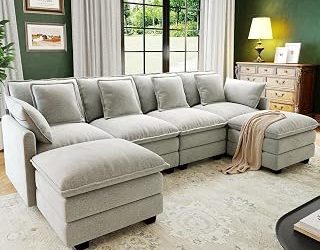
Corduroy’s ribbed pile is the most texturally interesting surface in this lineup: raking light from a low or side source picks out the wales and produces genuine depth instead of flat color. The no-assembly modular build lets you rotate it as seasonal light changes, and the storage pocket keeps remotes and dimmers within reach.
Frequently Asked Questions
Does futon color really affect how bright a room feels?
Yes, measurably. A large light-toned piece like the Stanford’s khaki twill bounces meaningful ambient light back into a room, while a charcoal or black futon absorbs it. In a small space, that difference can be worth an extra lamp.
Is faux leather or fabric better for evening comfort?
Fabric, generally. Faux leather’s specular reflections create bright points that the eye keeps tracking, which subtly works against a restful mood. If you want the leather look, keep sources shaded and indirect.
How do I light a boneless floor futon properly?
Bring the light down to meet it. Sconces around 40 inches, low table lamps, or a downward-aimed arc lamp all keep illumination in the seated zone instead of glaring over it.
Do hardwood frames hold up better than metal folding ones?
Hardwood sets like the Kodiak Monterey are more rigid and generally longer-lived, particularly with frequent conversion. Folding metal frames trade some durability for lighter weight and easier repositioning.
Final Thoughts
For most rooms, the Stanford Futon Set is the smartest default — its khaki twill cooperates with almost any lighting scheme and quietly improves a dim space. Choose the Kodiak Monterey in Linen Charcoal if you want a deliberately moody, enclosed feel with solid hardwood construction, or the 78.8″ corduroy convertible if you’d rather have texture, flexibility, and a surface that comes alive under raking light.