Key takeaways
- Wavelength specificity: Look for stated figures rather than the phrase “red light.” The 660nm and 850nm pairing is the well-studied combination — 660nm works at the skin surface, 850nm penetrates deeper into tissue. Vague marketing language usually signals a low-output decorative LED array rather than a therapeutic panel.
- Panel placement versus seated position: A red light panel mounted high on a back wall aims at empty air above your shoulders. Check the mounting height against the bench height and confirm the emitter faces the torso and legs where you will actually be sitting.
- Chromotherapy versus mood lighting: Full-color chromotherapy systems shift the entire cabin ambience and are worth paying for if you want variability. A single amber reading lamp is not a lighting system, but a warm-CRI lamp positioned low and off-axis often produces a calmer room than a color-cycling ceiling unit.
- Glass area and light behavior: Panoramic tempered glass makes a two-person cabin read considerably larger and lets the room’s ambient light soften the interior. In a bright space it can also wash out the red light entirely, so consider where the cabin will sit before choosing a full-glass front.
- Circuit and heat-up time: Most single-person cabins run 1290W on a standard 120V outlet. Larger two-person units approaching 2000W may need a dedicated circuit. Confirm this before delivery, and treat quoted heat-up times as best-case.
What's inside
Most sauna shoppers evaluate wattage, wood grade, and cabin footprint, then discover after installation that the thing they actually live with every session is the light. A cabin lit like a utility closet will get used twice a week for a month and then hold towels. The interior glow, the color temperature of the reading lamp, the spill from the red light panel onto hemlock grain, the way a tempered glass door either borrows light from the room or dumps it back in — these decide whether the space feels like a retreat or an appliance. Manufacturers rarely spec any of it clearly, which leaves buyers guessing at the single variable that governs whether a 25-minute session feels long or restorative.
This guide reviews the strongest full spectrum infrared saunas available in 2026 with attention to how each one handles illumination alongside the usual heat and build criteria. We look at near-infrared and red light wavelength delivery, chromotherapy implementation, panel placement relative to where your body actually sits, glass area and its effect on perceived room size, and how each cabin behaves in a dim basement versus a bright sunroom. Sizing, EMF handling, and heat-up behavior are covered too, since a beautifully lit cabin that takes 40 minutes to reach temperature still goes unused.
As an Amazon Associate we earn from qualifying purchases.



🛒 Best Price Today on Amazon
Prime members get fast, free shipping on everything above, plus member-only deals. New members get a 30-day free trial — cancel anytime.
How to Choose a Full Spectrum Infrared Sauna (2026)
- Wavelength specificity: Look for stated figures rather than the phrase “red light.” The 660nm and 850nm pairing is the well-studied combination — 660nm works at the skin surface, 850nm penetrates deeper into tissue. Vague marketing language usually signals a low-output decorative LED array rather than a therapeutic panel.
- Panel placement versus seated position: A red light panel mounted high on a back wall aims at empty air above your shoulders. Check the mounting height against the bench height and confirm the emitter faces the torso and legs where you will actually be sitting.
- Chromotherapy versus mood lighting: Full-color chromotherapy systems shift the entire cabin ambience and are worth paying for if you want variability. A single amber reading lamp is not a lighting system, but a warm-CRI lamp positioned low and off-axis often produces a calmer room than a color-cycling ceiling unit.
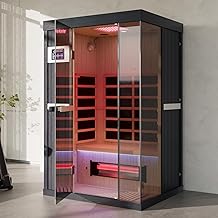
- Glass area and light behavior: Panoramic tempered glass makes a two-person cabin read considerably larger and lets the room’s ambient light soften the interior. In a bright space it can also wash out the red light entirely, so consider where the cabin will sit before choosing a full-glass front.
- Circuit and heat-up time: Most single-person cabins run 1290W on a standard 120V outlet. Larger two-person units approaching 2000W may need a dedicated circuit. Confirm this before delivery, and treat quoted heat-up times as best-case.
The Best Full Spectrum Infrared Sauna (2026)s Reviewed
Full Spectrum Infrared Sauna with Red Light Therapy, 1 Person
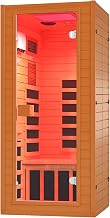
Seven heating panels and a dedicated foot warmer make this the most complete single-person setup here, and the 660nm/850nm emitter sits at a height that actually reaches a seated torso. Canadian hemlock takes the warm light beautifully, though the cabin is narrow enough that the red panel dominates the visual field at close range.
springspa Full Spectrum Infrared Sauna
Essentially the same 1290W seven-panel architecture in a tightly specified 31.5″ x 30.3″ x 67″ footprint, which makes it the easier choice for closets, landings, and awkward corners. Bluetooth speakers are integrated cleanly, and the compact interior means the red light throw stays even rather than hot-spotting.
DYNAMIC SAUNAS Cordoba 2-Person
The Cordoba is the most confident two-person build in this group, with hemlock construction that has held up well across Dynamic’s range and enough interior volume that the lighting reads as ambient rather than aimed. Best suited to a room where you can control the surrounding light, since the cabin’s own glow is subtle.
LTCCDSS Full Spectrum Outdoor Sauna, 4 Person
At 73″ x 48.7″ x 83.5″ this is the only genuinely outdoor, genuinely four-person option here, and the chromotherapy system carries the ambience work that a larger cabin demands. Low-EMF far infrared heaters are the sensible trade for the scale — expect a warm envelope rather than the focused intensity of the smaller units.
2-Person Full Spectrum Infrared Sauna, 1990W
The 12″ x 12″ red light panel is the largest single emitter in this roundup, and at 1990W the cabin reaches temperature noticeably faster than the 1290W builds. Verify your circuit capacity first, since 1990W on 120V leaves little headroom on a shared line.
Frequently Asked Questions
Does the red light panel actually add anything over the infrared heaters?
They do different jobs. Infrared heaters produce the thermal load that drives the sauna response, while 660nm and 850nm emitters deliver targeted photobiomodulation at wavelengths the heaters do not meaningfully output. Whether you value the second effect is a personal call, but it is not redundant.
Will a full-glass door make the sauna feel less private?
Somewhat, though the tradeoff usually favors the glass. A panoramic tempered door removes the coffin-like quality that afflicts small cabins and makes a two-person interior feel closer to three-person. If the cabin sits in a shared space, position it so the door faces a wall.
Can I dim the interior lighting?
Rarely on the reading lamp, which is typically a fixed on/off circuit. Chromotherapy systems generally allow color selection but not true dimming. Practical workaround: control the room’s ambient light instead, since interior perception depends heavily on what spills in through the glass.
How long until the cabin is usable?
Plan on 20 to 30 minutes for 1290W single-person units and slightly less for the 1990W builds, though ambient room temperature moves these numbers considerably. Basement installations in winter will run at the long end.
Final Thoughts
For most buyers the springspa single-person cabin is the smartest entry — the footprint is honest, the seven-panel layout is proven, and the compact interior keeps the red light even. Step up to the DYNAMIC SAUNAS Cordoba if you want two-person space with build quality that will still feel right in five years, or the LTCCDSS four-person outdoor unit if you have the yard and want chromotherapy doing real ambience work at scale.