Key takeaways
- Finish and reflectance: Brushed stainless diffuses light softly and hides fingerprints; mirror-polished panels act as an accidental mirror for every downlight above them. Matte black absorbs spill and visually recedes — useful if the unit sits in a sightline you’d rather not emphasize.
- Indicator glow: Check what color the status lights are and whether they stay lit. Cool white and blue LEDs read as clinical against warm 2700K kitchen lighting. Units with a single amber or dimmable indicator blend far better into an evening room.
- Noise as ambience: Compressor pitch matters more than decibel rating. A low hum disappears under a room’s baseline; a high whine cuts through it. If the unit sits near seating, prioritize models people describe as low and steady.
- Placement and clearance: Undercounter units need side and rear breathing room and a drain plan. Countertop models need vertical clearance for the lid — and they’ll occupy prime counter space that may already be lit for prep work.
- Ice shape and use case: Bullet ice chills fast and suits everyday drinks. Solid clear cubes melt slowly and look better in a glass under warm light. Match the shape to whether you’re making iced coffee or cocktails.
What's inside
Most ice maker shopping happens on a spec sheet: pounds per day, cubes per cycle, bullet or nugget. That’s fine as far as it goes, but it ignores the part you actually live with. I spend my days planning how rooms read after sundown — where the warm pools sit, what the cool spill from an appliance does to a wood tone, which surfaces bounce light and which absorb it. An ice maker is a small machine that emits sound, light, and reflection into your kitchen or bar area every night. Choose it badly and you get a blue LED throwing an aquarium cast across your walnut counter at 10pm, plus a compressor cycling under the conversation.
This guide sorts the current field by how these units behave as fixtures, not just as producers of frozen water. I’ve grouped built-in undercounter units, countertop portables, retro-styled compacts, refrigerator ice maker kits, and full French door refrigerators — noting where each one sits visually, how loud it runs, and what its finish does under typical kitchen lighting. Below are the picks worth your attention this year.
As an Amazon Associate we earn from qualifying purchases.


🛒 Best Price Today on Amazon
Prime members get fast, free shipping on everything above, plus member-only deals. New members get a 30-day free trial — cancel anytime.
How to Choose a Fridge Ice Maker (2026)
- Finish and reflectance: Brushed stainless diffuses light softly and hides fingerprints; mirror-polished panels act as an accidental mirror for every downlight above them. Matte black absorbs spill and visually recedes — useful if the unit sits in a sightline you’d rather not emphasize.
- Indicator glow: Check what color the status lights are and whether they stay lit. Cool white and blue LEDs read as clinical against warm 2700K kitchen lighting. Units with a single amber or dimmable indicator blend far better into an evening room.
- Noise as ambience: Compressor pitch matters more than decibel rating. A low hum disappears under a room’s baseline; a high whine cuts through it. If the unit sits near seating, prioritize models people describe as low and steady.
- Placement and clearance: Undercounter units need side and rear breathing room and a drain plan. Countertop models need vertical clearance for the lid — and they’ll occupy prime counter space that may already be lit for prep work.
- Ice shape and use case: Bullet ice chills fast and suits everyday drinks. Solid clear cubes melt slowly and look better in a glass under warm light. Match the shape to whether you’re making iced coffee or cocktails.
The Best Fridge Ice Maker (2026)s Reviewed
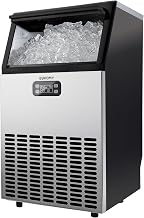
EUHOMY Commercial Undercounter Ice Maker (100lbs/24H)
This is the pick if you’re building a genuine bar zone — 100 lbs daily output and 33 lbs of storage means you stop thinking about ice entirely. The stainless front reads as a satisfying vertical break in a run of cabinetry, and because it’s undercounter it stays below your task lighting rather than reflecting it back.
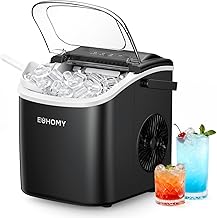
EUHOMY Countertop Ice Maker with Handle (26lbs, Black)
Nine cubes in six minutes, a carry handle, and auto-cleaning make this the most flexible option here — kitchen island one week, RV galley the next. The black housing is the practical choice for a lit counter, since it swallows glare instead of throwing it.
Frigidaire Retro Compact Ice Maker (Bullet, Black)
The rounded retro shell has real presence, which is either the point or the problem depending on your kitchen. Put it where it can be seen and lit deliberately — a corner with a warm sconce or under-shelf strip — and it functions as an object rather than an appliance.
Frigidaire IM117000 Top-Mount Ice Maker Kit
The invisible solution. If your freezer is ice-maker-ready, this retrofit kit adds automatic ice production with zero footprint, zero added noise signature, and nothing new to light around. Verify your model’s compatibility before ordering.
18 Cu.Ft. French Door Refrigerator with Ice Maker
A frost-free French door unit with a freezer drawer, three cooling modes, and integrated ice — the cleanest answer if you’re replacing a refrigerator anyway. Consolidating ice into the fridge keeps your counters clear and your lighting scheme uninterrupted.
Frequently Asked Questions
Do countertop ice makers need plumbing?
No. You fill the reservoir manually, which is why they work in RVs and offices. Undercounter and built-in units generally require a water line and drain.
Why does my ice look cloudy?
Fast-freeze cycles trap air, producing opaque bullet ice. It chills perfectly well but won’t have the glassy clarity of slow-frozen cubes. Filtered water helps slightly.
How loud are these in a quiet room?
Expect intermittent compressor noise plus a clatter when ice drops into the basket. Countertop units are noticeably more audible than undercounter models simply because they’re closer to ear level.
Can I use one in an enclosed cabinet?
Only if it’s rated as built-in. Freestanding units vent from the sides or rear and will overheat, run inefficiently, and shorten their own lifespan in a sealed enclosure.
Final Thoughts
For a dedicated bar or entertaining space, the EUHOMY Commercial Undercounter unit is the clear choice — high output, tidy stainless face, and it stays out of your sightlines. If you want flexibility without committing to plumbing, the EUHOMY Countertop model in black is the most livable everyday pick. And if a refrigerator upgrade is already on the list, the 18 Cu.Ft. French Door unit folds ice into your existing footprint and leaves your counters and lighting untouched.