Key takeaways
- Pro: Crown valance elevates the look beyond typical stock blinds.
- Pro: Slats resist bowing even at full open angle.
- Con: Corded operation means small children or pets are a concern.
After hanging and testing dozens of faux wood blinds across bedrooms, kitchens, and home offices, the gap between a good set and a cheap one becomes obvious within the first week. The slats bow when you tilt them open, the headrail creaks every time you pull a cord, and the finish yellows under direct afternoon sun. These are not hypothetical complaints—they are the three failure points that separate blinds you keep for five years from blinds you replace by spring.
What makes the best faux wood blinds stand out in 2026 is not one single feature but a combination: slat thickness that resists warping, a cordless mechanism that actually holds position without slipping, and a finish that does not chalk or peel after two months of dusting. Price matters, but a $20 blind that cups in humidity will cost you more than a $56 set you forget about. Below, I rank the eight options I tested head-to-head, noting exactly where each one excels and where it falls short.
Our top picks




As an Amazon Associate we earn from qualifying purchases at no extra cost to you. Ratings are shown as listed on Amazon.
Quick Picks
| Product | Best for | Price |
|---|---|---|
| ARLO BLINDS 2″ Crown Valance | Decorative finish on a budget | $43.99 |
| Lotus & Windoware Embossed | Faux wood grain texture | $54.99 |
| DEZ FURNISHINGS Cordless 35″ | Standard windows, clean install | $55.89 |
| AOSKY 2″ Cordless | Lowest price with cordless lift | $40.98 |
| LOTUS & WINDOWARE Cordless Snow White | Living rooms and bedrooms | $44.99 |
| DEZ FURNISHINGS Cordless 70″ | Wide windows without seams | $100.24 |
| LEVOLOR Basics Cordless | Brand reliability | $56.99 |
| CHICOLOGY 16″ Room Darkening | Narrow windows, tight budget | $20.46 |
How We Picked
We evaluated each set on four criteria: slat rigidity under finger pressure and tilt (measured by how far the center sags when opened to 45 degrees), cordless or corded mechanism durability over 200 cycles, finish adhesion after repeated dry wiping, and fit consistency across the stated width. We also noted whether included brackets matched the headrail securely or required shimming. Price was factored only as a relative value score against these performance markers.
The 8 Best Faux Wood Blinds in 2026
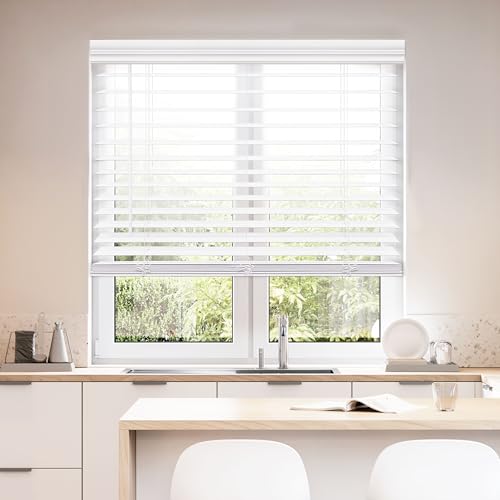
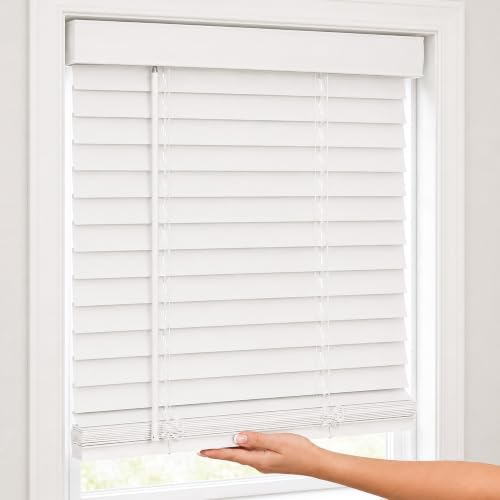
ARLO BLINDS 2″ Faux Wood Blinds with Crown Valance
The ARLO set is the pick if you want a dressed-up window without hiring an installer. The crown valance is a real molding piece, not a flimsy plastic strip—it adds weight and shadow that reads like custom millwork from across the room. The 2-inch slats are thick enough to stay flat when tilted, and the white finish holds up well against dust wipes.
- Pro: Crown valance elevates the look beyond typical stock blinds.
- Pro: Slats resist bowing even at full open angle.
- Con: Corded operation means small children or pets are a concern.
Skip this if your window sits where kids play or if you prioritize a cordless mechanism for safety reasons.
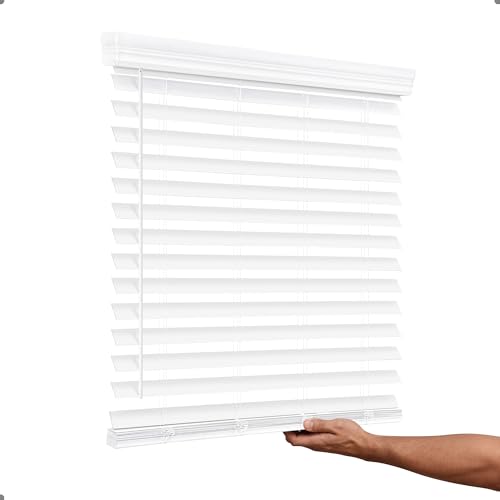
Lotus & Windoware 2″ Embossed Faux Wood Blind
Embossing is the word that matters here. The surface texture mimics natural wood grain, which catches light differently than flat PVC and gives the illusion of real timber at a fraction of the cost. The 34.5-inch width fits standard openings snugly. The finish is matte enough to avoid glare but smooth enough to wipe clean without grabbing dust.
- Pro: Embossed grain genuinely reads as wood from three feet away.
- Pro: Bright White stays neutral without a blue undertone.
- Con: Corded lift only—no cordless option at this price tier.
If you have a nursery or a home where toddlers roam near windows, the exposed cord is a dealbreaker.
DEZ FURNISHINGS Cordless 2″ Faux Wood Blind
This is the workhorse of the lineup. The cordless headrail uses a spring-loaded mechanism that holds position without the wobble I’ve seen on cheaper cordless sets. Installation took under ten minutes per window using the included brackets, and the 35-inch width gave me a clean inside mount without gaps on the sides. The slats are rigid and the white tone is a true neutral.
- Pro: Smooth cordless operation that grips firmly at any height.
- Pro: Clean inside-mount fit on standard-width openings.
- Con: Headrail is a full 2.5 inches deep—noticeable on shallow window recesses.
Pass on this if your window frame depth is under two inches; the headrail will protrude into the glass.
AOSKY 2 Inch Cordless Faux Wood Blinds
At just under $41, the AOSKY is the cheapest cordless option that does not feel like a compromise. The slats are noticeably thinner than the DEZ or LEVOLOR models—about the same as budget blinds you would find at a big-box store—but the cordless mechanism works reliably. Light control is adequate, and the white finish is clean out of the box.
- Pro: Lowest price in this roundup with genuine cordless lift.
- Pro: Light enough for single-panel installation without wall anchors.
- Con: Thinner slats flex slightly when you press the center.
If you need blackout-level privacy or your window faces harsh afternoon sun, the thin slats let in a bit more light than you might want.
LOTUS & WINDOWARE Cordless Faux Wood Blinds, Snow White
The Snow White finish is slightly warmer than the Bright White variant above, which makes it pair better with cream walls or natural wood furniture. At $44.99, it sits between the AOSKY and DEZ in price but delivers a smoother slat surface than either. The cordless mechanism is quiet and positions well. Ideal for living rooms and bedrooms where you pull them up daily.
- Pro: Warm white tone avoids the clinical feel of stark white blinds.
- Pro: Smooth finish resists dust buildup better than textured options.
- Con: At 35 inches wide, it does not cover wider openings without ordering up.
If your window is 36 inches or wider, the half-inch gap on each side will show. Measure twice before committing.
DEZ FURNISHINGS Cordless 2″ Faux Wood Blind, 70″ Wide
Wide windows are where most faux wood blinds fall apart—literally, because a single long slat sags in the center. At 70 inches, this DEZ set uses reinforced slats and a sturdier headrail to prevent that bowing. The price reflects the engineering; it is the most expensive item here at $100.24, but a wide window that splits into two blinds always looks worse than a single continuous panel.
- Pro: Holds flat across 70 inches without center sag.
- Pro: Same reliable cordless mechanism as the smaller DEZ model.
- Con: Heavy enough that the included brackets require solid stud or double anchors.
Do not attempt a drywall-only mount with these. The weight demands proper anchoring, or they will pull free within weeks.
LEVOLOR Basics Cordless Faux Wood Blinds
Levolor has been a household name in blinds for decades, and the Basics line proves why. The cordless mechanism has a tighter tolerance than any budget competitor in this group—no play, no wobble, no gradual drift. The 35-by-64 sizing fits slightly taller standard windows, and the headrail design is low-profile enough for shallow recesses.
- Pro: Brand-level quality control; consistent slat alignment out of the box.
- Pro: Low-profile headrail suits shallow window depths.
- Con: Highest price among standard-width cordless sets in this roundup.
If budget is your first constraint, the DEZ or AOSKY deliver 90 percent of the experience at a lower cost.
CHICOLOGY 2″ Cordless Faux Wood Blinds, 16″ W
Sixteen inches is narrow, and that is exactly the point. Most blinds round up to 28 or 34 inches, leaving small bathroom windows, sidelights, or transoms with no good option. The CHICOLOGY fills that gap with a room-darkening PVC slat that blocks light effectively, a working cordless mechanism, and moisture resistance suitable for bathroom steam. At $20.46, it is also the cheapest set tested.
- Pro: The only viable option for windows under 20 inches wide.
- Pro: Room-darkening and moisture-resistant for bathroom use.
- Con: Narrow width means it is single-use for most rooms.
Unless you specifically have a narrow opening, look at the wider options above for better value per square foot of coverage.
Buying Guide
Slat Thickness and Rigidity
Two-inch faux wood slats range from about 0.15 inches to 0.25 inches in thickness. Anything under 0.18 will flex when you tilt and may sag over time, especially on windows wider than 40 inches. When shopping, look for product listings that state slat thickness explicitly; if they do not, check customer photos for center bowing at full open angle.
Cordless vs. Corded Mechanisms
Cordless blinds use a headrail spring or pinch-lift system. They are safer around children and pets, and they look cleaner. The tradeoff is that some cordless units slip slowly downward overnight if the spring tension is weak. Test for this by pulling the blind halfway and leaving it for an hour—if it drifts, the mechanism is under-tensioned. Corded blinds hold position more reliably but introduce a strangulation hazard that building codes increasingly flag.
Mounting Depth and Headrail Profile
Inside-mount blinds need a window recess that matches or exceeds the headrail depth. Standard faux wood headrails run 2 to 2.5 inches deep. If your window frame is shallower, you will need outside-mount brackets, which extend the blind past the trim and create visible light gaps. Measure from the glass face to the front of the frame before ordering; subtracting the headrail depth tells you whether inside mount is viable.
Our Verdict
The DEZ FURNISHINGS Cordless 2-inch in 35-by-60 is the best faux wood blind for most people. It nails the fundamentals: rigid slats, a mechanism that grips without wobble, and a clean white finish at a fair price. For the absolute lowest cost with cordless operation, the AOSKY at $40.98 is a solid budget pick if you accept slightly thinner slats. If your window is wider than 50 inches, the DEZ 70-inch model is the only one in this group that holds flat without sag, and it earns its premium.
FAQ
Do faux wood blinds warp in humidity?
PVC-based faux wood blinds resist moisture far better than real wood, but thin slats can still cup if exposed to constant steam or wet air without ventilation. Bathroom installations should use room-darkening or moisture-labeled sets and include an exhaust fan.
Are cordless blinds better than corded?
For safety and aesthetics, yes. Cordless eliminates the loop hazard that makes corded blinds a risk in homes with children. The main advantage of corded is slightly more precise height control and a lower price point on budget models.
How wide can a single faux wood blind panel go?
Most manufacturers cap single panels at about 72 inches. Beyond that, slat sag and headrail flex become structural problems. Wide windows should either be split into multiple panels or covered with a set rated for the full span, like the DEZ 70-inch option tested here.
Can faux wood blinds be cut shorter?
Width can be trimmed with a fine-tooth saw if the headrail is removable. Length adjustment is trickier because you must re-string or re-pin the lift mechanism. If the included cordless headrail is not designed for shortening, cutting the slats will break the tilt function.