Key takeaways
- Match output to volume, not floor area: Coverage claims assume standard eight-foot ceilings. Vaulted rooms, open stairwells, and lofts need roughly 30–50% more capacity than the square-footage number suggests.
- Check the light behavior before the specs: A humidifier running overnight in a bedroom is a light source. Look for full display dimming or blackout in sleep mode, and treat blue LEDs as a strike against a nursery or bedside placement.
- Tank size determines refill rhythm: A 3L tank at high output may need daily attention. Larger 5–10L reservoirs stretch to multi-day intervals, which matters more than it sounds when the unit sits behind furniture.
- Plan for filter replacement: Wicks accumulate the minerals your air never sees. Budget for a change every one to three months depending on water hardness, and confirm replacements are actually stocked.
- Prioritize auto-dry and top-fill: Auto-dry cycles the fan after shutoff to prevent a damp wick from turning musty. Top-fill saves you from wrestling a full tank across a room.
What's inside
Anyone who has spent time tuning the mood of a room knows how quickly dry air undermines the work. Warm lamplight goes brittle, wood finishes lose their soft sheen, and the whole space starts to feel static rather than settled. Winter heating is the usual culprit, and the standard fix — an ultrasonic humidifier — often trades one problem for another: a visible plume that catches every beam in the room, plus a chalky film of white dust across shades, shelves, and matte-painted walls.
Evaporative humidifiers work differently. A wick draws water up, a quiet fan moves air across it, and moisture leaves as invisible vapor while minerals stay behind in the filter. No fog, no dust, no interference with the light you have carefully arranged. This guide covers six evaporative models worth considering in 2026, judged on output, coverage, noise floor, and — a detail most reviews skip entirely — how their indicator lights and displays behave after dark.
As an Amazon Associate we earn from qualifying purchases.


How to Choose an Evaporative Humidifier (2026)
- Match output to volume, not floor area: Coverage claims assume standard eight-foot ceilings. Vaulted rooms, open stairwells, and lofts need roughly 30–50% more capacity than the square-footage number suggests.
- Check the light behavior before the specs: A humidifier running overnight in a bedroom is a light source. Look for full display dimming or blackout in sleep mode, and treat blue LEDs as a strike against a nursery or bedside placement.
- Tank size determines refill rhythm: A 3L tank at high output may need daily attention. Larger 5–10L reservoirs stretch to multi-day intervals, which matters more than it sounds when the unit sits behind furniture.
- Plan for filter replacement: Wicks accumulate the minerals your air never sees. Budget for a change every one to three months depending on water hardness, and confirm replacements are actually stocked.
- Prioritize auto-dry and top-fill: Auto-dry cycles the fan after shutoff to prevent a damp wick from turning musty. Top-fill saves you from wrestling a full tank across a room.
The Best Evaporative Humidifiers (2026) Reviewed
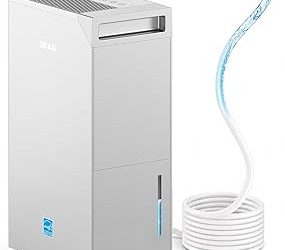
DREO Smart Evaporative Humidifier, 10L
With 800ml/h output and a 50-hour runtime, this is the one to reach for in great rooms and open-plan spaces where smaller units simply lose the argument. The 10L tank means you refill twice a week rather than nightly, and the display dims low enough not to compete with ambient lighting.
Levoit Evaporative Humidifier for Bedroom & Baby
The standout feature here is genuinely thoughtful: a blue-light-free nightlight that emits warm rather than cool tones, so it works as gentle wayfinding light in a nursery instead of a sleep disruptor. Dual air and water filtration plus a separate remote humidity sensor make it the most precise option on this list.
LAVIEAIR 5L Top-Fill Humidifier
A well-judged middle ground for bedrooms up to 300 sq ft, with a 5L tank stretching to 48 hours and a top-fill design that removes the usual awkward carry. Mist-free operation keeps bedside lamps and dark nightstands free of residue.
AEOCKY 420mL/h Mist-Free Humidifier
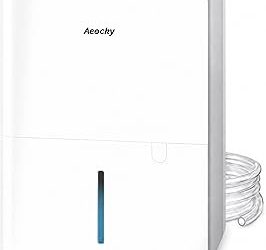
The self-cleaning cycle and dry-filter function address the maintenance problem that quietly kills most evaporative units. Sleep mode is properly dark, making this a sensible pick for a room where you have already dialed the lighting down to a warm low glow.
Vornado Evap40
Vornado’s vortex airflow distributes moisture across a full 1,000 sq ft rather than pooling it near the unit, and the mechanical humidistat with three fan speeds means no app, no pairing, no glowing screen. The 4-gallon dual-tank design is the most refill-friendly here.
Frequently Asked Questions
Do evaporative humidifiers really eliminate white dust?
Yes. Minerals are captured in the wick filter rather than aerosolized, so nothing settles on furniture, fabric shades, or picture glass. That is the primary reason to choose evaporative over ultrasonic in a carefully finished room.
Are they louder than ultrasonic models?
Slightly, since they use a fan. Most run around 25–35 dB on low, which reads as soft airflow rather than noise. On the highest setting, expect something closer to a small desk fan.
Can I use tap water?
Yes, and that is a real advantage. Hard water shortens filter life but causes no dust or buildup in the room itself.
What humidity level should I target?
Between 40 and 50%. That range protects wood furniture and instruments, keeps skin and sinuses comfortable, and stays well below the threshold where condensation forms on windows.
Final Thoughts
For large open spaces, the DREO 10L and Vornado Evap40 are the two to weigh against each other — DREO for smart control and long runtime, Vornado for straightforward mechanical reliability and superior air distribution. In a bedroom or nursery, the Levoit earns the recommendation outright, largely because its warm, blue-light-free nightlight respects the darkness a good sleep environment depends on.