Key takeaways
- Judge the flame at low brightness, not high: Manufacturer photos are shot at maximum output, which flatters every unit. The real test is how a flame looks dimmed to 20–30 percent in a dark room — that’s where cheap LED arrays reveal hard edges and visible repeat cycles, while good ones stay soft and irregular.
- Treat color count as range, not a feature list: Thirteen or thirty color options sounds impressive, but most buyers cycle through the novelty tones once and settle on amber, deep orange, or a low ember red. What matters is whether those two or three warm presets look genuinely convincing and whether flame and fuel bed can be colored independently.
- Match the format to your wall: Linear inserts read as architectural light and want a clear span with nothing competing above them. Log-set inserts read as traditional hearth light and suit an existing firebox or a freestanding placement where the glow can pool downward into the room.
- Confirm heat and light run separately: The flame effect should operate with the heater off. Nearly all current models allow this, but verify it — it’s the single most-used setting for anyone who wants ambience in September as well as January.
- Weigh smart control honestly: WiFi and app control genuinely help when the unit sits high on a wall or behind furniture. If it’s at knee height with a remote in the same room, a touch panel is faster and one less thing to break.
What's inside
Most people shop for an electric fireplace insert the way they shop for a space heater, and that’s where the disappointment starts. Heat output is largely standardized across this category — nearly everything lands at 750W on low and 1500W on high, which means the difference between a unit you love and one you quietly unplug has almost nothing to do with warmth. It comes down to how the light behaves: whether the flame reads as a soft, layered glow at dusk or a flat blue strobe against your drywall, whether the ember bed holds a believable heat gradient, and whether you can dim the whole thing down to a low simmer when the room lights go off.
This guide approaches the 2026 lineup from a lighting-and-ambience perspective first, heating second. We look at flame color range and how usable those colors actually are, brightness and speed control, ember bed realism, glass treatment and reflection behavior, and the practical side of recessed versus freestanding installation. Sizes below run from a compact 23-inch log insert up to a 65-inch linear panel, so there’s something here for a firebox retrofit, a media-wall build, or a bedroom corner that just needs a warm anchor.
As an Amazon Associate we earn from qualifying purchases.



🛒 Best Price Today on Amazon
Prime members get fast, free shipping on everything above, plus member-only deals. New members get a 30-day free trial — cancel anytime.
How to Choose a Electric Fireplace Insert Heater (2026)
- Judge the flame at low brightness, not high: Manufacturer photos are shot at maximum output, which flatters every unit. The real test is how a flame looks dimmed to 20–30 percent in a dark room — that’s where cheap LED arrays reveal hard edges and visible repeat cycles, while good ones stay soft and irregular.
- Treat color count as range, not a feature list: Thirteen or thirty color options sounds impressive, but most buyers cycle through the novelty tones once and settle on amber, deep orange, or a low ember red. What matters is whether those two or three warm presets look genuinely convincing and whether flame and fuel bed can be colored independently.
- Match the format to your wall: Linear inserts read as architectural light and want a clear span with nothing competing above them. Log-set inserts read as traditional hearth light and suit an existing firebox or a freestanding placement where the glow can pool downward into the room.
- Confirm heat and light run separately: The flame effect should operate with the heater off. Nearly all current models allow this, but verify it — it’s the single most-used setting for anyone who wants ambience in September as well as January.
- Weigh smart control honestly: WiFi and app control genuinely help when the unit sits high on a wall or behind furniture. If it’s at knee height with a remote in the same room, a touch panel is faster and one less thing to break.
The Best Electric Fireplace Insert Heater (2026)s Reviewed
Touchstone Sideline 50″ Smart Electric Fireplace
Thirty ember and flame combinations sounds like marketing until you see how gradually this one steps between them — the transitions are smooth enough to tune the glow to your room’s existing lamp temperature rather than fighting it. The thermostat and Alexa integration are the practical wins, and the choice between log and crystal hearth media lets you push the look either warm-traditional or cool-contemporary.
65″ Electric Fireplace Insert with App Control
At 65 inches this becomes a light source for the whole room, not just a focal point, and the independent 13-color control over flame and fuel bed is what makes that scale workable — you can run a warm flame over a neutral bed instead of drenching everything in one hue. Recessed installation is where it looks best, with the glass sitting flush so there’s no shadow line breaking the effect.
33″ Electric Fireplace Insert with Adjustable Flame Colors
A sensible middle size that drops into most standard firebox openings, with a responsive touch screen for setup and a remote for everything after. The adjustable flame colors lean convincing in the amber range, and the timer plus dual 750/1500W output covers the practical side without fuss.
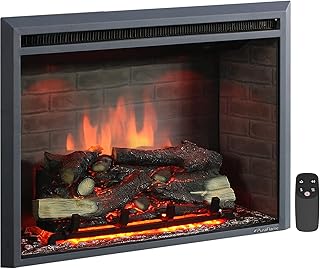
PuraFlame Western 33″ Insert
The crackling sound effect is the differentiator here and it’s better executed than most — irregular enough to fade into the background rather than loop noticeably. PuraFlame’s flame render is more restrained than the multi-color units, which is exactly what you want in a room aiming for traditional hearth character.
24.5″ WiFi Freestanding Log Set
Five brightness levels and five flame speeds give this compact unit more fine control than several larger inserts, making it easy to dial down to a bedroom-appropriate simmer. The 9-hour timer and thermostat handle overnight use, and freestanding placement means no construction required.
Frequently Asked Questions
Can I run the flame effect without the heat?
Yes, on every model here. This is the most common way people actually use these units — ambient light year-round, heat only for a few months. Expect the LED-only draw to be minimal, comparable to a couple of household bulbs.
How much space will 1500W actually heat?
Roughly 350 to 400 square feet as supplemental heat in a reasonably insulated room. These are zone heaters, not furnace replacements, and they perform best warming a room you’re already occupying rather than fighting a cold house.
Does recessed installation require an electrician?
Framing and drywall work you can often handle yourself, but the electrical side depends on your setup. A dedicated 15-amp circuit is the safe recommendation for 1500W operation, and if you’re adding an outlet inside the recess cavity, bring in a licensed electrician.
Do the LEDs need replacing?
Practically speaking, no. LED flame assemblies in current models are rated well beyond typical ownership periods. Occasional interior dusting through the access panel does more for long-term appearance than any component swap.
Final Thoughts
If ambience quality is your priority, the Touchstone Sideline 50″ earns its premium through genuinely graduated color control and reliable smart integration. For a wide media-wall installation, the 65″ app-controlled insert delivers room-scale light with the independent flame and bed coloring needed to keep it from looking monochrome, while the PuraFlame Western 33″ remains the pick for anyone retrofitting a traditional firebox and wanting a restrained, crackling hearth rather than a color show.