Key takeaways
- Light placement over raw lumens: A lamp mounted high on the head casts the chuck and bit as a hard shadow right where you need to see. Look for a light positioned forward of the quill or on a flexible arm so the beam arrives at a shallow angle and rakes across your layout lines instead of flattening them.
- Laser guides in real ambient conditions: Crosshairs are a genuine aid for repeat hole placement, but a low-output diode disappears in a sunlit shop. Judge the laser under your own working brightness, and treat it as confirmation of a center-punched mark rather than a substitute for one.
- Table finish and glare: Polished cast iron throws specular hot spots that hide pencil marks. A matte or lightly oxidized table surface diffuses light more evenly, and a sacrificial plywood insert both protects the tabletop and gives you a non-reflective, pale background for layout.
- Speed range for the species you cut: Variable speed earns its keep with hardwoods and large Forstner bits, where slower RPM prevents scorching. Stepped-pulley presses are fine if you are willing to open the cover and move a belt, but you will do it less often than you think.
- Quill travel, runout, and the base: Two inches of stroke handles most furniture joinery; three is better for deep mortising. Check that the table locks square without creep and that the machine’s footprint suits your bench, since vibration blurs both your cut and your sightline.
What's inside
Most drill press shopping happens on the spec sheet: swing, spindle travel, amps, chuck capacity. Then the machine lands on the bench and the real problem shows up. You lean in over a walnut blank, the quill housing eclipses your shop’s overhead fixture, and you end up boring into your own shadow with a pencil line you can no longer see. Accuracy in woodworking is a visibility problem long before it is a power problem, and a benchtop press is the one tool that puts your head, your hands, and the light source in direct competition.
This guide reads the 2026 field the way a lighting designer would read a room: where the illumination originates, how it falls across cast iron and end grain, whether the laser crosshair survives a bright garage, and how much contrast you actually get at the moment the bit touches wood. Along the way we cover the practical fundamentals too, since a beautifully lit machine that wanders under load is no bargain.
As an Amazon Associate we earn from qualifying purchases.


How to Choose a Drill Press Woodworking (2026)
- Light placement over raw lumens: A lamp mounted high on the head casts the chuck and bit as a hard shadow right where you need to see. Look for a light positioned forward of the quill or on a flexible arm so the beam arrives at a shallow angle and rakes across your layout lines instead of flattening them.
- Laser guides in real ambient conditions: Crosshairs are a genuine aid for repeat hole placement, but a low-output diode disappears in a sunlit shop. Judge the laser under your own working brightness, and treat it as confirmation of a center-punched mark rather than a substitute for one.
- Table finish and glare: Polished cast iron throws specular hot spots that hide pencil marks. A matte or lightly oxidized table surface diffuses light more evenly, and a sacrificial plywood insert both protects the tabletop and gives you a non-reflective, pale background for layout.
- Speed range for the species you cut: Variable speed earns its keep with hardwoods and large Forstner bits, where slower RPM prevents scorching. Stepped-pulley presses are fine if you are willing to open the cover and move a belt, but you will do it less often than you think.
- Quill travel, runout, and the base: Two inches of stroke handles most furniture joinery; three is better for deep mortising. Check that the table locks square without creep and that the machine’s footprint suits your bench, since vibration blurs both your cut and your sightline.
The Best Drill Press Woodworking (2026)s Reviewed
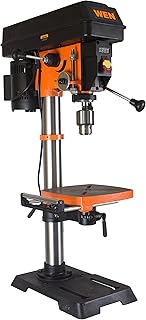
WEN 12-Inch Benchtop Drill Press (DP1263V)
The most thoroughly considered lighting package in this group, pairing an LED work light with a laser and backing both with a genuinely useful variable-speed motor and heavy cast iron. For furniture builders drilling shelf pins, dowels, and Forstner-bit hardware mortises, this is the machine that lets you see the line and slow the bit down at the same time.
WOODSKIL 8-Inch Benchtop Drill Press
An induction motor at this size is a quiet, low-vibration surprise, and the 45-degree beveling cast iron table opens up angled joinery that most compact presses refuse. Five speeds and a two-inch stroke cover typical case and chair work comfortably.
SKIL 10-Inch 5-Speed Benchtop Drill Press (DP9505-00)
SKIL’s forward-set work light and laser alignment combine into unusually clean illumination at the bit, with minimal shadow cast by the chuck. A sensible middle choice in swing and footprint for a shared garage bench.
JET Benchtop Drill Press (JWDP-12)
No laser, no lamp, and it still belongs here because the mechanical fundamentals are excellent: smooth variable speed via a front-mounted dial, low runout, and a rigid column that keeps repeat holes consistent. Budget for an aftermarket magnetic LED arm and you have a lifetime tool.
WEN 8-Inch 5-Speed Benchtop Drill Press (4206T)
The compact, dependable entry point, with cast iron construction that punches above its 2.3-amp rating. Add a clip-on lamp positioned low and to the side, and its accuracy climbs immediately.
Frequently Asked Questions
Do I really need a laser guide?
No, but it shortens setup on repetitive hole patterns. Center-punch your mark, lower the bit to confirm alignment, and use the laser as a fast visual check between workpieces.
What if I need portability instead of a benchtop machine?
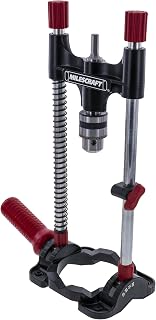
The Milescraft DrillMate portable drilling guide converts a handheld drill into a controlled straight or angled boring setup, which is the right answer for assembled casework and on-site repairs where a fixed press cannot reach.
Is 8 inches of swing enough for furniture?
For most joinery, yes. Ten to twelve inches helps when you need to reach further from the edge of a wide panel or use a large drilling table.
Can I upgrade the lighting on a press that has none?
Easily. A magnetic-base gooseneck LED around 4000K, mounted below the head and angled across the table, gives better contrast than most factory lamps.
Final Thoughts
For a shop that wants sightlines and speed control solved out of the box, the WEN DP1263V is the clearest pick. Choose the JET JWDP-12 if you would rather buy mechanical precision and light it yourself, or the WOODSKIL 8-inch if a quiet induction motor and a beveling table matter more than swing.