Key takeaways
- Low-end spindle speed: This is the single most important spec for steel. You want a bottom speed near 300 RPM or lower for larger holes in mild steel; anything with a 600 RPM floor will burn bits in 1/2″ material. Variable speed is preferable to stepped pulleys, but a low first step beats a wide range with a high minimum.
- Mass and cast iron: Chatter is your enemy. Cast iron heads, columns, and tables absorb vibration that stamped steel frames amplify. Heavier machines hold tolerance through the cut and leave cleaner exit burrs.
- Quill travel and spindle runout: Look for at least 2″ to 3-1/4″ of travel so you can clear thick stock in one pass. Excess runout shows up as oversized, out-of-round holes, which matters when you’re threading for a lamp nipple or fitting a bushing.
- Fixed or magnetic: Benchtop presses win for repeatable shop work and small parts. A mag drill is the answer when the steel cannot come to you: installed I-beams, wall-mounted channel, or an already-assembled track for a linear pendant run.
- Cooling and cutter type: Steel drilling needs cutting fluid. Mag drills with integrated coolant systems and annular cutters remove far less material than twist bits, cutting faster with less motor strain and a cleaner bore.
What's inside
Steel is where most lighting projects stop being fun. Ask anyone who builds their own fixtures: the wiring is straightforward, the shade is a joy, and then you need four clean 3/8″ holes through a piece of 1/4″ flat bar for a ceiling canopy, and suddenly you’re chasing a wandering bit across a scored workpiece with a hand drill. Steel punishes low torque and inconsistent feed pressure. It work-hardens when you drill too fast, glazes over, and turns a two-minute job into a ruined blank and a dead bit.
This guide is written from the fabrication side of lighting and ambience design, where mild steel brackets, mounting plates, stems, and structural channel are everyday materials. Below are six presses worth considering for steel, split between benchtop machines for shop work and portable magnetic drills for on-site structural steel. We cover what actually matters at low RPM, then review the top picks in detail.
As an Amazon Associate we earn from qualifying purchases.



How to Choose a/an Drill Press For Steel (2026)
- Low-end spindle speed: This is the single most important spec for steel. You want a bottom speed near 300 RPM or lower for larger holes in mild steel; anything with a 600 RPM floor will burn bits in 1/2″ material. Variable speed is preferable to stepped pulleys, but a low first step beats a wide range with a high minimum.
- Mass and cast iron: Chatter is your enemy. Cast iron heads, columns, and tables absorb vibration that stamped steel frames amplify. Heavier machines hold tolerance through the cut and leave cleaner exit burrs.
- Quill travel and spindle runout: Look for at least 2″ to 3-1/4″ of travel so you can clear thick stock in one pass. Excess runout shows up as oversized, out-of-round holes, which matters when you’re threading for a lamp nipple or fitting a bushing.
- Fixed or magnetic: Benchtop presses win for repeatable shop work and small parts. A mag drill is the answer when the steel cannot come to you: installed I-beams, wall-mounted channel, or an already-assembled track for a linear pendant run.
- Cooling and cutter type: Steel drilling needs cutting fluid. Mag drills with integrated coolant systems and annular cutters remove far less material than twist bits, cutting faster with less motor strain and a cleaner bore.
The Best Drill Press For Steel (2026)s Reviewed
ZELCAN 1550W Magnetic Drill Press
With 3,125 lbf of magnetic hold, stepless speed control down from 650 RPM, and reversible rotation, this is the most capable portable option here for structural work and tapping. The 2″ capacity and six included bits cover most mounting plate and beam work, and the reverse function is genuinely useful when backing a cutter out of a bind.
WEN 4206T 8-Inch Benchtop Drill Press
An honest entry point for light steel: cast iron construction, five speeds, and a 740 RPM low end that handles small-diameter holes in sheet and thin bar. Fine for 1/8″ to 1/4″ pilot work on brackets, but underpowered for anything over 3/8″ in thick plate.
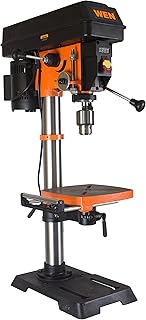
WEN DP1263V 12-Inch Variable Speed Drill Press
The 6.2-amp variable speed motor drops low enough for serious steel drilling, and the cast iron body keeps chatter down through the cut. The laser and LED work light sound like extras until you’re setting up a series of identical holes on a dark bench, at which point they earn their keep.
JET JWDP-12 12-Inch Benchtop Drill Press
The precision pick. JET’s 1/2 HP variable speed head delivers consistently low runout and a smooth quill feel that shows up directly in hole quality, which matters for threaded assemblies and press fits. It costs more than the WEN, and for a shop drilling steel weekly, it is worth the difference.
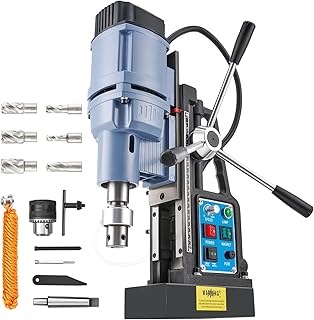
VEVOR 1450W Mag Drill Press
A well-specified mid-tier mag drill: 2,922 lbf of hold, 0–750 RPM variable speed, overload protection, a cooling system, and six annular cutters included. Strong value for occasional jobsite fabrication, though the ZELCAN holds harder and runs smoother under sustained load.
Frequently Asked Questions
What speed should I drill steel at?
As a working rule for mild steel with HSS bits, aim for roughly 250–350 RPM for 1/2″ holes and 700–1,000 RPM for 1/8″. Slower with more feed pressure and cutting fluid; faster speeds generate heat that dulls the cutting edge and hardens the material ahead of it.
Can I use a wood drill press on steel?
Only within limits. If its lowest speed is above roughly 700 RPM, you’re restricted to small holes in thin stock. Frame rigidity is the other constraint, since lightweight presses flex and produce tapered, oversized holes.
Do I need a magnetic drill for a home lighting shop?
Not usually. A mag drill earns its place when you’re drilling steel that is already installed, such as an exposed beam for a suspended fixture or a mounting rail in a finished room. For bench fabrication, a 12″ cast iron press is more versatile.
Annular cutters or twist bits?
Annular cutters for anything above about 1/2″ in plate, since they cut only the perimeter and demand far less power. Twist bits remain the practical choice for small pilot holes and general bracket work.
Final Thoughts
For a shop that builds its own fixtures and mounting hardware, the JET JWDP-12 is the accuracy benchmark and the WEN DP1263V delivers most of that capability for less. If your steel is already bolted into a ceiling or wall, the ZELCAN 1550W magnetic drill is the one that travels to the work and holds firm while it cuts.