Key takeaways
- Dark repeats that blend with the original note.
- A simple control layout with little menu diving.
- Natural overload and pitch movement when feedback is high.
- A delay that remains unobtrusive for rhythm guitar.
The best delay pedals depend on whether you want warm, degrading repeats, pristine rhythmic echoes, convincing tape movement, or several delay styles in one board: choose an analog pedal for feel, a digital pedal for clarity and flexibility, a tape-style pedal for character, and a multi-mode unit when one pedal must cover nearly everything.
Quick picks by playing situation
| Situation | Best fit | Why it works | Typical power and space |
|---|---|---|---|
| Small board or apartment practice | MXR Carbon Copy or BOSS DD-8 | Compact enclosures, simple controls, and useful sounds without a large switching system | About 11–13 cm wide; 9V power, generally under 100 mA |
| Ambient, worship, or textural playing | Strymon El Capistan V2 | Detailed tape modulation, multiple heads, and long, atmospheric repeats | Approximately 14 cm wide; 9V center-negative supply, about 250 mA |
| Live player covering several bands | BOSS DD-500 or Strymon Timeline | Presets, tap tempo, subdivisions, stereo operation, and many delay families | Roughly 13–14 cm wide; usually 200–300 mA at 9V |
| Classic rock and blues | BOSS DM-2W or Electro-Harmonix Deluxe Memory Man | Dark repeats and natural interaction with overdrive | Compact to medium enclosures; analog units may use more current than basic mini pedals |
| Need clear loops and precise rhythm | TC Electronic Flashback 2 or BOSS DD-8 | Digital repeats stay intelligible, with subdivisions, tap tempo, and multiple modes | About 10–13 cm wide; commonly 9V, approximately 100 mA or less depending on model |
Analog delay: warm, compressed, and naturally imperfect
Analog delay pedals use bucket-brigade circuitry. Each repeat loses some treble and becomes softer, so the echoes sit behind the dry guitar rather than competing with it. Turning up the feedback can create a pleasingly unstable wash, especially when the pedal is placed after overdrive.

Walrus Audio Fundamental Series Delay
Included for 'Best Delay Pedals for Guitarists' as a relevant option in this category; details come from the product listing.
View on Amazon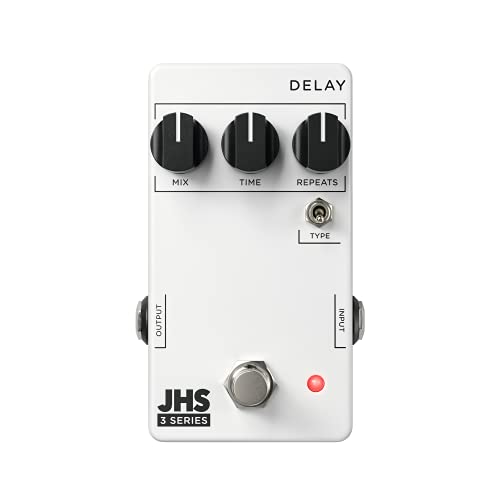
JHS Pedals 3 Series Delay
Included for 'Best Delay Pedals for Guitarists' as a relevant option in this category; details come from the product listing.
View on Amazon
MXR® Carbon Copy® Analog Delay
Included for 'Best Delay Pedals for Guitarists' as a relevant option in this category; details come from the product listing.
View on Amazon
BOSS DD-3T Digital Delay Guitar Effect Pedal
Included for 'Best Delay Pedals for Guitarists' as a relevant option in this category; details come from the product listing.
View on AmazonThe MXR Carbon Copy is a practical starting point. Its compact enclosure, modulation switch, and separate modulation controls make it useful for slapback, blues leads, and subtle chorus-like movement. The BOSS DM-2W Waza Craft offers a similarly musical analog response, with a custom mode that changes the character and level of the repeats.
Analog delay is less suitable when you need long, bright repeats or exact rhythmic subdivisions. Many traditional units also have a shorter maximum delay time, often around 300–600 milliseconds. Their current draw is usually modest, but check the exact model before connecting it to a crowded daisy chain.
Choose analog if you want:
- Dark repeats that blend with the original note.
- A simple control layout with little menu diving.
- Natural overload and pitch movement when feedback is high.
- A delay that remains unobtrusive for rhythm guitar.
Digital delay: clean repeats and the widest practical range
Digital pedals sample the guitar signal and reproduce it with greater clarity. They are the better choice for dotted-eighth patterns, extended ambient trails, looping-style parts, and players who want several delay voices without buying several pedals.
The BOSS DD-8 is one of the most board-friendly digital choices. It offers multiple modes, tap-tempo access through an external switch, stereo connections, and a compact footprint. The TC Electronic Flashback 2 adds several delay types and TonePrint editing, allowing sounds to be configured beyond the front-panel controls.
Digital delay does not have to sound sterile. Many modern pedals include analog, tape, reverse, shimmer, or modulated modes that deliberately reduce high frequencies or add movement. The key advantage is control: repeats can remain even in volume and pitch for a polished, predictable part.
Important digital controls
- Delay time: Sets the distance between repeats, from slapback territory to long ambient echoes.
- Feedback: Determines how many repeats occur. Near maximum, some pedals self-oscillate.
- Mix or level: Controls the balance between dry guitar and delayed signal.
- Subdivision: Converts tap tempo into quarter notes, eighth notes, dotted eighths, or triplets.
- Trails: Lets repeats continue after bypass, which is useful for ambient playing but may complicate abrupt song changes.
Tape-style delay: character, modulation, and controlled wear
Tape-style pedals imitate the tone of mechanical echo machines. Their repeats usually lose top end, wobble slightly in pitch, and change as the virtual tape is pushed or slowed. This sound is more animated than a basic analog delay and more forgiving than a perfectly clean digital repeat.
The Strymon El Capistan V2 is a deep tape-style option with multiple virtual tape-machine modes, adjustable wow and flutter, tape-age controls, and several head arrangements. The Catalinbread Belle Epoch focuses on the character of the Echoplex EP-3, including preamp coloration as well as echo. The Dunlop EP103 Echoplex Delay is another compact route to a recognizable tape-echo flavor.
Tape emulations often need more power than simple analog pedals, particularly when they include stereo processing, presets, or extensive digital control. A typical unit may require 150–300 mA from a regulated 9V center-negative supply. Do not assume that a pedalboard’s spare daisy-chain output is adequate; insufficient current can cause noise, rebooting, or unreliable switching.
Multi-mode pedals: maximum coverage, larger commitment
Multi-mode delays are the strongest option when a single pedal must handle several songs or genres. The BOSS DD-500 and Strymon Timeline provide extensive algorithms, preset storage, tap tempo, MIDI connectivity, stereo routing, and detailed parameter editing. The Walrus Audio D1 V2 offers a smaller, more approachable alternative with several delay families and preset capability.
The trade-off is physical and mental space. A multi-mode pedal may be roughly twice the footprint of a compact analog delay, and its power demand can approach 200–300 mA. Its switches may also perform different functions depending on whether you tap, hold, or press two controls together. Set up presets at home and label the most important ones before a performance.
| Delay type | Common enclosure width | Typical maximum time | Typical current demand | Main trade-off |
|---|---|---|---|---|
| Compact analog | 6–7 cm | 300–600 ms | 20–60 mA | Warm tone, but limited clarity and rhythmic precision |
| Compact digital | 6–7 cm | Up to several seconds | 50–100 mA | More flexibility, with fewer hands-on controls on small models |
| Tape-style digital | 7–14 cm | Several seconds | 100–300 mA | Rich movement, but greater power and control requirements |
| Multi-mode workstation | 13–14 cm or more | Several seconds to minutes, model dependent | 200–300 mA | Presets and connectivity, but a larger footprint and steeper learning curve |
Check your board before buying
Measure the actual gap between pedal rows rather than relying only on the pedal’s listed width. Leave at least 2–3 cm above a footswitch for comfortable access, and more if patch cables exit from the top or sides. A 10 cm-wide pedal can consume 12–14 cm once plugs and cable bends are included.
For a small board, top-mounted jacks can make a substantial difference. Side-mounted cables may require an additional 3–5 cm at each edge, particularly with rigid right-angle plugs. Also measure the height of your board’s upper tier: a tall multi-mode pedal can interfere with the row behind it, even when its width fits.
Power, signal path, and durability realities
Most current delay pedals use a regulated 9V DC, center-negative supply, but voltage, polarity, and current requirements are not interchangeable. Check the manufacturer’s specification before using an isolated output. High-current digital pedals should generally receive their own appropriately rated output rather than sharing an overloaded daisy chain.
Place delay after distortion and overdrive for clear repeats. Placing it before gain produces more smeared, compressed echoes, which can be desirable for vintage sounds. If the amplifier has an effects loop, delay often sounds cleaner there, especially with high-gain settings.
What wears first is usually not the delay circuit itself: footswitches, jack sockets, patch cables, and power connectors take the most mechanical abuse. Use strain relief on power cables, avoid stacking heavy pedals on delicate knobs, and leave room to remove a pedal without dismantling the whole board. For touring, a metal enclosure and recessed controls are worthwhile; for home use, sound and control layout matter more than extreme enclosure strength.
How to make the final choice
- Choose the shortest delay time you regularly need, then add room for experimentation.
- Decide whether you need tap tempo or can set delay time manually.
- Count your available isolated power outputs and compare their current ratings.
- Measure the pedal with cables connected, not just the bare enclosure.
- Buy analog for interaction and warmth, digital for accuracy, tape-style for movement, or multi-mode for preset-based variety.
For most players seeking one dependable starting point, a compact digital pedal such as the BOSS DD-8 offers the broadest range per square centimetre. If the goal is a delay that disappears into the guitar tone, choose the MXR Carbon Copy or BOSS DM-2W. Players who value evolving, characterful echoes should look to the Strymon El Capistan V2, while performers needing multiple song-specific sounds will get the most value from a BOSS DD-500, Strymon Timeline, or similarly capable multi-mode pedal.