Key takeaways
- Suction throughput, measured honestly: Look for gallons per minute or GPH rather than vague “powerful” claims. Roughly 18.5 GPM (about 1,100 GPH) is the current handheld benchmark, and anything meaningfully below that will push fine sediment around instead of lifting it.
- Runtime against pool size: Sixty minutes covers a small above-ground pool or a spa with room to spare. Larger inground shapes with steps, benches, and tanning ledges need 80 minutes or more, since detail work around features eats battery faster than open floor.
- Filter volume and media type: Fine silt and pollen demand a tight cartridge; oak leaves and acorns demand raw capacity. Dual-filter systems let you swap based on season, which matters more than most buyers expect.
- Pole reach and head geometry: A pole in the 80 to 90 inch range gets you to the deep-end floor without swimming. Check that the head sits flat rather than nose-down, or you will lose contact and suction on slopes.
- Waterline and wall coverage: Handhelds clean floors. If the tide line of oils and dust is what you notice under low-angle lighting, you need a robotic unit that climbs walls and scrubs the waterline itself.
What's inside
Anyone who has designed a backyard for evening use knows that a pool is not really a body of water. It is a lens. Every fixture you aim into it, every LED wash on the coping, every candle flickering on the deck gets bent, doubled, and thrown back onto your fence and soffits. Suspended silt kills that effect faster than a bad bulb ever will. A film of pollen turns crisp caustic ripples into a flat grey glow, and a scattering of leaves on the floor reads as dead spots in what should be a continuous, moving pattern of light.
That is the case for a cordless vacuum. Not the deep-clean weekly service, but the ten-minute pass you make at dusk before guests arrive, with no hose to thread and no pump to prime. This guide covers what actually matters in 2026: real suction throughput versus marketing numbers, runtime honesty, filter capacity for the debris your yard produces, and which units handle waterline grime that ruins reflections. Below are the models worth your money, followed by the specs to check before you buy.
As an Amazon Associate we earn from qualifying purchases.


🛒 Best Price Today on Amazon
Prime members get fast, free shipping on everything above, plus member-only deals. New members get a 30-day free trial — cancel anytime.
How to Choose a Cordless Pool Vacuum (2026)
- Suction throughput, measured honestly: Look for gallons per minute or GPH rather than vague “powerful” claims. Roughly 18.5 GPM (about 1,100 GPH) is the current handheld benchmark, and anything meaningfully below that will push fine sediment around instead of lifting it.
- Runtime against pool size: Sixty minutes covers a small above-ground pool or a spa with room to spare. Larger inground shapes with steps, benches, and tanning ledges need 80 minutes or more, since detail work around features eats battery faster than open floor.
- Filter volume and media type: Fine silt and pollen demand a tight cartridge; oak leaves and acorns demand raw capacity. Dual-filter systems let you swap based on season, which matters more than most buyers expect.
- Pole reach and head geometry: A pole in the 80 to 90 inch range gets you to the deep-end floor without swimming. Check that the head sits flat rather than nose-down, or you will lose contact and suction on slopes.
- Waterline and wall coverage: Handhelds clean floors. If the tide line of oils and dust is what you notice under low-angle lighting, you need a robotic unit that climbs walls and scrubs the waterline itself.
The Best Cordless Pool Vacuum (2026)s Reviewed
Cordless Robotic Pool Vacuum with Track Drive
Dual 180W brushless motors and a track drive give this one genuine climbing ability, so it scrubs walls and the waterline rather than just the floor. With a 150-minute runtime and coverage up to 2,150 square feet, it is the only pick here that will restore mirror-clean reflections without you holding a pole.
Pool Blaster Max (2026)
The Max has been the reference handheld for years, and the 2026 revision adds suction and omni-directional rollers that glide over transitions instead of catching. Sixty minutes is enough for a focused pass, and the charging setup is simple enough to keep it docked on the deck all season.
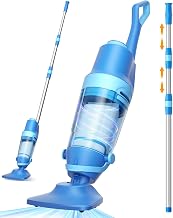
Cordless Pool Vacuum with Telescopic Pole and Supercharge
18.5 GPM suction paired with 1.5-hour supercharge technology makes this a strong all-rounder for above-ground pools, inground pools, and hot tubs. The included telescopic pole means you are not sourcing hardware separately, which is a real convenience at this price tier.
Cordless Handheld Vacuum with Dual-Filter System
The 80-minute runtime and dual-filter design make this the smart seasonal choice: tight media for spring pollen, coarse for autumn leaf fall. The bundled leaf-scooping net is a genuinely useful addition rather than filler, letting you skim floaters before they waterlog and sink.
Pool Vacuum with 1427 GPH Suction and 90.7″ Pole
The highest raw flow figure in this group, with an extra-large filter chamber built for leaves, sand, and grit. The 90.7-inch pole reaches deep-end floors comfortably, though the one-hour runtime means you will want to plan your route rather than wander.
Frequently Asked Questions
Do cordless vacuums replace my pool pump and filter?
No. They handle spot cleaning and debris removal between full circulation cycles. Your pump still does the chemical and micro-particle work, so keep running it on its normal schedule.
Will a handheld unit clean my pool walls?
Only the lower sections you can reach and hold flat against the surface. For consistent wall and waterline cleaning, choose a robotic model with climbing capability.
How often should I vacuum for clear water at night?
Twice weekly during heavy pollen or leaf drop, weekly otherwise. Under low-angle lighting, sediment shows up long before it is visible in daylight, so err toward more frequent short passes.
Can I use these in a hot tub or spa?
Most handhelds, including the telescopic-pole and Pool Blaster models, are rated for spas. Robotic units generally are not, since they need floor area to navigate.
Final Thoughts
For a genuinely hands-off pool that looks good under evening light, the Cordless Robotic Pool Vacuum with track drive is the clear investment, since waterline and wall coverage is what separates clean water from clear water. If you want a fast handheld for quick passes, the 2026 Pool Blaster Max remains the most reliable option, while the dual-filter model with an 80-minute runtime is the better fit for yards that throw serious seasonal debris.