Key takeaways
- Shadow line over laser: An LED shadow-casting system projects the blade’s own silhouette onto the workpiece, so the indicator is the blade — it cannot drift out of calibration. Lasers are a separate emitter that needs periodic adjustment and washes out under bright ambient light.
- Bevel capability: Single bevel tilts one way and forces you to flip stock for opposing cuts; double bevel tilts both, which matters when you’re cutting crown, plinths, or mitered case corners where flipping introduces reference errors.
- Capacity for furniture stock: A 10-inch chop saw handles most rails, stiles, and 1x lumber comfortably. Sliding 12-inch heads are what you want for wide panels, deep aprons, and bench slabs up to roughly 13–16 inches of crosscut.
- Dust extraction as a visibility feature: Fine dust in the air diffuses your task light and kills edge contrast. A bag catches the coarse stuff; a shop vac on the port is what actually keeps the cut zone readable.
- Detents and fence height: Positive stops at common angles let you return to a setting without re-measuring, and a tall sliding fence supports crown and baseboard on edge. Confirm both are adjustable, not just present.
What's inside
Most miter saw guides talk about amps and blade diameter as though a cut fails because the motor ran out of muscle. In furniture work, that’s rarely what goes wrong. A 45-degree return on a walnut picture-frame apron fails because you couldn’t actually see the pencil line at the moment the teeth touched it — the arm cast a shadow across the kerf, the overhead fluorescent threw a second ghost line two millimetres off, or airborne dust scattered enough light to soften the whole reference edge into a grey smudge. Miters are the least forgiving joint in the shop: a half-degree error doubles at the corner and shows up as a hairline gap that no clamp pressure will close.
I design lighting and ambience for a living, which means I spend my days thinking about contrast ratios, glare angles, and how a surface reads under a given source. Applied to a miter saw station, that lens changes which features matter. This guide looks at six well-regarded compound saws through that filter — how each one illuminates the cut, how honestly its indicator tracks the blade, and how well it holds a repeatable angle for cabinet doors, bed rails, and trim work. Specs are covered too, but always in service of the line you’re following.
As an Amazon Associate we earn from qualifying purchases.



🛒 Best Price Today on Amazon
Prime members get fast, free shipping on everything above, plus member-only deals. New members get a 30-day free trial — cancel anytime.
How to Choose a Compound Miter Saw (2026)
- Shadow line over laser: An LED shadow-casting system projects the blade’s own silhouette onto the workpiece, so the indicator is the blade — it cannot drift out of calibration. Lasers are a separate emitter that needs periodic adjustment and washes out under bright ambient light.
- Bevel capability: Single bevel tilts one way and forces you to flip stock for opposing cuts; double bevel tilts both, which matters when you’re cutting crown, plinths, or mitered case corners where flipping introduces reference errors.
- Capacity for furniture stock: A 10-inch chop saw handles most rails, stiles, and 1x lumber comfortably. Sliding 12-inch heads are what you want for wide panels, deep aprons, and bench slabs up to roughly 13–16 inches of crosscut.
- Dust extraction as a visibility feature: Fine dust in the air diffuses your task light and kills edge contrast. A bag catches the coarse stuff; a shop vac on the port is what actually keeps the cut zone readable.
- Detents and fence height: Positive stops at common angles let you return to a setting without re-measuring, and a tall sliding fence supports crown and baseboard on edge. Confirm both are adjustable, not just present.
The Best Compound Miter Saws (2026) Reviewed
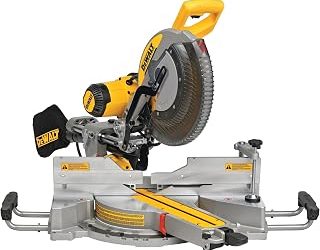
DEWALT DWS780 12-Inch Double Bevel Sliding
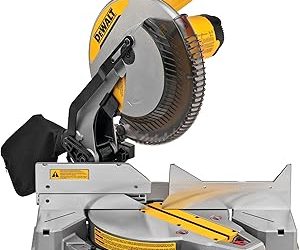
The XPS shadow system is the reason this saw sits at the top: switch on the light, lower the head an inch, and the blade’s own shadow lands exactly where the kerf will go, with no calibration ritual and no wash-out under shop lighting. Pair the double-bevel slide with a vacuum on the port and it becomes the most consistently readable cut station on this list.
DEWALT DWS779 12-Inch Double Bevel Sliding
Mechanically close to the DWS780 — same 15-amp, 3,800 RPM motor and the same generous crosscut capacity — but without the XPS light. If you already run good task lighting from a low, oblique angle, the savings are real and the cut quality is identical.
DEWALT DWS715 12-Inch Single Bevel
A non-sliding 12-inch head gives you height for taller stock while keeping the footprint tight against a wall, which suits small shops where the saw shares bench space. Single bevel means flipping workpieces for opposing angles, so it’s better for repetitive trim and rails than for complex casework.
DEWALT DWS713 10-Inch Single Bevel
The most portable of the DEWALT chop saws and genuinely accurate out of the box once you check the fence with a reliable square. Its lighter head is easy to control on delicate hardwood mouldings where a heavy drop can tear the exit fibres.
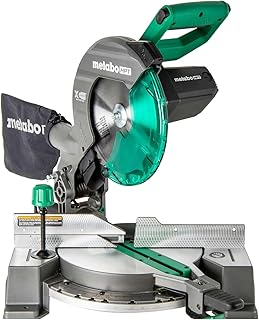
Metabo HPT C10FCG2 10-Inch Single Bevel
The Xact Cut shadow line brings blade-silhouette indication to a genuinely budget saw, which is unusual and worth noting. It’s light enough to carry one-handed and cuts cleanly with the supplied 40T blade, though the compact table wants an outboard support for anything over three feet.
Frequently Asked Questions
Is a shadow line really better than a laser?
For precision furniture work, yes. A shadow is cast by the blade itself, so it reflects the actual kerf including blade thickness and any deflection, and it stays true without adjustment. A laser is a proxy that can be knocked out of alignment and often disappears under bright light or on pale timber.
How should I light a miter saw station?
Use a low, raking light from the operator’s side at roughly 4000K, rather than a single bright source directly overhead. Side-lighting rakes across the pencil line and lifts its contrast, while overhead light flattens the surface and puts the saw arm’s shadow right where you need to see.
Do I need a sliding saw for furniture?
Only if you regularly crosscut wide stock — panels, bench tops, deep aprons. For frames, legs, rails, and trim under about six inches, a fixed 10 or 12-inch head is more rigid and easier to keep square.
Does the supplied blade need replacing?
For visible joinery, yes. Factory blades are general-purpose; a 60–80 tooth fine-finish blade leaves a glue-ready face and dramatically reduces tear-out on veneered and figured stock.
Final Thoughts
If you build furniture where the miters are seen, the DEWALT DWS780 is the clearest choice — the XPS shadow light removes the single biggest source of layout error, and the double bevel spares you from flipping delicate stock. The DWS779 delivers the same cut for less if your task lighting is already sorted, and the Metabo HPT C10FCG2 is the smartest entry point, bringing genuine shadow-line visibility to a light, affordable 10-inch saw.