Key takeaways
- Match pint capacity to real square footage: A 200-pint or 260-pint industrial unit is built for open warehouse volume and active restoration work, not a finished 800 sq ft den. Oversizing a small room means short cycling, wasted energy, and air that feels oddly brittle under warm lighting.
- Insist on a built-in pump, not just a hose port: Gravity drainage only works if your floor drain sits lower than the unit. A pump lets you route condensate upward into a sink or window, which matters enormously in basements where the drain is on the wrong wall.
- Check auto defrost if the space runs cold: Unheated crawlspaces and winter garages drop below 41°F, where coils frost over and dehumidification stops entirely. Auto defrost keeps the compressor cycling instead of icing into uselessness.
- Weigh decibels against how the room is used: A 41dB unit disappears beneath a conversation; a restoration-grade machine will dominate any space you intend to relax in. If the dehumidifier shares a room with reading lamps and a sofa, noise is a design constraint, not a footnote.
- Look for genuine humidity control, not just a fan switch: Constant-mode and auto-humidity settings hold a target percentage rather than running blind. Stable RH protects solid-wood furniture joints, leather, and paper far better than intermittent brute force.
What's inside
Anyone who has spent time staging a room knows that humidity ruins ambience before it ruins anything else. Lamp diffusers grow cloudy, warm-white bulbs read dingy instead of golden, and that soft glow you carefully layered across a basement lounge turns flat and gray. Damp air scatters light differently — it dulls contrast, mutes wood tones, and leaves upholstery looking heavier than it is. Add swollen veneer, musty cushions, and condensation creeping across window trim, and the whole design reads unfinished no matter how good the fixtures are.
A commercial-grade dehumidifier is the least glamorous piece of equipment in a well-lit room and often the most consequential. This guide covers heavy-duty units built for basements, warehouses, workshops, and water-damage restoration, alongside smarter residential models that hold a comfortable 45–50% relative humidity without droning over your evening. Below you’ll find what actually matters when choosing capacity, drainage, and noise levels, plus honest notes on the models worth your attention in 2026.
As an Amazon Associate we earn from qualifying purchases.


🛒 Best Price Today on Amazon
Prime members get fast, free shipping on everything above, plus member-only deals. New members get a 30-day free trial — cancel anytime.
How to Choose a Commercial Dehumidifier (2026)
- Match pint capacity to real square footage: A 200-pint or 260-pint industrial unit is built for open warehouse volume and active restoration work, not a finished 800 sq ft den. Oversizing a small room means short cycling, wasted energy, and air that feels oddly brittle under warm lighting.
- Insist on a built-in pump, not just a hose port: Gravity drainage only works if your floor drain sits lower than the unit. A pump lets you route condensate upward into a sink or window, which matters enormously in basements where the drain is on the wrong wall.
- Check auto defrost if the space runs cold: Unheated crawlspaces and winter garages drop below 41°F, where coils frost over and dehumidification stops entirely. Auto defrost keeps the compressor cycling instead of icing into uselessness.
- Weigh decibels against how the room is used: A 41dB unit disappears beneath a conversation; a restoration-grade machine will dominate any space you intend to relax in. If the dehumidifier shares a room with reading lamps and a sofa, noise is a design constraint, not a footnote.
- Look for genuine humidity control, not just a fan switch: Constant-mode and auto-humidity settings hold a target percentage rather than running blind. Stable RH protects solid-wood furniture joints, leather, and paper far better than intermittent brute force.
The Best Commercial Dehumidifier (2026)s Reviewed
260 Pints Commercial Dehumidifier with Pump
This is the unit you call in when a pipe has already burst — 260 pints of daily extraction with a pump and auto defrost, sized for warehouse floors and restoration jobs rather than tidy finished basements. Overkill for ambience work, indispensable for drying a space back to a condition worth lighting.
200 Pints Commercial Dehumidifier with Pump
The slightly more manageable sibling, pairing heavy-duty extraction with both pump and drain hose so you can leave it running unattended in a large basement or shop. Expect industrial noise and industrial results; it pulls moisture out of block walls and concrete slabs that residential units simply cannot reach.
DREO 110-Pint Smart Dehumidifier (711S)
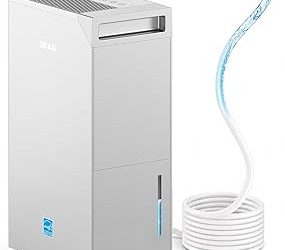
Rated for 4500 sq ft with auto, comfort, and constant modes, this is the sweet spot for anyone protecting furniture across a large open basement without surrendering the room’s atmosphere. The 2-gallon tank plus continuous hose drainage means you set it once and stop thinking about it.
DREO Energy Star 73-Pint Smart Dehumidifier
At 41dB across 2000 sq ft, this is the quietest serious option here — soft enough to sit in a lounge with dimmed sconces and a record playing. Energy Star certification and auto humidity control make it the sensible choice for spaces you actually inhabit rather than merely dry out.
Midea Cube 20 Pint Dehumidifier
The Cube’s expandable tank design and Wi-Fi control with Alexa integration suit smaller basements and bedrooms up to 1,500 sq ft, and it genuinely runs quietly. Its stackable form factor also tucks behind furniture more gracefully than a conventional box unit.
Frequently Asked Questions
What humidity level protects wood furniture best?
Aim for 40–50% relative humidity year-round. Below 35%, veneers and joints shrink and crack; above 60%, wood swells, drawers stick, and mold gains a foothold in upholstery and rugs.
Do I really need a commercial unit for a home basement?
Only if the space is very large, unfinished, or actively wet. For a typical 1,000–2,000 sq ft basement, a 70–110 pint residential smart unit like the DREO models will hold target humidity with far less noise and power draw.
Can I run the drain hose continuously?
Yes, and you should if a drain or sink is available. Continuous drainage eliminates tank emptying entirely — just confirm whether your unit needs gravity fall or has an internal pump, since a hose alone won’t lift water upward.
Will a dehumidifier make my basement lighting look better?
Indirectly, yes. Dry air holds less airborne particulate and stops condensation hazing on fixtures and glass, so warm bulbs read cleaner and colors hold their intended depth instead of going muddy.
Final Thoughts
For most homes, the DREO 110-Pint 711S delivers the best balance of coverage, quiet operation, and set-and-forget drainage, while the 73-Pint DREO Energy Star model is the one to choose when the space doubles as a living room and near-silence matters. If you’re drying out genuine water damage or managing a warehouse floor, step up to the 260 Pints Commercial Dehumidifier with Pump and accept the noise as the cost of getting the space back.