Key takeaways
- Match reach to fixture height, not ceiling height: Work at the third rung from the top, never the last. For eight-foot ceilings a 6.5ft model is plenty; two-story stairwell pendants and exterior soffit lights generally need 12.5ft or more.
- Insist on stabilizers for indoor detail work: Triangle or outrigger stabilizers widen the base and kill the side-to-side sway that makes aligning a canopy plate or seating a bulb in a recessed can feel precarious.
- Check the certification, not just the load number: EN131 or ANSI-rated designs have been tested for rung deflection and locking integrity. A “330lbs capacity” claim means more when it sits alongside a standard.
- Prioritize section-by-section retraction: Ladders that collapse one rung at a time let you set partial heights for lower sconces and drop the ladder down slowly instead of in one alarming crash.
- Weigh the carry, not the spec sheet: Anything you’ll haul up a staircase repeatedly should stay near or under 30 pounds. Aluminum is the practical choice, and non-slip feet matter as much on polished concrete as on damp patio stone.
What's inside
Lighting work happens at the worst possible heights. The chandelier over the stairwell, the track heads eleven feet up in a converted loft, the festoon run that needs re-tensioning across a courtyard, the cove strip behind a soffit that has developed one dead segment. None of it happens at eye level, and almost none of it happens where a full-size extension ladder can be stored, carried, or opened without hitting a wall. Most homes solve this badly: a wobbly step stool for anything under seven feet, and a borrowed ladder for anything above it. That gap is exactly where fixtures go unmaintained, bulbs stay mismatched, and a room’s ambience quietly degrades for years.
A telescoping ladder closes that gap. Collapsed, it lives in a hall closet or a van’s side compartment; extended, it reaches soffits, ceiling boxes, and gutter-line uplights. This guide looks at collapsible ladders through a lighting-and-ambience lens: the reach you actually need to service common fixture heights, the stability features that matter when both hands are holding a driver and a diffuser, and the details that separate a ladder you trust from one you tolerate.
As an Amazon Associate we earn from qualifying purchases.

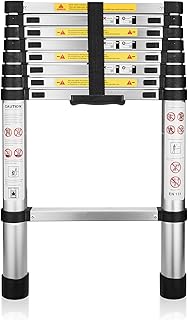


How to Choose a Collapsible Ladder (2026)
- Match reach to fixture height, not ceiling height: Work at the third rung from the top, never the last. For eight-foot ceilings a 6.5ft model is plenty; two-story stairwell pendants and exterior soffit lights generally need 12.5ft or more.
- Insist on stabilizers for indoor detail work: Triangle or outrigger stabilizers widen the base and kill the side-to-side sway that makes aligning a canopy plate or seating a bulb in a recessed can feel precarious.
- Check the certification, not just the load number: EN131 or ANSI-rated designs have been tested for rung deflection and locking integrity. A “330lbs capacity” claim means more when it sits alongside a standard.
- Prioritize section-by-section retraction: Ladders that collapse one rung at a time let you set partial heights for lower sconces and drop the ladder down slowly instead of in one alarming crash.
- Weigh the carry, not the spec sheet: Anything you’ll haul up a staircase repeatedly should stay near or under 30 pounds. Aluminum is the practical choice, and non-slip feet matter as much on polished concrete as on damp patio stone.
The Best Collapsible Ladders (2026) Reviewed
BOWEITI 15.5FT Telescoping Ladder
At 4.7 meters this is the reach specialist, and the one to pick if your project list includes double-height entry chandeliers or exterior wall washers under a second-story eave. It is the heaviest option here, so treat it as the dedicated big-job ladder rather than the one you grab for a bulb swap.
SocTone 12.5FT Telescoping Ladder with Stabilizers
The most balanced pick for serious lighting work: enough height for stairwell fixtures and gutter-line installs, with stabilizer bars that make fine alignment at full extension genuinely comfortable. The 330lb rating leaves real headroom once you add a tool belt, a fixture, and a coil of wire.
10.5FT Lightweight Telescoping Ladder
A smart middle distance — tall enough for vaulted-ceiling pendants and RV awning lights, light enough to carry one-handed between rooms. The triangle stabilizers punch above the price, and it collapses small enough to ride in a camper’s storage bay.
8.5FT EN131 Aluminum Telescoping Ladder
The EN131 certification is the headline here, and 2.6 meters covers standard and lightly raised ceilings, closet strip lighting, and most under-cabinet retrofits. A sensible default for anyone who wants one ladder for interior fixture maintenance.
6.5ft Telescopic Ladder
Compact, quick to deploy, and the right answer for sconces, dimmer plates, and eight-foot-ceiling downlights. Non-slip feet and the same 330lb rating make it far steadier than the folding stool it replaces, and it stows behind a door.
Frequently Asked Questions
What height do I need for a stairwell chandelier?
Measure floor-to-fixture from the lowest tread you can safely set the ladder on, then add roughly four feet for safe working position. Most two-story stairwells land in 12.5ft territory.
Are telescoping ladders stable enough for delicate fixture work?
Yes, provided the model has stabilizers and every section is fully locked. Extend, confirm each lock audibly clicks, then load the ladder before you bring tools up.
Can I use one on a stair landing or uneven patio?
Only on a full, level footprint for both feet. For stairs, work from the landing or use a purpose-built stair platform; never shim one leg.
How should I store it?
Collapsed, upright or flat, somewhere dry. Wipe grit off the rails occasionally so the sections keep sliding freely and the locks seat cleanly.
Final Thoughts
For most homes, the SocTone 12.5FT with stabilizers is the ladder that handles the widest range of lighting jobs without becoming a burden to move. Go to the BOWEITI 15.5FT if double-height fixtures and exterior eaves are on your list, or keep the 6.5ft Telescopic on hand as the fast, everyday choice for sconces and standard-ceiling downlights.