Key takeaways
- Footprint relative to the chaise return: Measure the distance from the front edge of the chaise cushion to the opposing sofa arm. The table should occupy roughly 60–70 % of that depth so every seat stays within easy reach without crowding the traffic lane behind the chaise.
- Surface reflectivity and finish: A satin or lightly oiled wood top bounces ambient light softly and won’t show fingerprints the way a high-gloss lacquer does under overhead recessed cans. Fluted or ribbed panels create micro-shadow lines that add texture without visual heaviness.
- Lift-top versatility: With a chaise you often lose the traditional “lean forward” posture for eating or working. A lift-top mechanism brings the surface to lap height, effectively turning the seating zone into a secondary dining or workspace—particularly valuable in open-plan rooms.
- Storage depth and access direction: Look for compartments that open toward the sofa side rather than the open room side. You want to stash remotes and throws out of sight without standing up and breaking the relaxed flow of the space.
- Leg profile and floor visibility: Exposed legs keep sightlines open beneath the table, making a large sectional feel less grounded and more airy. In rooms with statement area rugs, this also lets the pattern read fully rather than being swallowed by a solid base.
What's inside
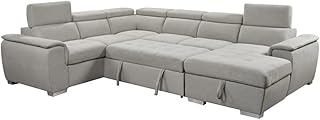
Pairing a coffee table with a sectional that has a chaise is one of those purchases that looks simple on paper and immediately gets complicated. You’re working with an asymmetric footprint, a fixed seat height, and a sightline that cuts across the chaise longway—so a table that looked perfect in a showroom can feel either dwarfed or domineering once it lands in your living room. Get the proportions wrong and the entire seating area feels off-balance, like a stage lit from only one direction.
This guide approaches the selection from a materiality and spatial-lighting perspective—the same lens we use when specifying furniture for residential projects where ambience matters as much as function. We evaluated each contender on how its surface and silhouette interact with both natural and artificial light, how its storage solution keeps clutter from killing the mood, and whether the scale actually serves the extended reach a chaise configuration demands. Below you’ll find our top picks, a concise buying framework, and answers to the questions that come up most often.
As an Amazon Associate we earn from qualifying purchases.



🛒 Best Price Today on Amazon
Prime members get fast, free shipping on everything above, plus member-only deals. New members get a 30-day free trial — cancel anytime.
How to Choose a Coffee Table For Sectional With Chaise (2026)
- Footprint relative to the chaise return: Measure the distance from the front edge of the chaise cushion to the opposing sofa arm. The table should occupy roughly 60–70 % of that depth so every seat stays within easy reach without crowding the traffic lane behind the chaise.
- Surface reflectivity and finish: A satin or lightly oiled wood top bounces ambient light softly and won’t show fingerprints the way a high-gloss lacquer does under overhead recessed cans. Fluted or ribbed panels create micro-shadow lines that add texture without visual heaviness.
- Lift-top versatility: With a chaise you often lose the traditional “lean forward” posture for eating or working. A lift-top mechanism brings the surface to lap height, effectively turning the seating zone into a secondary dining or workspace—particularly valuable in open-plan rooms.
- Storage depth and access direction: Look for compartments that open toward the sofa side rather than the open room side. You want to stash remotes and throws out of sight without standing up and breaking the relaxed flow of the space.
- Leg profile and floor visibility: Exposed legs keep sightlines open beneath the table, making a large sectional feel less grounded and more airy. In rooms with statement area rugs, this also lets the pattern read fully rather than being swallowed by a solid base.
The Best Coffee Table For Sectional With Chaise (2026)s Reviewed
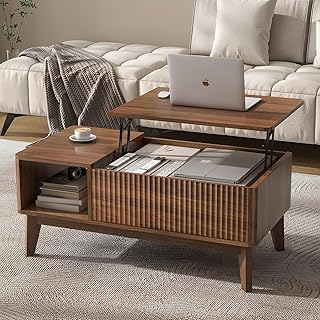
LYNCOHOME Fluted Lift Top Coffee Table (Walnut)
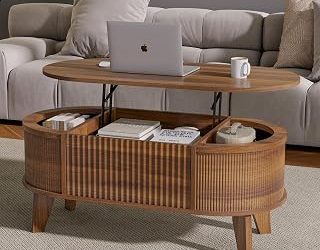
The fluted walnut surface on this lift-top piece catches warm-toned pendants beautifully, producing a subtle gradient across each ribbed channel. The storage cavity underneath is deep enough for board-game boxes and throw blankets, and the lift mechanism raises to a comfortable working height—ideal for the person stationed on the chaise end who wants to set down a laptop or a plate without twisting.
JOINICE Oval Lift Top Coffee Table (Oak)
This oval silhouette reads surprisingly elegant against the hard right angles most sectionals impose. The lighter oak finish has a natural, slightly open grain that diffuses overhead light rather than reflecting it in hot spots, which keeps the room’s color temperature feeling balanced even under cool-white LEDs. At 43 inches it scales well for mid-size sectionals, and the 88-pound weight capacity means you won’t worry about it tipping during a lift.
Mid Century Modern Triangle Top Coffee Table (Walnut)
The asymmetric triangle profile breaks the predictable rectangle-in-front-of-a-sofa formula and works especially well tucked into the inner corner where the chaise meets the straight sofa section. At 16.2 inches tall it sits just below the typical 18-inch seat height, preserving that intentional drop that keeps a room’s horizontal layers legible. The walnut tone leans warm without tipping into orange, making it flexible alongside both cool and warm wall colors.
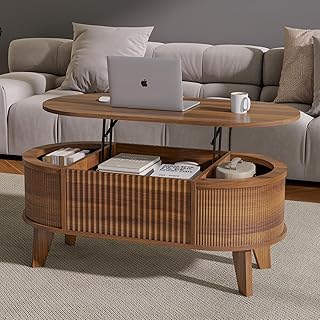
LYNCOHOME Fluted Lift Top Oval Coffee Table (Walnut)
A compact oval variant from LYNCOHOME at 43.3 inches that trades the rectangular footprint for softer curves—useful when the chaise return leaves a narrower gap. The fluted panel on the side apron creates shadow play that echoes the first LYNCOHOME pick, but the oval form reads less heavy in tighter spaces. The lift top and interior storage remain generous for a table of this size.
IFGET 48″ Modern Center Table (Natural Oak)
This two-tier minimalist design uses an open lower shelf to maintain airiness—light from floor-level sconces passes right through, preventing the dark pool that a solid-base table would cast in front of a large sectional. The curved profile softens the table’s edges, which matters when shins and bare feet navigate the space between the chaise and the table. The natural oak finish pairs well with warm-white bulb temperatures (2700 K) without pulling too yellow.
Frequently Asked Questions
What size coffee table works best with a sectional that has a chaise?
Aim for a table that is roughly two-thirds the length of the chaise seat cushion and no taller than the seat height. For most standard sectionals, that means a table between 42 and 52 inches long with a height between 15 and 18 inches. Always measure the clearance between the chaise edge and any opposing furniture—leave at least 18 inches of walkway.
Should the coffee table match the sectional’s upholstery color?
Match the undertone rather than the exact hue. A warm-toned sectional in cream or taupe pairs naturally with walnut or oak finishes, while a cool gray or navy fabric looks intentional alongside ash, black, or white-oiled wood. The goal is harmony of temperature, not identical color.
Is a lift-top coffee table practical for everyday use with a chaise sectional?
It is arguably the most practical choice for a chaise layout because the lift mechanism eliminates the need to lean forward—a motion the chaise position already makes awkward. Lift-tops turn the chaise zone into an impromptu desk or dining surface, which adds real functionality to a configuration that is otherwise purely lounging-oriented.
How do I keep the area under and around a coffee table lit when the sectional is large?
Layer the light. Pair a ceiling fixture or pendant centered over the table with a floor lamp positioned at the chaise end, and consider a small rechargeable accent light on or beneath the table itself. This three-source approach eliminates the dark void that large sectionals tend to create in the center of a room.
Final Thoughts
For the most versatile combination of storage, ambience-friendly surface texture, and chaise-compatible scale, the LYNCOHOME Fluted Lift Top (Walnut) and the JOINICE Oval Lift Top (Oak) stand out as our top recommendations. If your room calls for a lighter visual footprint and you prefer an open shelf over hidden storage, the IFGET 48″ Minimalist Center Table delivers clean lines and excellent light flow at a strong value. Any of these five will anchor a sectional-with-chaise layout without compromising the mood of the space.