Key takeaways
- Clarity mechanism first: Directional freezing is what pushes air and minerals out of the cube. Machines built around slow layered freezing produce ice with genuine optical transparency; fast cycling countertop units almost always trade that clarity for volume, so decide which one your drinks actually need.
- Cube geometry as an optic: A 2″ cube has flat faces that behave like mirrors, throwing crisp specular highlights and hard-edged shadows. A sphere collects light from the whole room and concentrates it into one small hotspot. Cubes photograph sharper; spheres look warmer and softer in low light.
- Shell finish and reflectance: Brushed stainless diffuses reflections and sits quietly next to walnut or oiled oak. Gloss white and mirror-polished panels will pick up every downlight above them and create glare in the corner of your eye — worth avoiding directly beneath a fixture.
- Noise floor and interior LEDs: Ambience is not only visual. Anything above roughly 45 dB competes with conversation at close range, and a bright cool-white interior lamp inside the bin will fight a warm room. Look for units you can leave running while guests are present.
- Footprint, clearance and heat: These are refrigeration units, so they need breathing room at the back and sides. Measure the depth under wall cabinets and remember that a machine tucked into a tight alcove will run hotter, louder and slower.
What's inside
Every host eventually meets the same quiet disappointment. The dimmers are set, the pendants are throwing that low amber wash across the counter, the glassware has been polished — and then the ice goes in and the whole picture goes matte. Cloudy ice is full of trapped air and mineral veils that scatter light in every direction at once. Instead of catching your carefully placed key light and throwing it back, it swallows it. From a lighting standpoint, you have just dropped a piece of frosted acrylic into a drink you wanted to glow.
Clear ice behaves like a completely different material. It refracts rather than diffuses, which means a single warm source overhead becomes a bright edge, a caustic on the coaster, and a lens that magnifies whatever colour the spirit brings. This guide looks at cocktail ice makers through that lens specifically: which cube geometries actually bend light well, how machine finishes read under warm and cool lighting, and which units hold their own on an open shelf or a furnished bar cabinet where the appliance itself is part of the visual composition.
As an Amazon Associate we earn from qualifying purchases.



🛒 Best Price Today on Amazon
Prime members get fast, free shipping on everything above, plus member-only deals. New members get a 30-day free trial — cancel anytime.
How to Choose a Cocktail Ice Maker (2026)
- Clarity mechanism first: Directional freezing is what pushes air and minerals out of the cube. Machines built around slow layered freezing produce ice with genuine optical transparency; fast cycling countertop units almost always trade that clarity for volume, so decide which one your drinks actually need.
- Cube geometry as an optic: A 2″ cube has flat faces that behave like mirrors, throwing crisp specular highlights and hard-edged shadows. A sphere collects light from the whole room and concentrates it into one small hotspot. Cubes photograph sharper; spheres look warmer and softer in low light.
- Shell finish and reflectance: Brushed stainless diffuses reflections and sits quietly next to walnut or oiled oak. Gloss white and mirror-polished panels will pick up every downlight above them and create glare in the corner of your eye — worth avoiding directly beneath a fixture.
- Noise floor and interior LEDs: Ambience is not only visual. Anything above roughly 45 dB competes with conversation at close range, and a bright cool-white interior lamp inside the bin will fight a warm room. Look for units you can leave running while guests are present.
- Footprint, clearance and heat: These are refrigeration units, so they need breathing room at the back and sides. Measure the depth under wall cabinets and remember that a machine tucked into a tight alcove will run hotter, louder and slower.
The Best Cocktail Ice Makers (2026) Reviewed
COMMODORE LUXECUBE Luxury Ice Maker
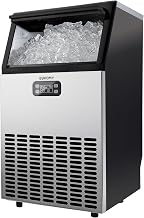
The LUXECUBE is the closest thing here to a purpose-built showpiece, turning out nine genuinely crystal-clear 1.5″ cubes an hour and holding eighteen in reserve. Its quiet operation and self-cleaning cycle mean you can run it during service, and those flat facets are what deliver the hard, jewel-like highlights that make a stirred drink look intentional under a single warm pendant.
ecozy 2.1″ Clear Ice Ball Maker
A deliberately narrow footprint makes this one easy to place on a shelf or console without crowding the bottles, and its CrystalFlux cycle produces one clear 2.1″ sphere every half hour, up to 48 a day. Spheres read beautifully in dim rooms, gathering ambient light into a single soft point rather than a pattern of hard edges.
Klaris Clear Ice Maker
Klaris takes the patient route: four large 2″ cubes over eight to twelve hours using a reusable tray inside a stainless shell. There is no compressor rush here, and the payoff is exceptionally dense, slow-melting ice with the flattest, most optically honest faces of anything on this list.
Silonn 2.4″ Sphere Ice Maker
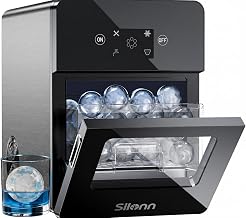
The largest spheres in the roundup at 2.4″, produced three at a time in about forty minutes and up to a hundred a day. That extra diameter matters visually — a bigger sphere holds its shape far longer in the glass, so the drink still looks composed twenty minutes into a conversation.
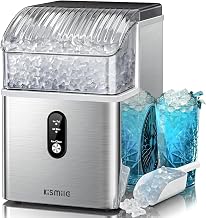
Kismile Nugget Ice Maker
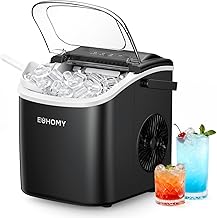
Nugget ice is the opposite aesthetic: soft, chewable, and light-scattering rather than light-bending, which suits highballs, spritzes and anything served tall. At 35 lbs a day and a genuinely low 43 dB, the Kismile is the one to choose if volume and quiet matter more than optical clarity.
Frequently Asked Questions
Why does clear ice look so different under warm lighting?
Cloudy ice diffuses light through thousands of tiny air pockets, so it reads as a dull white mass. Clear ice transmits and refracts instead, picking up the colour temperature of your fixtures and passing it through the liquid.
Do I need a machine, or will a directional-freeze tray do?
Trays work and cost far less, but they demand freezer space, planning and trimming. A dedicated machine matters when you want clear ice available on demand rather than the morning after you remembered to prepare it.
What lighting shows clear ice off best?
A single warm source slightly above and behind the glass, around 2700K, on a dimmer. Side or back placement produces the internal highlights and caustics on the surface below; flat frontal light kills them entirely.
Where should the unit sit on a bar cabinet?
Off to one side with clearance at the rear, ideally out of the direct beam of a downlight so the panels do not glare. If your cabinet has an interior light, keep the machine outside it — the ice should be the brightest object in the scene.
Final Thoughts
For pure optical quality and daily convenience, the COMMODORE LUXECUBE is the one to build a bar around, with the Klaris as the slower, quieter alternative for anyone who values density and flawless flat faces over throughput. If you prefer that single glowing sphere in a rocks glass, the Silonn delivers the largest and longest-lasting; and if your gatherings run to tall drinks and volume, the Kismile or EUHOMY nugget machines will keep the room supplied without ever raising their voice.