Key takeaways
- Optical clarity: Clarity comes from directional freezing, which pushes air and minerals out instead of trapping them mid-sphere. Look for machines that name the process, and test yours by holding a finished ball against a bare lamp — you should see through it, not into a fog.
- Sphere diameter: A 2.4″ or 2.5″ ball fills a rocks glass and gives you a large curved surface to catch highlights. Smaller 2″ spheres refract less but melt slower in multiples and suit coupes and stemmed glassware better.
- Footprint and finish: Anything living permanently on a counter becomes part of your visual composition. Measure the gap under wall cabinets, and check whether the housing reads matte or glossy under downlights, since glossy plastic picks up hotspots that brushed finishes diffuse.
- Output versus occasion: One sphere every 30 to 40 minutes is fine for two people and a nightcap. Hosting means you want daily throughput above 100 pieces plus insulated storage, otherwise you will be rationing ice while guests wait.
- Maintenance and acoustics: Self-cleaning cycles keep scale from clouding future batches, and auto water supply removes the refill interruption. Also listen before committing — a compressor cycling during a quiet, low-lit evening carries further than you expect.
What's inside
Cloudy ice is a lighting problem before it’s a beverage problem. Trapped micro-bubbles scatter every photon that enters the cube, so instead of carrying light through the glass, the ice absorbs it and goes flat and chalky — the visual equivalent of a dead bulb in a picture light. Clear ice does the opposite. A dense, bubble-free sphere behaves like a lens, bending the warm output of a 2700K pendant into the whiskey and throwing amber onto the countertop underneath. If you have spent money on dimmers, backlit shelving, or a decent glass, cloudy ice is the weak link in that whole optical chain.
This guide looks at clear ice ball makers the way a lighting designer looks at any fixture: how the output reads under real domestic light, how the hardware itself sits in a styled room, and whether the thing earns its place on a visible countertop. We cover countertop machines that freeze directionally for optical clarity, plus press-style and tray-style molds for people who would rather keep the bar surface uncluttered and the equipment out of the light.
As an Amazon Associate we earn from qualifying purchases.




🛒 Best Price Today on Amazon
Prime members get fast, free shipping on everything above, plus member-only deals. New members get a 30-day free trial — cancel anytime.
How to Choose a Clear Ice Ball Maker (2026)
- Optical clarity: Clarity comes from directional freezing, which pushes air and minerals out instead of trapping them mid-sphere. Look for machines that name the process, and test yours by holding a finished ball against a bare lamp — you should see through it, not into a fog.
- Sphere diameter: A 2.4″ or 2.5″ ball fills a rocks glass and gives you a large curved surface to catch highlights. Smaller 2″ spheres refract less but melt slower in multiples and suit coupes and stemmed glassware better.
- Footprint and finish: Anything living permanently on a counter becomes part of your visual composition. Measure the gap under wall cabinets, and check whether the housing reads matte or glossy under downlights, since glossy plastic picks up hotspots that brushed finishes diffuse.
- Output versus occasion: One sphere every 30 to 40 minutes is fine for two people and a nightcap. Hosting means you want daily throughput above 100 pieces plus insulated storage, otherwise you will be rationing ice while guests wait.
- Maintenance and acoustics: Self-cleaning cycles keep scale from clouding future batches, and auto water supply removes the refill interruption. Also listen before committing — a compressor cycling during a quiet, low-lit evening carries further than you expect.
The Best Clear Ice Ball Makers (2026) Reviewed
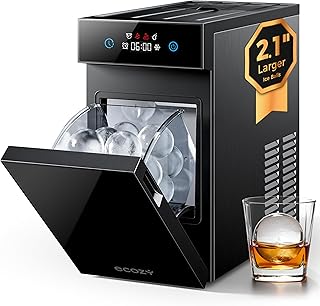
ecozy 2.4″ Clear Ice Ball Maker
The 2.4″ sphere is the sweet spot for refraction in a standard rocks glass, and ecozy’s CrystalFlux freezing delivers genuinely transparent results rather than the semi-frosted compromise most countertop units produce. The narrow body and 8-hour timer make it easy to tuck under a cabinet run and have ice waiting by the time you dim the lights.
Silonn 2.4″ Sphere Ice Maker
Three spheres per 40-minute cycle and roughly 100 pieces a day put this in genuine hosting territory, which matters when a room full of guests is working through a batch faster than a single-mold machine can replace it. Slow-melting density also means the ice holds its shape and its clarity through a long conversation.
ecozy 2.1″ Clear Ice Ball Maker
A slightly smaller sphere for stemmed glassware and tighter counters, with the same clarity engine and a faster 30-minute cycle. Choose this if your bar area is a shallow ledge or a shelf rather than a full worktop.
2.5″ Stainless Steel Ice Ball Press Mold
Two stainless press molds, a storage box, and tongs give you the largest sphere here with no compressor, no power draw, and nothing to style around. The trade-off is freezer time and a little technique, but the resulting 2.5″ ball is the most dramatic light-catcher of the group.
Crystal Clear 4-Cavity Ice Ball Tray
Four 2.5″ spheres per batch from an insulated directional-freeze tray, which is the cheapest honest route to clear ice. Best for anyone who entertains occasionally and would rather keep the counter, and the sightlines, completely clear.
Frequently Asked Questions
Why does clear ice look so much better under warm lighting?
Bubble-free ice transmits and bends light instead of scattering it, so a warm bulb reads as a bright core and a soft amber cast on the surface below. Cloudy ice diffuses that same light into a dull grey mass.
Do I need distilled water?
Filtered tap water is usually enough with a directional-freezing machine. Distilled water helps in hard-water areas and reduces scale that gradually dulls output.
How long does a 2.4″ sphere last in a drink?
Typically 30 to 45 minutes of slow dilution, thanks to the low surface-area-to-volume ratio of a dense sphere.
Are countertop machines loud?
Most run around the level of a small fridge during the freeze cycle. Position them away from seating if you care about a quiet room.
Final Thoughts
For most homes the ecozy 2.4″ is the right balance of clarity, compact styling, and hands-off timing, while the Silonn 2.4″ is the better call if you host and need real volume. If you would rather keep your counter and your lighting scheme uninterrupted, the stainless 2.5″ press mold produces the most striking sphere of all with nothing left on display.