Our Top Picks


As an Amazon Associate we earn from qualifying purchases.
One good 8-inch chef’s knife handles the great majority of kitchen work: breaking down onions and herbs, slicing proteins, dicing root vegetables and gliding through a melon. Sets fill a block with tools most cooks rarely touch, but a single well-chosen chef’s knife earns its counter space every day. The five knives below span the main schools of design — a forged German classic, two stamped workhorses built for professional lines, and two Japanese blades with thinner, harder edges — so you can match the knife to your grip, your sharpening habits and the way you actually cook.
Disclosure: This article contains affiliate links. If you buy through a link on this page, we may earn a commission at no additional expense to you.
How to Choose a Chef’s Knife
Start with the steel and its hardness. Hardness, measured in HRC, decides how long an edge lasts and how it must be maintained. Softer Western steels around 56 HRC dull sooner but shrug off rough treatment and sharpen quickly on almost any tool. Harder Japanese steels at 59–61 HRC hold a fine edge far longer, yet they can chip if you twist the blade in a joint or lever through frozen food, and they reward a whetstone over a pull-through sharpener.
Forged versus stamped is a feel decision. A forged knife is shaped from a single blank of steel, usually with a full bolster and a heavier, planted feel that suits a rocking chop. A stamped knife is cut from a sheet, so it is lighter and more nimble, and the missing bolster lets you sharpen the entire edge from tip to heel. Neither is automatically better; your wrist and your cutting style decide.
Weight and balance change how long you can work. A knife near 8.5 oz powers through squash and cabbage with momentum. One near 6 oz feels like an extension of your hand during an hour of fine dice. Check where the balance point sits: at the bolster suits a pinch grip, slightly handle-heavy suits a full grip.
Handle shape matters more than handle material. Textured synthetic handles stay secure with wet or greasy hands, which is why working kitchens standardise on them. Smooth riveted handles feel traditional and clean easily. All-metal handles look seamless and hygienic but can feel slick and cold, and they transmit every vibration from the board.
Match the edge to your board and habits. A plain edge around 15 degrees per side is the versatile default. Hollow-edge dimples reduce drag on potatoes, cheese and other sticky foods. Whatever you choose, plan the upkeep: a honing rod for weekly alignment, a stone or guided system a few times a year, and hand washing if you want the edge and handle to last.
1. Victorinox Fibrox Pro 8-Inch Chef’s Knife

Specs
- Blade: 8 in high-carbon stainless steel, stamped, plain edge
- Model: 45520
- Hardness: 56 HRC (maker figure)
- Edge angle: about 15 degrees per side
- Handle: Fibrox Pro thermoplastic elastomer, textured non-slip grip
- Weight: about 5.8 oz (maker figure)
- Certification: NSF certified; dishwasher safe per maker
- Origin: made in Switzerland
This is the knife professional kitchens buy in quantity, and it is the easiest recommendation on this page. The stamped blade is thin and light, so it falls through onions and herbs without wedging, and the soft-by-Japanese-standards steel is forgiving: it tolerates a steel honing rod, a crowded knife roll and the occasional careless twist. The Fibrox handle is the real standout. Its textured, slightly bulbous shape locks into a wet or greasy palm better than most polished handles at any tier, which is why the design shows up on prep lines everywhere. There is no bolster, so sharpening runs the full length of the edge. It will never be the prettiest knife in the drawer, and the edge needs attention more often than the harder blades below, but as a first serious knife or a dependable daily driver it is very hard to beat.
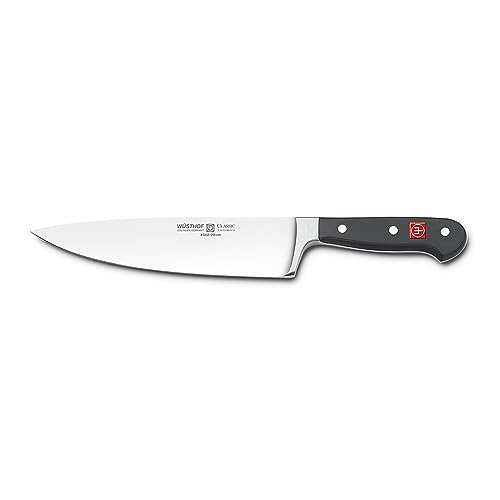
2. Wüsthof Classic 8-Inch Chef’s Knife
Specs
- Blade: 8 in X50CrMoV15 stainless steel, precision forged from one blank
- Model: 4582-7/20
- Hardness: 58 HRC (maker figure)
- Construction: full tang with full bolster
- Handle: black POM synthetic, triple-riveted
- Weight: about 8.5 oz
- Origin: made in Solingen, Germany
The Classic is the reference point for the forged German style. A single blank of steel is forged into a blade with a thick spine, a full bolster and a full tang running through a triple-riveted handle, and the result is a knife with genuine heft. That weight does the work in a rocking chop and powers through celeriac, squash and thick cabbage wedges where lighter knives stall. The bolster protects the fingers and adds to the planted feel, though it also means the last stretch of edge needs care on a stone so a step does not develop over years of sharpening. At 58 HRC the edge is a touch harder than the Victorinox above, so it holds a little longer while staying easy to maintain with a honing steel. Choose this one if you want a single buy-it-for-decades knife and you like your tools with substance.
3. MAC Professional 8-Inch Chef’s Knife with Dimples (MTH-80)
Specs
- Blade: 8 in (200 mm) MAC high-carbon stainless steel, hollow edge with dimples
- Model: MTH-80
- Hardness: 59–61 HRC (maker figure)
- Handle: Pakkawood, riveted
- Weight: about 6.5 oz
- Origin: made in Japan
MAC built its name with professional cooks in Japan, and the MTH-80 shows why. The blade is noticeably thinner than the German pattern, with a hard, fine edge that moves through onions, fish and ripe tomatoes with almost no resistance, and the dimples along the face help slices release instead of climbing the blade. At 59–61 HRC the edge keeps its bite far longer than softer Western steels, and the thin geometry means that when it does need a stone, it comes back quickly. The trade-off is discipline: this is not a knife for prying lids, hacking at bones or twisting through a chicken joint, and the Pakkawood handle wants hand washing. If your cooking leans toward precise knife work and you are willing to treat the edge with respect, this is the sharpest tool on the page.
4. Global G-2 8-Inch Chef’s Knife
Specs
- Blade: 8 in (20 cm) CROMOVA 18 stainless steel (chromium, molybdenum and vanadium alloy)
- Model: G-2
- Hardness: 56–58 HRC
- Construction: one-piece all-stainless blade and handle, seamless
- Handle: hollow stainless steel with dimpled grip, filled for balance
- Weight: about 6.1 oz
- Overall length: about 12.8 in
- Origin: made in Japan
The G-2 looks like nothing else here: blade and handle are one seamless piece of stainless steel, with a hollow handle filled to set the balance point and a dimpled surface for grip. The CROMOVA 18 blade is ground thin with an acute edge, so it cuts with the precision of a Japanese knife, while the moderate hardness keeps it less fragile than the MAC above. At about 6.1 oz it is light and quick, and the seamless construction leaves no seams or rivets to trap food, which makes cleanup simple. Two honest caveats: the metal handle can feel slick with wet hands and cold in a winter kitchen, and its slim profile divides opinion among cooks with large hands. If you like a modern, hygienic, featherweight knife and your grip suits a slim handle, the G-2 is a distinctive and proven choice.
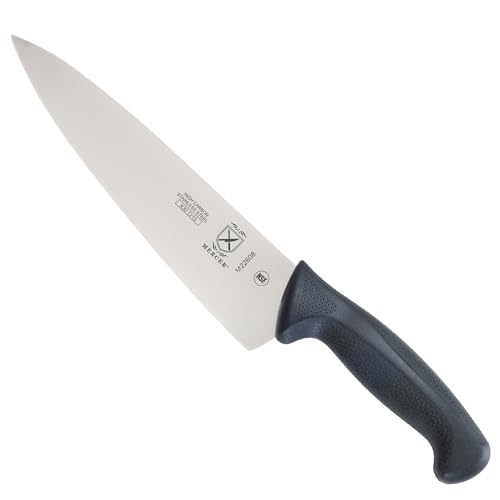
5. Mercer Culinary Millennia 8-Inch Chef’s Knife
Specs
- Blade: 8 in high-carbon, stain-resistant Japanese stainless steel, plain edge
- Model: M22608
- Handle: Santoprene with textured finger points
- Certification: NSF certified
- Care: hand wash recommended by the maker
The Millennia line was designed for culinary schools and working kitchens, and the 8-inch chef’s knife is its centrepiece. The Japanese high-carbon stainless blade takes a keen edge and touches up fast, which matters when the knife is used for hours a day, and the Santoprene handle mixes a soft grip with firmer finger points so it stays put during repetitive prep. Like the Victorinox, it skips the heavy bolster and keeps the weight down for long shifts. It is a plain, working tool with no decorative ambitions, and the steel needs regular honing to stay at its best. For a new cook building skills, a rental kitchen, or anyone who wants a capable second knife that nobody has to baby, the Millennia is the sensible workhorse of this group.
Which One Should You Buy?
If you want one knife and no fuss, take the Victorinox Fibrox Pro: light, grippy, forgiving and easy to maintain. If you prefer heft and a traditional forged feel that will last for decades, the Wüsthof Classic is the anchor knife. For the finest, longest-lasting edge and precision work, choose the MAC MTH-80 and commit to a whetstone. The Global G-2 suits cooks who want Japanese cutting performance in a seamless, lightweight, all-metal design. And the Mercer Culinary Millennia is the pick for high-volume prep, shared kitchens and anyone learning their way around a cutting board. Whichever you choose, pair it with a honing rod and a decent board, and it will repay you at every meal.
More from Amazon
Programs that pair well with the guide above. Offers and eligibility are set by Amazon and may change.
Collect the home and kitchen items you want in one registry that guests can shop from.
Create a wedding registrySet up recurring deliveries of everyday items on eligible products. Terms and savings are set by Amazon.
Explore Subscribe & SaveFree shipping on eligible items, Prime Video and more. Eligible new members can start with a free trial.
Start a Prime free trialAudiobooks and podcasts to listen to on the go. Eligible new members can start with a free trial.
Try Audible freeAs an Amazon Associate we earn from qualifying purchases.