Key takeaways
- IP Rating & Wet Rating: An IP65 or wet-rated label means the fan can handle direct rain, splashing, and humidity — critical for uncovered patios or coastal installations. Dry-rated fans belong strictly under solid roofs with no moisture exposure.
- Motor Type: DC motors run quieter, consume up to 70% less energy than AC motors, and usually offer more speed settings. They’re worth the premium if the fan sits close to a seating or dining zone where hum becomes noticeable.
- Blade Span & Airflow: Smaller 20-to-24-inch fans excel over compact tables or in gazebo corners, while 52-to-65-inch models move serious air across open patios. Match blade diameter to square footage — undersized fans underperform regardless of motor power.
- Lighting Quality: Look for tunable CCT (color temperature tuning) on outdoor fixtures. Warm 2700K light reads inviting under a dining canopy, while 4000K works better for task-heavy barbecue zones. Integrated LEDs with dimming give you real ambience control.
- Mounting & Installation: Plug-in caged fans with hanging hooks simplify installation on pergolas and gazbo beams without hardwiring. Standard-mount fans need a junction box and suit permanent covered structures. Know your ceiling before you buy.
What's inside
Shopping for an outdoor ceiling fan in 2026 means wading through a market flooded with IP ratings, DC motors, and app-connected remotes — specs that matter, but rarely come with honest context about what actually changes the feel of a covered patio or open gazebo. The wrong choice leaves you with a fan that rattles, corrodes, or pushes air in ways that feel more like a wind tunnel than a breeze off the coast.
This guide cuts through the noise. As someone who designs ambient outdoor living spaces for a living, I evaluated each fan below on airflow character, noise signature at low speed, finish durability under real weather exposure, and how well the integrated lighting (where present) complements a curated outdoor palette. Every pick here earned its spot by balancing performance with the kind of design sensibility that makes an outdoor room feel intentional, not improvised.
As an Amazon Associate we earn from qualifying purchases.


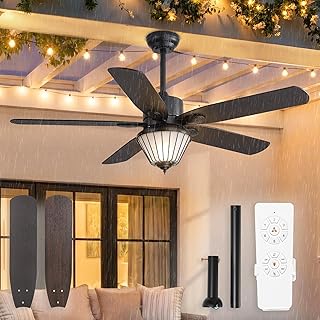
How to Choose a Ceiling Fan Outdoor (2026)
- IP Rating & Wet Rating: An IP65 or wet-rated label means the fan can handle direct rain, splashing, and humidity — critical for uncovered patios or coastal installations. Dry-rated fans belong strictly under solid roofs with no moisture exposure.
- Motor Type: DC motors run quieter, consume up to 70% less energy than AC motors, and usually offer more speed settings. They’re worth the premium if the fan sits close to a seating or dining zone where hum becomes noticeable.
- Blade Span & Airflow: Smaller 20-to-24-inch fans excel over compact tables or in gazebo corners, while 52-to-65-inch models move serious air across open patios. Match blade diameter to square footage — undersized fans underperform regardless of motor power.
- Lighting Quality: Look for tunable CCT (color temperature tuning) on outdoor fixtures. Warm 2700K light reads inviting under a dining canopy, while 4000K works better for task-heavy barbecue zones. Integrated LEDs with dimming give you real ambience control.
- Mounting & Installation: Plug-in caged fans with hanging hooks simplify installation on pergolas and gazbo beams without hardwiring. Standard-mount fans need a junction box and suit permanent covered structures. Know your ceiling before you buy.
The Best Ceiling Fan Outdoor (2026)s Reviewed
Addlon 20-Inch Caged Outdoor Fan with Light
The Addlon’s caged silhouette delivers serious charm to gazebo and porch settings where a conventional blade design would look out of place. Its IP65 plug-in installation makes it a favorite for renters or anyone who doesn’t want to commit to hardwiring — the hanging hook mounts fast, the DC motor runs nearly silent on low, and the reversible airflow pushes warm air down in cooler months.
Hunter Cassius 44-Inch Outdoor Fan
Hunter’s Cassius is the no-nonsense workhorse: 44 inches of matte-black airflow with no integrated light, which is exactly the point if you’ve already curated your own pendant or string-light scheme. The pull-chain control feels analog and dependable, and the three-blade design pushes a clean column of air without the visual clutter of five blades competing for attention.
Minka-Aire Xtreme H2O 65-Inch in Coal
At 65 inches, the Xtreme H2O moves air with the authority of a commercial ceiling fan while keeping its profile surprisingly sleek. The coal finish reads sophisticated against dark-stained timber ceilings, and the DC motor offers effortless speed transitions — no jerky startup, just a gradual build that preserves the calm of an evening patio.
Orison 24-Inch Caged Outdoor Fan with Lights
The Orison nails the smart-home angle with both remote and app control, plus three-color-tunable LED lighting that lets you dial in everything from candlelit dinner warmth to bright task lighting without swapping bulbs. The caged weatherproof housing gives it an industrial edge that pairs beautifully with string lights draped across a pergola.
52-Inch IP65 Waterproof Farmhouse Outdoor Fan
This 52-inch farmhouse-style fan is the value pick that doesn’t feel like a compromise — five dual-finish blades, full wet rating, and a DC motor that delivers six reversible speeds. The black finish disappears against dark ceilings while the dual-finish blade option lets you flip to a lighter wood grain if your space skims more coastal or Scandinavian.
Frequently Asked Questions
Can I use an indoor ceiling fan outdoors?
Only if it carries a damp or wet rating. Indoor fans lack the corrosion-resistant hardware, sealed motor housing, and moisture-safe blade materials needed to survive outdoor humidity, rain splashing, or salt air. Using an indoor fan outside voids the warranty and creates a safety hazard.
What does IP65 mean for a ceiling fan?
IP65 indicates total dust protection (the 6) and resistance to low-pressure water jets from any direction (the 5). For outdoor fans, this means the unit can withstand heavy rain, sprinkler mist, and coastal humidity without water infiltrating the motor or electrical components.
Do outdoor ceiling fans with lights need a separate switch?
Most modern outdoor fans with integrated LEDs include a remote that controls both fan speed and light dimming independently, so a separate wall switch isn’t strictly necessary. Hardwired installations can tie into a single switched circuit, but the remote handles everything at the fan level.
How many CFM should an outdoor ceiling fan produce?
For comfortable seating areas, aim for at least 3,000 to 5,000 CFM on high. Larger uncovered patios benefit from 6,000+ CFM. CFM per watt (efficiency) matters too — DC motor fans typically deliver better ratios, meaning more airflow per unit of energy consumed.
Final Thoughts
For most outdoor spaces, the Addlon 20-inch caged fan offers the best blend of easy installation, quiet operation, and ambient lighting for covered patios and gazebos. If you’re outfitting a large open patio and need serious air movement, the Minka-Aire Xtreme H2O 65-inch in coal is the premium pick that justifies its footprint. Budget-conscious buyers who still want wet-rated reliability and tunable lighting should look closely at the Orison 24-inch — it punches well above its price class in both design and smart-home flexibility.