Key takeaways
- Blade Span and Room Volume: Match blade diameter to square footage — 65 inches covers standard great rooms, 72 inches handles open-concept spaces over 350 square feet, and 96-to-120-inch spans are reserved for commercial or vaulted barn-style ceilings exceeding 600 square feet.
- Downrod Length: A high ceiling demands a longer downrod so the blades sit 8 to 9 feet above the floor. Most manufacturers include 6- and 12-inch options, but for ceilings above 14 feet, plan to purchase an extended downrod separately.
- Motor Type and Noise: DC motors run quieter and use less energy than AC or PMSM alternatives, which matters when a fan is centered over a dining table or bedroom. Look for fans rated under 30 decibels if silence is non-negotiable.
- Light Quality and CCT Control: From a designer’s lens, integrated lighting that offers three color-temperature settings (2700K–5000K) lets you tune the room’s warmth seasonally. Dimmable LED modules with frosted or textured glass shades produce softer, more even downlight than bare-bulb designs.
- Damp Rating and Blade Material: Covered patios and screened porches need damp-rated fans with aluminum or ABS blades that won’t warp with humidity. Indoor-only finishes — raw wood, fabric, or paper composites — deteriorate quickly in outdoor exposure.
What's inside
From a lighting-and-ambience standpoint, tall rooms present a paradox: the extra volume is gorgeous, but a ceiling fan that doesn’t account for it can flatten the entire mood of a space — dangling too low, pushing air sideways, or casting light in all the wrong directions. Buyers end up guessing between industrial-spec models and decorative fixtures that can’t actually move air through 12 or 14 feet of vertical space.
This roundup evaluates six ceiling fans engineered specifically for elevated ceilings, comparing how each handles air delivery, noise, light output, and visual integration into rooms where the ceiling plane itself is a design element. Every pick earns its place based on performance-to-height ratio, not just raw specs.
As an Amazon Associate we earn from qualifying purchases.


🛒 Best Price Today on Amazon
Prime members get fast, free shipping on everything above, plus member-only deals. New members get a 30-day free trial — cancel anytime.
How to Choose a Ceiling Fan For High Ceilings (2026)
- Blade Span and Room Volume: Match blade diameter to square footage — 65 inches covers standard great rooms, 72 inches handles open-concept spaces over 350 square feet, and 96-to-120-inch spans are reserved for commercial or vaulted barn-style ceilings exceeding 600 square feet.
- Downrod Length: A high ceiling demands a longer downrod so the blades sit 8 to 9 feet above the floor. Most manufacturers include 6- and 12-inch options, but for ceilings above 14 feet, plan to purchase an extended downrod separately.
- Motor Type and Noise: DC motors run quieter and use less energy than AC or PMSM alternatives, which matters when a fan is centered over a dining table or bedroom. Look for fans rated under 30 decibels if silence is non-negotiable.
- Light Quality and CCT Control: From a designer’s lens, integrated lighting that offers three color-temperature settings (2700K–5000K) lets you tune the room’s warmth seasonally. Dimmable LED modules with frosted or textured glass shades produce softer, more even downlight than bare-bulb designs.
- Damp Rating and Blade Material: Covered patios and screened porches need damp-rated fans with aluminum or ABS blades that won’t warp with humidity. Indoor-only finishes — raw wood, fabric, or paper composites — deteriorate quickly in outdoor exposure.
The Best Ceiling Fans For High Ceilings (2026) Reviewed
TCL 72-Inch White Large Ceiling Fan
Three selectable color temperatures and a clean matte-white housing make this fan disappear into a white ceiling plane while delivering strong, even airflow across large living areas. The dual-finish blades can be flipped between white and a contrasting tone, giving you two looks from a single installation — a detail that matters when you’re designing around existing trim work.
ZMISHIBO 72-Inch Ceiling Fan with Lights
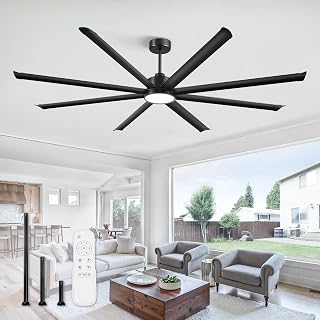
With 24 watts of dimmable tri-CCT LED and a damp rating, this model bridges indoor comfort and covered-outdoor durability without requiring two separate purchases. The DC motor stays remarkably quiet at every speed, and the black dual-finish blades read modern without tipping into industrial — exactly the balance a designer wants over a living room or patio seating area.
65-Inch Farmhouse Ceiling Fan with Light
At a friendlier price point, this 65-inch fan brings textured glass shading and an E26 base into a farmhouse silhouette that works surprisingly well in transitional interiors. The six-speed reversible motor runs smooth enough for bedrooms, though it’s the dual-finish blades and flexible downrod lengths that give this model real versatility across rooms with varying ceiling heights.
ZMISHIBO 96-Inch Ceiling Fan with Lights
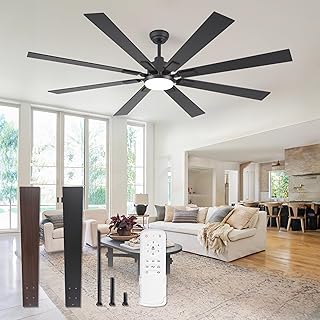
When a 72-inch fan simply can’t move enough air, this 96-inch industrial-grade unit steps up with eight aluminum blades and a quiet DC motor built for rooms north of 500 square feet. It still includes integrated three-CCT lighting, which most competitors at this scale skip entirely — making it a genuine one-unit solution for high-ceiling garages, workshops, or gazebo structures.
AA-Orion 120-Inch HVLS Industrial Ceiling Fan
This is not a residential compromise; it is a 120-inch, 28,000-CFM machine designed for warehouses, gyms, and barns where total air volume matters more than aesthetics. The PMSM motor handles continuous operation without the heat buildup of traditional industrial fans, and the silver finish at least keeps the visual profile clean. For anyone outfitting a commercial space attached to a home — a converted barn gym, a large shop — this is the fan that actually works.
Frequently Asked Questions
What ceiling height requires a longer downrod?
Fans installed above 9 feet of clearance generally perform better with a downrod longer than the included 6 or 12 inches. For 12-to-14-foot ceilings, a 24-inch downrod places blades at an effective height, while ceilings above 16 feet typically call for a 36-to-48-inch rod to maintain proper air circulation and room aesthetics.
Can I use a high-ceiling fan with a vaulted or sloped ceiling?
Most ceiling fans on this list support sloped ceilings up to 15 degrees with an included angled canopy adapter. For steeper pitches above 20 degrees, confirm that the manufacturer offers a compatible sloped-ceiling mount, as a flat-canopy installation on an angled surface creates vibration and reduces blade-to-ceiling clearance.
How much louder are HVLS fans compared to residential models?
Large HVLS fans like the 120-inch AA-Orion produce a lower-frequency hum rather than the higher-pitched whir of smaller residential fans. At typical operating speeds, they register between 35 and 45 decibels — comparable to a quiet conversation — while most DC-motor residential fans stay under 30 decibels.
Is a DC motor worth the price premium over an AC motor?
DC motors consume roughly 60 percent less energy, run noticeably quieter, and offer more speed settings than their AC counterparts. Over a fan’s lifespan in a room where it runs daily, the energy savings alone typically offset the higher upfront cost within two to three years.
Final Thoughts
For most high-ceiling homes, the TCL 72-inch White hits the best balance of clean design, flexible lighting, and quiet operation. Rooms that extend into covered outdoor spaces benefit most from the ZMISHIBO 72-inch, whose damp rating and tri-CCT LED give a designer genuine control over ambiance. And for anyone facing a truly massive volume — a converted barn, a workshop addition, or a vaulted great room exceeding 600 square feet — the ZMISHIBO 96-inch delivers commercial-scale airflow without sacrificing integrated lighting.