Key takeaways
- Measure the opening, not the window: Casement units are tall and slim, often around 14–15 inches wide by 23–24 inches high. Record the clear interior width at the narrowest point and the full crank-out swing before you shop.
- Protect the daylight you have: A unit that occupies the lower third of a vertical opening leaves the top pane clear. That upper band of glass does most of the work for ambient light, so guard it.
- Match BTUs to the room, not the fear: Roughly 8,000 BTU handles 350 sq ft, 10,000 BTU covers 450 sq ft. Oversizing chills fast, then short-cycles, leaving air clammy and the compressor cycling loudly.
- Weigh noise as an ambience decision: Inverter compressors modulate instead of slamming on and off, which reads as steady background air rather than an interruption. In bedrooms and reading corners, that difference matters more than a single BTU spec.
- Plan the seal and the support: Vertical installs need a sturdy sill bracket and closed-cell foam at the frame edges. Gaps leak conditioned air, invite insects, and undercut the tidy look of a well-dressed window.
What's inside
Casement and crank-out windows are a gift to a room’s light. They swing wide, pull in a clean sheet of daylight, and frame a view without a horizontal sash cutting across it. Then July arrives, and you discover that almost every air conditioner on the shelf is built for a window that slides up and down. Drop a standard unit into a tall, narrow casement opening and you get a gap-toothed install, a wobbly seal, and a plywood filler panel where your afternoon glow used to be.
This guide is written from a lighting-and-ambience perspective as much as a cooling one: which units fit vertical openings, which ones spare the upper glass, and which keep the hum low enough that a quiet evening stays quiet. Below you’ll find true casement-format models alongside two alternatives worth considering when a purpose-built unit isn’t available in your size.
As an Amazon Associate we earn from qualifying purchases.



How to Choose a/an Casement Window Air Conditioner (2026)
- Measure the opening, not the window: Casement units are tall and slim, often around 14–15 inches wide by 23–24 inches high. Record the clear interior width at the narrowest point and the full crank-out swing before you shop.
- Protect the daylight you have: A unit that occupies the lower third of a vertical opening leaves the top pane clear. That upper band of glass does most of the work for ambient light, so guard it.
- Match BTUs to the room, not the fear: Roughly 8,000 BTU handles 350 sq ft, 10,000 BTU covers 450 sq ft. Oversizing chills fast, then short-cycles, leaving air clammy and the compressor cycling loudly.
- Weigh noise as an ambience decision: Inverter compressors modulate instead of slamming on and off, which reads as steady background air rather than an interruption. In bedrooms and reading corners, that difference matters more than a single BTU spec.
- Plan the seal and the support: Vertical installs need a sturdy sill bracket and closed-cell foam at the frame edges. Gaps leak conditioned air, invite insects, and undercut the tidy look of a well-dressed window.
The Best Casement Window Air Conditioner (2026)s Reviewed
Perfect Aire 10,000 BTU Casement Air Conditioner
This is the purpose-built answer: a 14.75-inch-wide chassis designed for sliding and crank-out frames, with a digital LED readout and a Follow Me remote that reads temperature where you’re actually sitting. Because it stacks vertically, the upper glass stays open to daylight rather than disappearing behind a filler panel.
ELEMENT 10,000 BTU Window Casement AC (ESC10BE)
A straightforward vertical-format unit that covers 450 sq ft without fuss or app-pairing rituals. It’s the sensible pick for a home office or guest room where you want a clean install, mechanical simplicity, and a low profile against the sill.
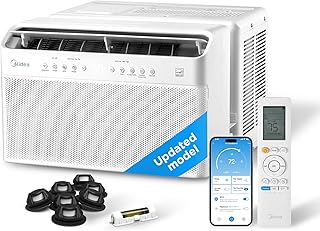
Midea 10,000 BTU U-Shaped Smart Inverter
The U-shape lets the sash close through the middle of the unit, which puts the glass between you and the compressor and drops the noise floor dramatically. Note it needs a sliding sash to work, so it belongs on your list only if you have a double-hung window elsewhere in the room, but as an ambience-first cooler it’s the quietest option here.
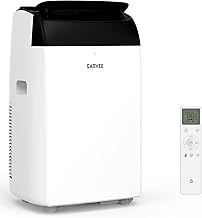
Air Choice 10,000 BTU Portable Air Conditioner
When a casement opening simply won’t accept a fixed chassis, a portable unit vents through a slim hose kit and leaves the entire pane unobstructed. You trade floor space and a little efficiency for a window that still looks like a window.
BLACK+DECKER 12,000 BTU Window AC (BWAC12WTB)
A capable, well-reviewed horizontal unit for larger rooms up to 550 sq ft, with three cooling speeds and a fan-only mode for mild evenings. It is not a casement fit, so consider it for the double-hung window down the hall while a slim vertical model handles the crank-out.
Frequently Asked Questions
Can I use a regular window air conditioner in a casement window?
Not safely. Standard units are wider than they are tall and rely on a sash sliding down onto the top of the chassis. A casement opening leaves them unsupported, and the improvised panels people build to fill the gap tend to leak air and light.
What size unit do I need for a bedroom?
For most bedrooms under 450 sq ft, 8,000 to 10,000 BTU is the right band. An 8,000 BTU model suits rooms up to about 350 sq ft, particularly north-facing spaces that don’t take direct afternoon sun.
Will the unit block my view or darken the room?
A vertical casement unit typically fills the bottom half of the opening, leaving the upper pane clear for daylight. Pairing it with a light-filtering shade above keeps the room feeling open rather than boxed in.
Do these units drain water indoors?
Most self-evaporate condensate during normal cooling. In very humid weather, expect occasional dripping outside, and confirm the unit is pitched slightly toward the exterior during installation.
Final Thoughts
For a genuine casement fit, the Perfect Aire 10,000 BTU is the most complete package thanks to its Follow Me remote and slim vertical body, with the ELEMENT ESC10BE close behind as the simpler, no-frills alternative. If you have a sliding sash available in the same room, the Midea U-Shaped Inverter remains the quietest way to cool a space without sacrificing the light.