Key takeaways
- Pressure ceiling, not pressure bragging: Automotive clear coat is happiest between roughly 1200 and 1900 PSI at the nozzle. A 2500 PSI machine is fine — desirable, even — provided you can dial it down with a wider fan tip. Raw maximum numbers matter less than your ability to modulate them.
- Flow rate governs evenness: GPM is what carries loosened grit off the panel before it drags. A steady 1.7-plus GPM sheets water across a door in one pass, which is what prevents the streaky, patchy sheen that shows up the moment low light hits the surface.
- Nozzle range as a dimmer: Think of tips the way you think of beam spreads. A 40-degree fan is your ambient wash, 25 degrees is your accent, and the red 0-degree pencil beam has no business anywhere near bodywork. More included nozzles means finer control.
- Foam delivery quality: Thick, clinging foam buys dwell time, and dwell time is what lifts bonded contaminants instead of scraping them. Onboard tanks are convenient; a dedicated foam cannon produces denser lather and better results on neglected paint.
- Where you actually park: Corded units need an outlet and a spigot. If you are washing at a curb, in a shared garage, or on gravel, a battery unit or a bucket-fed 12V pump is the difference between a clean car and a good intention.
What's inside
Spend enough years aiming lamps at surfaces and you learn an uncomfortable truth: light does not flatter dirt, it audits it. A grazing beam across a car hood will find every water spot, every film of road grime, every dull patch where oxidation has softened the reflection. Homeowners notice this most in the driveway at dusk, when a porch fixture or a low garage wash rakes across the paint at a shallow angle and turns a “clean” vehicle into a topographical map of everything the sponge missed. The problem is rarely effort. It is that hand washing leaves a microscopically uneven surface, and raking light is merciless to unevenness.
This guide approaches car pressure washers the way a lighting designer approaches a finish sample: what does it do to reflectivity, does it clean consistently across a whole panel, and can you control intensity so you are polishing the surface rather than scarring it? Below are the machines worth your driveway time in 2026, plus the specs that actually govern how your car reads under real light — sunlight, sodium streetlamps, and that unforgiving LED over the garage door.
As an Amazon Associate we earn from qualifying purchases.



How to Choose a/an Car Pressure Washer (2026)
- Pressure ceiling, not pressure bragging: Automotive clear coat is happiest between roughly 1200 and 1900 PSI at the nozzle. A 2500 PSI machine is fine — desirable, even — provided you can dial it down with a wider fan tip. Raw maximum numbers matter less than your ability to modulate them.
- Flow rate governs evenness: GPM is what carries loosened grit off the panel before it drags. A steady 1.7-plus GPM sheets water across a door in one pass, which is what prevents the streaky, patchy sheen that shows up the moment low light hits the surface.
- Nozzle range as a dimmer: Think of tips the way you think of beam spreads. A 40-degree fan is your ambient wash, 25 degrees is your accent, and the red 0-degree pencil beam has no business anywhere near bodywork. More included nozzles means finer control.
- Foam delivery quality: Thick, clinging foam buys dwell time, and dwell time is what lifts bonded contaminants instead of scraping them. Onboard tanks are convenient; a dedicated foam cannon produces denser lather and better results on neglected paint.
- Where you actually park: Corded units need an outlet and a spigot. If you are washing at a curb, in a shared garage, or on gravel, a battery unit or a bucket-fed 12V pump is the difference between a clean car and a good intention.
The Best Car Pressure Washer (2026)s Reviewed
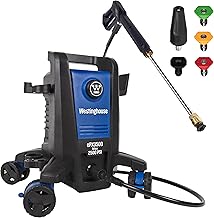
Westinghouse ePX3500
The most complete package here: 2500 max PSI and 1.76 max GPM give you enough flow to sheet an entire door panel in a single stroke, which is exactly how you avoid the mottled drying pattern that low sun exposes. The anti-tipping base is not a gimmick either — a unit that stays planted lets you keep a consistent standoff distance, and consistent distance is consistent gloss.
Power Washer with 4 Nozzles and Foam Cannon (Bright Green)
A sensible value pick that leads with the accessory kit rather than the spec sheet, and the included foam cannon is the reason to consider it. Quick-connect tips let you step down from driveway duty to paint-safe pressure in seconds, which encourages the habit of actually changing nozzles instead of powering through with the wrong one.
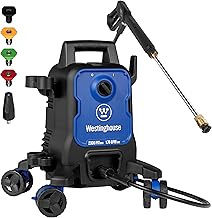
Westinghouse ePX3100
Essentially the ePX3500’s temperament with the volume turned down: 2300 max PSI, the same 1.76 max GPM, the same five-nozzle set and steel wand. For anyone whose main job is cars rather than fence restoration, this is arguably the more rational purchase.
Westinghouse ePX3100v
At 2100 max PSI with a detachable foam cannon and a built-in carry handle, this is the version aimed squarely at vehicle care. The three-nozzle set is leaner, but every tip in it is one you would reasonably use on paint.
6-in-1 Cordless Pressure Washer
Two 4.0Ah batteries and 1300 PSI make this the answer to washing where no outlet exists — apartment lots, driveways without a nearby spigot, detailing away from home. It draws from a bucket or barrel, so runtime and water discipline both matter, but for touch-ups and wheel arches it is genuinely liberating.
Frequently Asked Questions
Will a 2500 PSI washer damage my paint?
Not if you use the correct nozzle and keep the wand roughly 12 to 18 inches from the surface. Damage comes from narrow tips held close, not from a machine’s headline rating.
Do I still need to hand wash afterward?
For a truly reflective finish, yes — foam, rinse, then a gentle contact wash with a clean mitt. Pressure removes the abrasive particles that would otherwise be dragged across the clear coat.
Is a cordless model powerful enough for a car?
For maintenance washes, wheels, and interiors of wheel wells, comfortably so. For heavily soiled vehicles or seasonal deep cleans, a corded unit’s sustained flow does the job faster.
What about very compact 12V pumps?
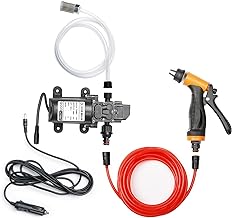
Kits like the Portable Intelligent Electric Pressure Washer Pump, at 100W and 160 PSI with a 21.3 ft hose, are best understood as smart rinse tools — excellent for dust, pollen, and garden tasks, not a substitute for a pressure washer.
Final Thoughts
If you want one machine that leaves paint reading cleanly under any light, the Westinghouse ePX3500 is the confident choice, with the ePX3100 close behind at lower intensity and lower cost. For anyone washing away from a fixed water and power source, the 6-in-1 cordless unit is the pick that actually gets used.