Key takeaways
- Flow before pressure: GPM carries contaminant away; PSI only pries it loose. For paint, 1.5–2.0 GPM at moderate pressure beats a high-PSI machine with a thin stream every time.
- Foam delivery: A cannon with an adjustable metering knob produces clinging, shaving-cream foam that dwells long enough to soften road film. Thin, runny suds slide off before the chemistry works.
- Nozzle range: You want a 40-degree fan and a soap tip you actually trust. Turbo and 0-degree tips have their uses on concrete, but they have no business near a clear coat.
- Motor design: Brushless induction motors run cooler, quieter, and longer than universal motors. If you detail on weekend mornings near neighbors, this matters more than a spec sheet suggests.
- Reach and stability: A 25-foot hose and a wide, low base let you circle a vehicle without dragging the unit over. Tipping mid-rinse means an interrupted sheet of water — and interrupted water dries into spots.
What's inside
I spend my working life arranging light so surfaces behave. A raking beam across a walnut credenza, a soft wash on plaster, a hard specular hit on lacquer — the material never changes, but the light decides whether it reads as luxurious or tired. Car paint is the same problem in a different envelope: a clear coat is just a mirror with a color underneath it. Which is why so many people scrub a car for two hours, roll it into afternoon sun, and see every swirl, water spot, and dried soap edge they thought they had removed. The defect was always there. The light simply told the truth.
A good pressure washer is a lighting tool disguised as a cleaning tool. It lifts grit before a mitt can drag it, it lays foam evenly so dwell time is consistent, and it rinses without leaving mineral halos that catch the sun. This guide looks at the machines worth owning in 2026 for paint-safe detailing — judged on flow rate, foam quality, nozzle control, and how they handle the reflective finishes we care about, whether that’s a hood or a high-gloss cabinet door on the patio.
As an Amazon Associate we earn from qualifying purchases.


🛒 Best Price Today on Amazon
Prime members get fast, free shipping on everything above, plus member-only deals. New members get a 30-day free trial — cancel anytime.
How to Choose a Car Detailing Pressure Washer (2026)
- Flow before pressure: GPM carries contaminant away; PSI only pries it loose. For paint, 1.5–2.0 GPM at moderate pressure beats a high-PSI machine with a thin stream every time.
- Foam delivery: A cannon with an adjustable metering knob produces clinging, shaving-cream foam that dwells long enough to soften road film. Thin, runny suds slide off before the chemistry works.
- Nozzle range: You want a 40-degree fan and a soap tip you actually trust. Turbo and 0-degree tips have their uses on concrete, but they have no business near a clear coat.
- Motor design: Brushless induction motors run cooler, quieter, and longer than universal motors. If you detail on weekend mornings near neighbors, this matters more than a spec sheet suggests.
- Reach and stability: A 25-foot hose and a wide, low base let you circle a vehicle without dragging the unit over. Tipping mid-rinse means an interrupted sheet of water — and interrupted water dries into spots.
The Best Car Detailing Pressure Washer (2026)s Reviewed
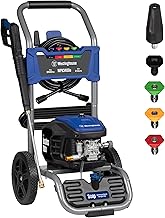
Westinghouse WPX3400e
The brushless motor and 2.0 GPM flow make this the most capable machine here — enough volume to sheet-rinse a full-size SUV in a single pass, which is the single best trick for avoiding water spots. Treat the higher pressure as headroom for driveways, not something to aim at paint.
Sun Joe SPX3000
Two onboard detergent tanks let you keep a pH-neutral wash soap and a wheel cleaner loaded simultaneously, so you never break rhythm mid-detail. It’s a proven, unfussy platform, and the PWMA-rated 2030 PSI is an honest number rather than a marketing peak.
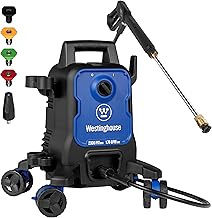
Westinghouse ePX3100
Anti-tipping geometry sounds like a footnote until you’ve knocked a washer over while reaching across a roof. With a steel wand, five nozzles, and a soap tank, this is the balanced choice for someone detailing one or two cars regularly.
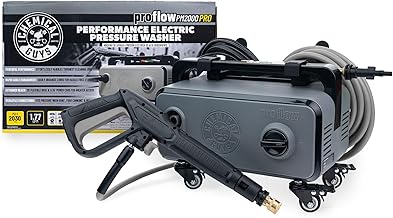
Chemical Guys PM2000 PRO
Built by a company that thinks in chemistry rather than horsepower, and it shows in the foam quality and the generous 25-foot hose. If your priority is consistent dwell and gentle contact washing, this is the most detail-native machine on the list.
Hiclean 2100 PSI
Compact, light, and green enough to find in a cluttered garage, this is the sensible entry point for apartment dwellers and small driveways. The included foam cannon and fan nozzle cover the fundamentals without asking for storage space you don’t have.
Frequently Asked Questions
How much pressure is safe on car paint?
Stay between roughly 1,200 and 1,900 PSI at the surface, use a 40-degree tip, and keep the wand about a foot away. Distance and angle do more to protect a finish than the machine’s rating.
Do I really need a foam cannon?
Yes, if you care about swirl marks. Foam encapsulates grit and lifts it before your mitt makes contact, which is where nearly all wash-induced scratching happens.
Can I use one on outdoor furniture?
On teak, aluminum, and powder-coated frames, absolutely — at low pressure with a fan tip. Avoid it on rattan, veneered pieces, and anything with an open joint, where water intrusion causes more damage than dirt ever would.
Electric or gas for detailing?
Electric, without hesitation. Gas machines deliver pressure most paint doesn’t want, and no one enjoys exhaust fumes drifting across a freshly foamed panel.
Final Thoughts
If you want one machine that handles paint and hardscape with equal composure, the Westinghouse WPX3400e has the flow and the quiet brushless motor to justify it. Detail-focused buyers should look at the Chemical Guys PM2000 PRO for its foam consistency, while the Sun Joe SPX3000 remains the most sensible value in the category. Wash in shade, rinse in volume, then let the light have its say.