Key takeaways
- Thickness and rail clearance: Measure from the slat deck to the top of the guardrail and subtract at least 5 inches. Most bunk frames land you at 5 or 6 inches of mattress, and going thicker undermines the rail’s entire purpose.
- Heat at the top bunk: Warm air pools near the ceiling, so the upper sleeper runs hotter than anyone expects. Gel-infused or graphite-infused foam moves heat sideways out of the sleep surface rather than trapping it.
- Firmness over plushness: Thin mattresses have no depth to spare. Medium firm keeps a lighter sleeper floating on the support layer instead of sinking through to hard slats.
- Verified safety materials: Look for CertiPUR-US foam and explicitly fiberglass-free construction. Kids’ bedding gets stripped, jumped on, and dragged, and a compromised cover shouldn’t expose anything worrying.
- Covers you can actually clean: A removable, washable cover saves you from wrestling a full mattress down a ladder. Light-colored covers also bounce whatever lamp light reaches the lower bunk, which makes a dim alcove read as calmer rather than gloomy.
What's inside
Most bunk bed shopping goes wrong at the tape measure. Buyers pick a mattress the way they’d pick one for a primary bedroom, and then the top bunk sits so high that the guardrail stops doing its job, or the lower bunk turns into a low-ceilinged cave where a reading lamp throws hard shadows across the pillow instead of soft, usable light. I spend my working hours tuning how rooms feel after dark, and bunk nooks are the trickiest fixture problem in any kids’ room: two sleeping zones stacked inside one column of air, each needing its own pool of light, its own airflow, and its own clearance. Mattress thickness quietly decides all three.
This guide looks at bunk-appropriate twin mattresses through that lens. Everything here is 5 or 6 inches thick, which is the range that keeps a top-bunk sleeper safely below the rail and leaves the lower bunk enough vertical room for a clip light or wall sconce to spread properly. I’ve weighed firmness, heat behavior, safety certifications, and the practical stuff that matters when a mattress lives eighteen inches from a ceiling or beneath a slat deck that blocks half the room’s ambient glow.
As an Amazon Associate we earn from qualifying purchases.



How to Choose Bunk Bed Mattresses in 2026
- Thickness and rail clearance: Measure from the slat deck to the top of the guardrail and subtract at least 5 inches. Most bunk frames land you at 5 or 6 inches of mattress, and going thicker undermines the rail’s entire purpose.
- Heat at the top bunk: Warm air pools near the ceiling, so the upper sleeper runs hotter than anyone expects. Gel-infused or graphite-infused foam moves heat sideways out of the sleep surface rather than trapping it.
- Firmness over plushness: Thin mattresses have no depth to spare. Medium firm keeps a lighter sleeper floating on the support layer instead of sinking through to hard slats.
- Verified safety materials: Look for CertiPUR-US foam and explicitly fiberglass-free construction. Kids’ bedding gets stripped, jumped on, and dragged, and a compromised cover shouldn’t expose anything worrying.
- Covers you can actually clean: A removable, washable cover saves you from wrestling a full mattress down a ladder. Light-colored covers also bounce whatever lamp light reaches the lower bunk, which makes a dim alcove read as calmer rather than gloomy.
The Best Bunk Bed Mattresses Reviewed
FDW 5 Inch Twin Gel Memory Foam Mattress
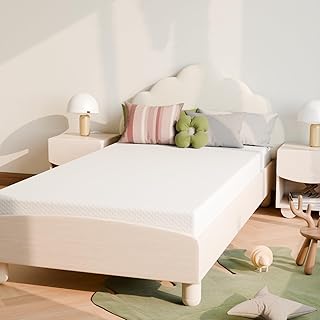
The dual-layer build gives this one more genuine support than its 5-inch profile suggests, and the white removable cover is a quiet advantage in a shadowed lower bunk where every reflective surface helps. A strong default pick when your frame has tight rail clearance.
Twin 5 Inch Fiberglass-Free Cooling Gel Mattress
Built specifically for bunks, daybeds, and trundles, with fiberglass-free construction stated up front rather than buried in a spec sheet. The cooling gel layer handles the warm upper-bunk air well, and the low profile leaves headroom intact.
MLILY 5 Inch Twin Mattress in a Box
Made in the USA with green tea gel infusion, this is the one I’d recommend for parents who care about off-gassing in a small, poorly ventilated room. At 75″ x 38″ it suits narrower vintage bunk frames that modern 39″ mattresses overhang.
Dopinmin 6 Inch Twin Bunk Bed Mattress
The extra inch buys noticeably better pressure relief for older kids and preteens without pushing past most guardrails. Medium-firm and gel-infused, it’s the sweet spot if your frame’s rail height allows it.
LIFEMENT 6 Inch Graphite Cooling Twin Mattress
Graphite conducts heat away faster than standard gel beads, which shows up on hot nights in the top bunk. The Basic version covers the essentials; step up to the Essential Graphite if motion isolation matters, since bunk frames transmit every shift between levels.
Frequently Asked Questions
How thick should a bunk bed mattress be?
Five to six inches for most frames. Confirm that at least 5 inches of guardrail sits above the finished mattress surface before buying.
Is 5 inches too thin for a growing child?
Not for most kids under roughly 100 pounds, provided the mattress is medium firm. Heavier or older sleepers do better on 6 inches.
Do these work on trundle and daybed frames?
Yes. Low-profile twins are ideal there, since a thick mattress can prevent a trundle from rolling back under the main bed.
How long does a compressed mattress need to expand?
Give it 24 to 48 hours in a well-lit, ventilated room before adding bedding. Thin foam recovers faster than full-depth mattresses.
Final Thoughts
For tight rail clearance and easy upkeep, the FDW 5 Inch is the safest all-around choice. If your frame allows 6 inches, the Dopinmin delivers the best support for a growing kid, while the LIFEMENT Graphite is the one I’d put on a top bunk in a warm room where heat collects near the ceiling.