Key takeaways
- 2.2–2.5 cubic feet: compact capacity for one or two people; best for smaller weekly loads.
- 4.5–5.0 cubic feet: versatile full-size capacity for couples and families.
- 5.0 cubic feet or more: helpful for comforters and large family loads, but only if the laundry room can accommodate the deeper cabinet.
- 7.0–7.4 cubic feet: a practical full-size dryer range that can keep up with a large washer.
- Quick wash: useful for lightly worn clothes, but it is not a substitute for a full cycle on towels, bedding, or stained garments.
- Extra rinse: worthwhile for sensitive skin, allergies, or households that use powdered detergent.
- Load sensing: helps reduce water use, but a deep-fill option can be useful for heavily soiled loads.
- Moisture sensing: more useful than a countdown timer because it can limit overdrying and fabric wear.
The best budget washer and dryer is usually a matched, full-size top-load pair for the lowest purchase price, a compact 24-inch ventless set for apartments, or a front-load pair when lower water use, stacking, and gentler clothing care matter more than the initial cost.
Best budget washer-and-dryer sets by situation
| Situation | Best configuration | Typical combined price | What to prioritize |
|---|---|---|---|
| Small apartment or closet | 24-inch compact front-load washer and ventless heat-pump dryer | $1,600–$3,000 | 23.5–25-inch depth, reversible door, 120-volt operation, stacking kit |
| Family with children | 4.5–5.3-cubic-foot top-load washer and 7.0–7.4-cubic-foot electric dryer | $900–$1,700 | Large capacity, deep-fill option, quick wash, lint-filter access |
| Renters | Standard top-load pair or compact ventless pair | $700–$2,500 | Simple hookups, no gas conversion, easy relocation, stackability if space is limited |
| Lowest utility use | ENERGY STAR front-load washer with heat-pump dryer | $1,800–$3,500 | Low water consumption, moisture sensors, low-temperature drying |
| Back or knee concerns | Front-load set on a manufacturer-approved pedestal | $1,300–$2,800 | Raised loading height, wide door, smooth-gliding drawer, minimal bending |
1. Best low-cost choice: a basic top-load pair
A basic top-load washer paired with a standard electric dryer is the most affordable route for many households. The washer typically costs about $400–$800, while the dryer costs about $450–$900. Look for a washer with at least 4.5 cubic feet and a dryer with at least 7.0 cubic feet so bulky towels and bedding do not become a weekly struggle.
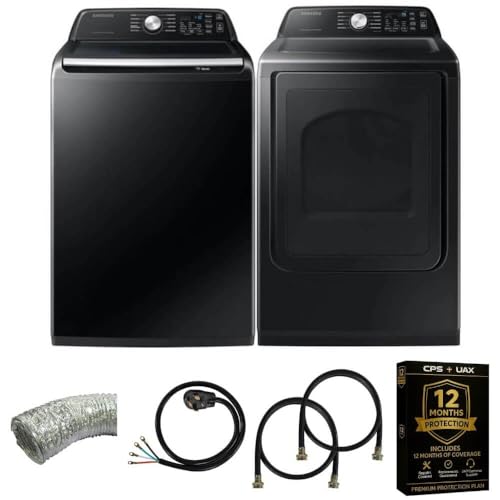
Samsung Smart 4.7 Cu Ft Top Load Washer & 7.4 Cu Ft Electric Dryer, Sensor Stops Overdrying, Low Vibration Quiet Wash, WaterJet w/Power Cords, Hoses, Vent Duct, 1 Year CPS Protection Bundle (Black)
Included for 'Best Budget Washer and Dryer Sets' because the listing specifies Sensor Stops Overdrying and Low Vibration Quiet Wash, details this guide uses to compare options.
View on Amazon
Midea Washer Dryer Combo 2.7 Cu.ft 24" All-in-One Front Load 1400 RPM White
Included for 'Best Budget Washer and Dryer Sets' as a relevant option in this category; details come from the product listing.
View on Amazon
Hamilton Beach 2.65 Cu Ft All-In-One Apartment Size Washer and Dryer Combo
Included for 'Best Budget Washer and Dryer Sets' as a relevant option in this category; details come from the product listing.
View on Amazon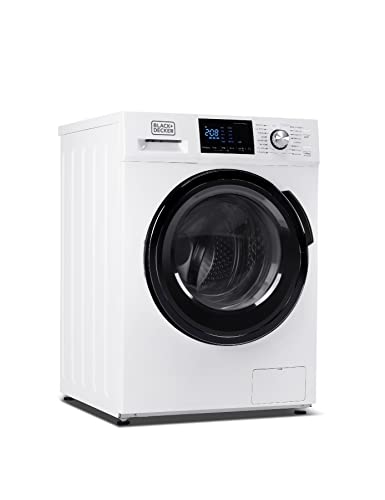
BLACK+DECKER Washer and Dryer Combo, 2.7 Cu. Ft. Capacity, BCW27MW, White
Included for 'Best Budget Washer and Dryer Sets' because the listing specifies 2.7 Cu. Ft. Capacity and BCW27MW, details this guide uses to compare options.
View on AmazonThis configuration is especially practical when the laundry area has a full 27-inch-wide opening and a nearby 240-volt dryer outlet. Agitator washers generally offer strong cleaning for heavily soiled work clothes, while impeller models provide more usable interior space and are often gentler on fabric. An agitator can be a good choice for children’s clothing and muddy items; an impeller is preferable when you regularly wash comforters or large loads.
Do not pay extra for dozens of specialty cycles unless you will use them. A useful budget control panel needs normal, delicate, bulky, quick, rinse-and-spin, and temperature or soil selections. In the dryer, moisture sensing is more valuable than a long list of named programs because it stops the cycle when clothes are dry instead of repeatedly heating them.
2. Best for apartments: compact front-load and ventless dryer
For a kitchen closet, condominium, or narrow utility room, a 24-inch compact front-load set is usually the safest fit. Compact washers commonly hold about 2.2–2.5 cubic feet, and compact dryers commonly hold about 4.0–4.3 cubic feet. That is enough for one or two people, but a full set of queen-size bedding may require multiple loads.
A ventless heat-pump dryer is often the best apartment option because it does not need a conventional exhaust duct. It usually runs on a 120-volt circuit and recycles warm air, although drying takes longer than with a vented dryer. It also releases less conditioned indoor air outdoors. Budget for a drain connection or accessible condensate system, and leave room to open the lint filter and clean the condenser.
Compact front-load pairs from brands such as Bosch, Electrolux, LG, Miele, and GE Profile are commonly sold with stacking options, but compatibility is not universal. Use only the stacking kit specified for that exact washer and dryer family. A universal bracket may not safely support the dryer or may interfere with vibration control.
3. Best for lower running costs: efficient front-load pair
A front-load washer generally uses less water than a top-load model because clothing tumbles through a shallow pool rather than being fully submerged. It also extracts more water during the final spin, reducing dryer time. An ENERGY STAR-certified washer is a useful starting point, but compare the estimated annual energy and water figures on the yellow EnergyGuide label rather than assuming every front-loader performs identically.
A heat-pump dryer can use substantially less electricity than a conventional electric resistance dryer, but its higher purchase price may take years to recover. It is most financially attractive when the machine will run frequently, electricity is expensive, or the laundry room has no practical vent. For occasional laundry in a low-cost utility market, a basic vented electric dryer may remain the cheaper overall choice.
Front-load washers have a maintenance requirement that top-loaders largely avoid: leave the door ajar after use, wipe the rubber gasket, and run the manufacturer’s cleaning cycle regularly. Otherwise, trapped moisture and detergent residue can create odors. This is a small habit, but it matters more than an extra “deep clean” button.
Capacity, cycles, and the numbers that matter
- 2.2–2.5 cubic feet: compact capacity for one or two people; best for smaller weekly loads.
- 4.5–5.0 cubic feet: versatile full-size capacity for couples and families.
- 5.0 cubic feet or more: helpful for comforters and large family loads, but only if the laundry room can accommodate the deeper cabinet.
- 7.0–7.4 cubic feet: a practical full-size dryer range that can keep up with a large washer.
- Quick wash: useful for lightly worn clothes, but it is not a substitute for a full cycle on towels, bedding, or stained garments.
- Extra rinse: worthwhile for sensitive skin, allergies, or households that use powdered detergent.
- Load sensing: helps reduce water use, but a deep-fill option can be useful for heavily soiled loads.
- Moisture sensing: more useful than a countdown timer because it can limit overdrying and fabric wear.
Measure the room before choosing the pair
Full-size machines are commonly about 27 inches wide and 30–34 inches deep, excluding hoses and door clearance. A compact pair is usually about 24 inches wide and 24–26 inches deep. Measure the entire route from the delivery entrance to the laundry area, not just the final alcove.
| Measurement | Recommended allowance | Why it matters |
|---|---|---|
| Side-to-side opening | At least 28 inches for a 27-inch pair; 25 inches for a 24-inch pair | Allows installation without scraping the cabinet |
| Rear clearance | 3–6 inches | Accommodates water hoses, drain hose, power cord, and a vent if required |
| Front clearance | 30–36 inches | Leaves room to load laundry and open doors fully |
| Top clearance | At least 1 inch for side-by-side machines; follow the kit instructions when stacked | Prevents rubbing and allows vibration movement |
| Doorway route | At least the machine’s narrowest packaged dimension | Packaging can be several inches larger than the cabinet |
A stacked pair needs vertical clearance for the full cabinet height, commonly about estado?